Archives

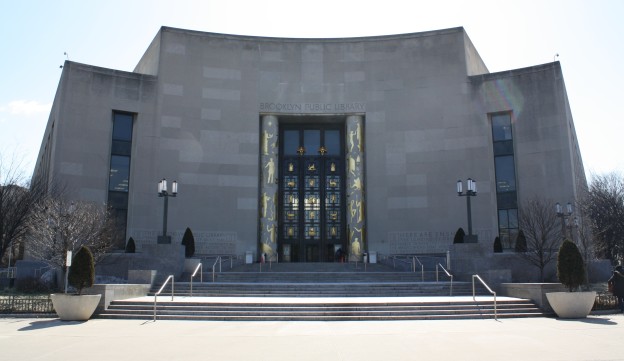
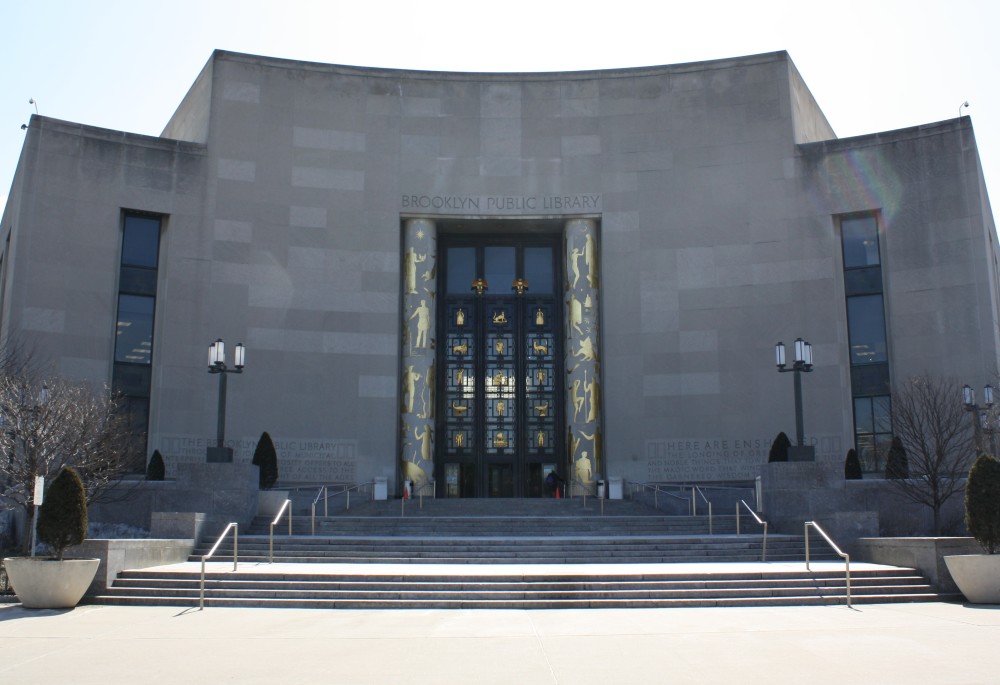
Central Building, BPL, Brooklyn

Grand Army Plaza at Flatbush Avenue and Eastern Parkway;
Alfred Morton Githens & Francis Keally, 1941;
sculptural elements:
Thomas Hudson Jones and C. Paul Jennewein;
NYC IL, NR-P|

The original 1907 design for the BPL’s Central Building was the work of Raymond F. Almirall, the architect of the Pacific, Park Slope, Bushwick and Eastern Parkway Branches. The grand Beaux Arts design, inspired by contemporary libraries in Europe, with a domed roof and colonnaded entrance, was meant to fit in stylistically with the nearby Brooklyn Museum and Soldiers’ and Sailors’ Arch. Though construction began in 1911, the project was beset with political and financial troubles and stalled in 1929. In 1935, architects Alfred Morton Githens and Francis Keally were commissioned to redesign the building, incorporating the completed foundations and steel structure. The resulting Modern Classical, limestone-clad building features a concave front façade with a 50-foot-tall entrance portico and striking sculpted Art Deco ornamentation. It is one of Brooklyn’s most well-known and frequently used public buildings. The Central Building was designated a New York City Individual Landmark in 1997 and is listed on the State and National Register of Historic Places.

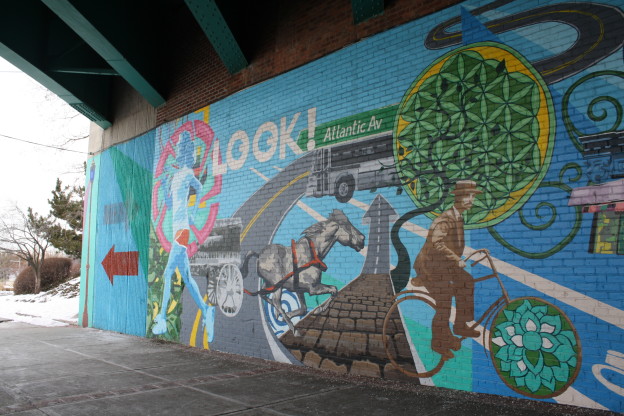
Groundswell Mural

Brooklyn Queens Expressway Overpass
2013

One of the AABID’s goals from its inception in 2012 has been to improve the pedestrian connection between Brooklyn Bridge Park and the shops and restaurants on its commercial strip. The obvious impediment is the elevated BQE that has bridged Atlantic Avenue since the 1950s. In late 2012, the AABID was awarded the BID Challenge Award to fund a re-design of the highway bridge and re-imagine it as a gateway. As a first step during the summer of 2013, the AABID worked with the NYC Department of Transportation (DOT) to fund a mural produced by the Summer Leadership Institute youth from Brooklyn-based Groundswell on the bridge’s north wall. The mural has added vibrancy and humanity to a previously foreboding space. The youth artists truly reflected the history and culture of Atlantic Avenue in their design. Its background vertical lines provide a clue to the pre-BQE past: these represent the lot lines of the buildings torn down for the highway’s construction. The large space in the center represents where Columbia Street veered slightly to the right going north, connecting Willowtown and South Brooklyn.

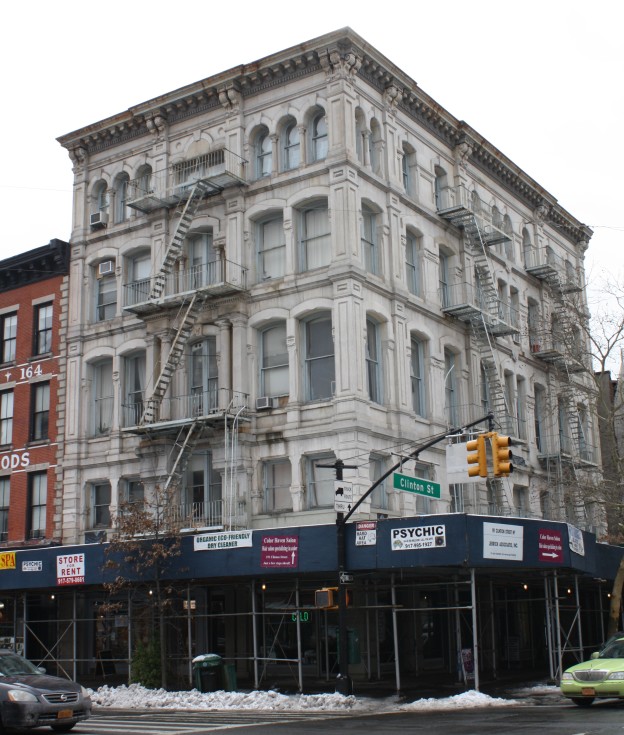
160 Atlantic Avenue, aka 191 Clinton Street

Ebenezer L. Roberts
1871|

This stately building was originally constructed for the South Brooklyn Savings Bank, which moved to a larger building at 130 Court Street (site # 13) in 1922. The bank had a number of influential board members, including merchant James Van Nostrand and businessman and politician James S. T. Stranahan, who, during his time as president of the Brooklyn Park Commission, was largely responsible for securing funding and support for the creation of Prospect Park. The Neo-Grec style, Tuckahoe Marble-clad building features round and square pilasters, corner quoins, arched windows supported by colonettes, and a bracketed cornice. Many of its original details have been lost, however, including a two-story pedimented temple front entrance and a balustrade with decorative urns on the roof. The ground floor has also been remodeled. The bank interior had been clad in marble and black walnut woodwork, but was refurbished many times over the years to accommodate new uses. The buildings are located in the Cobble Hill Historic District.

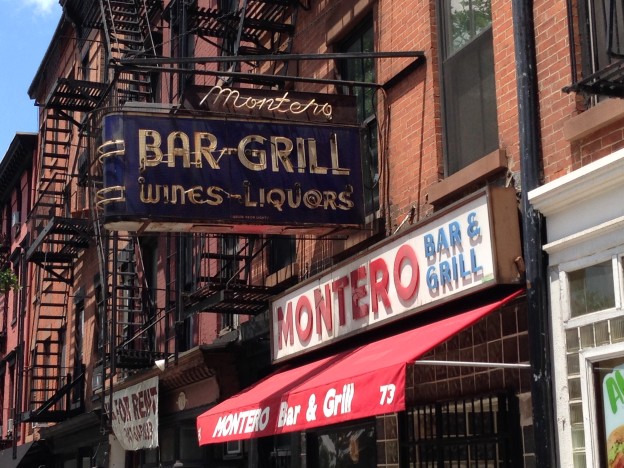
Historic bars & restaurants

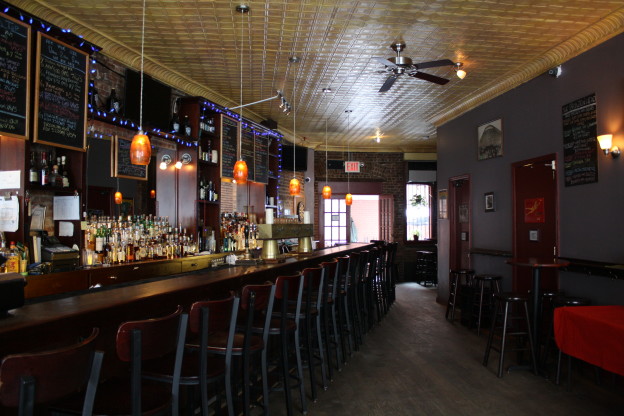
Atlantic Avenue’s western end, near Henry Street, is graced with a number of eating and drinking establishments, some of which have been here since the mid-20th century and others that are more recent. Those in the former category were set up to serve the community of people who worked on the nearby waterfront, and some of them still have their original, historic neon signage. This mid-20th century neon signage on buildings dating to the mid-19th century makes for a dynamic juxtaposition. 110 Atlantic Avenue, for instance, still has its mid-19th century cast iron, star-shaped tie rods, but also has a distinctly Modern storefront. These buildings are located in the Cobble Hill Historic District.

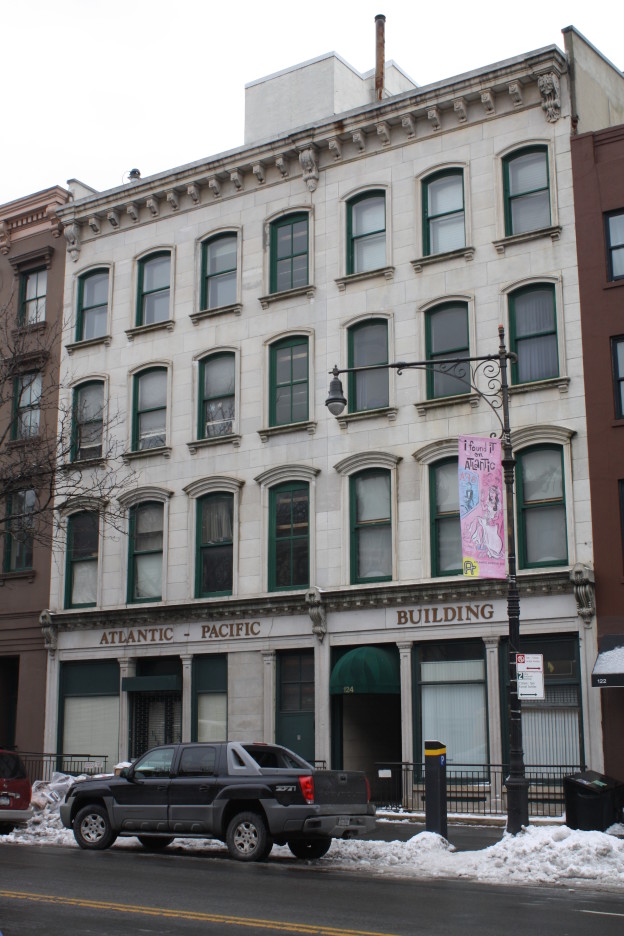
124-128 Atlantic Avenue

1851|

This Italianate commercial building was originally home to the area’s largest dry-goods store, Journeay & Burnham. The business was known for stocking fine quality fabrics and fashionable clothing. The business moved to Flatbush Avenue near Fulton Street in 1892, and closed in 1907. The building was subsequently home to the Atlantic-Pacific Chandlery Manufacturing Company, suppliers of ship provisions. The company’s name remains above the storefront, providing a reminder of Atlantic Avenue’s nautical past and its link to New York City’s bustling harbor. These buildings are located in the Cobble Hill Historic District.

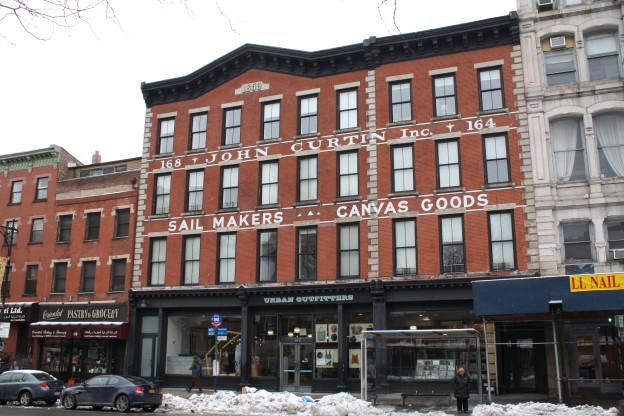
164 Atlantic Avenue, 166-168 Atlantic Avenue

1864
1856-60|

These mercantile buildings display the importance of architecture as a means of representing and advertising businesses in the 19th century. The quality of the materials and attention to details, such as stone quoins and bracketed roof cornices, is exceptional. They were designed in a simplified Italianate style and the center of 166-168 Atlantic Avenue has a prominent central gable. As evidenced by the painted sign, the buildings were home to a shop selling shipbuilders’ goods. New York City’s ports were some of the busiest in the world in the mid-19th century, and Atlantic Avenue was host to a number of nautical goods manufacturers and dealers.  These buildings were restored and converted to residential units in 2006, and the painted sign got a fresh coat of paint. Note the ornate parapet on 177 Atlantic Avenue, a commercial building directly across the street.These buildings are located in the Cobble Hill Historic District.

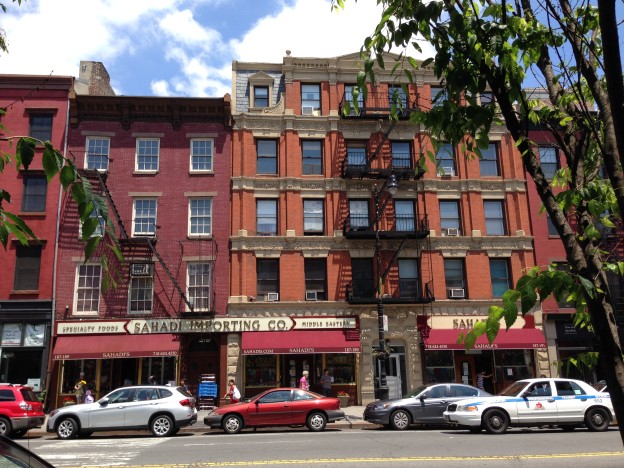
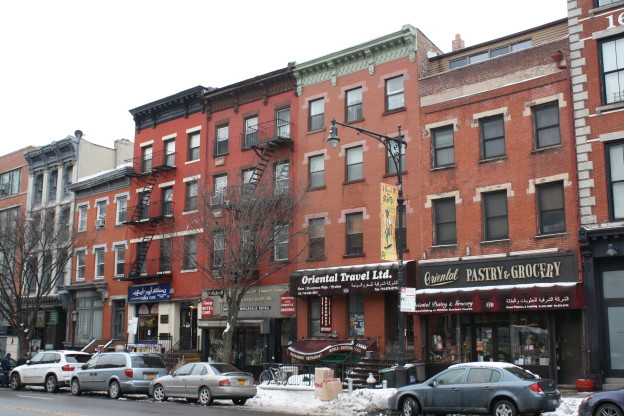
Middle Eastern businesses

Atlantic Avenue is home to a plethora of Middle Eastern shops and restaurants, mostly concentrated on the block between Court and Clinton Streets. The Middle Eastern population arrived on Atlantic Avenue in the early 20th century largely as a result of the construction of the Brooklyn Battery Tunnel on Manhattan’s Lower West Side, which had been home to a sizeable Middle Eastern community. This displaced population came to Atlantic Avenue and self-identified as the “South Ferry community,” in homage to their previous home near the South Ferry terminal and also in reference to the South Ferry at the foot of Atlantic Avenue.

170-178 Atlantic Avenue

1846|

These five buildings were originally part of a row of eight Gothic Revival style houses. By 1860, as the street was becoming more commercial, three of the houses introduced stores to their ground floors with residential units above. They were all originally three stories tall, a configuration that only the two end buildings have retained.The buildings are located in the Cobble Hill Historic District.

180 Atlantic Avenue

1873|

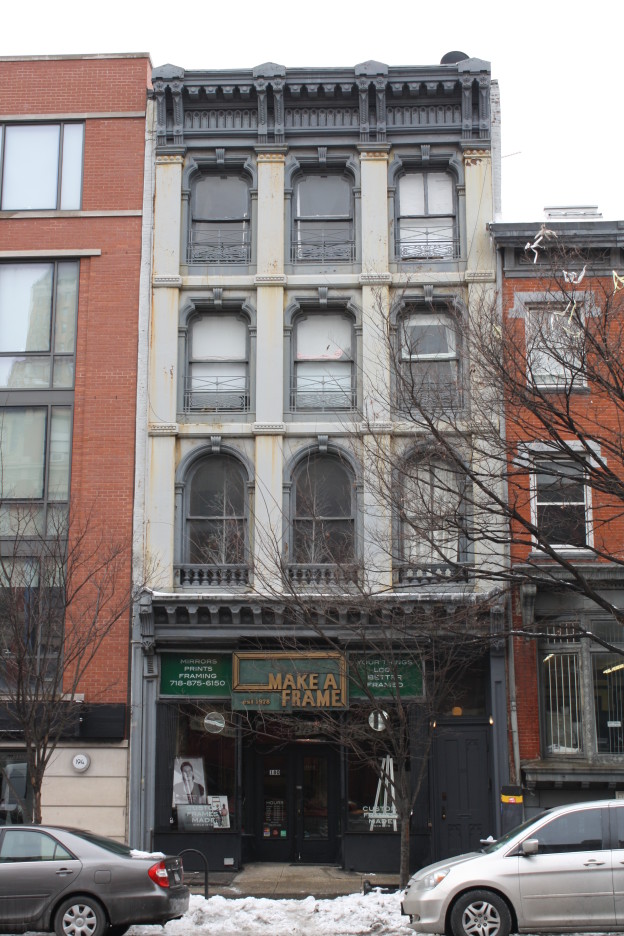
This four-story commercial building has a cast-iron façade, an unusual feature for Atlantic Avenue. The wrought-iron railings at the window openings are separated by smooth pilasters rising up the three stories above the ground level. It is capped by a Neo-Grec bracketed cornice. Aside from the storefront, which was replaced, the façade retains its original materials and configuration. The building is located in the Cobble Hill Historic District.

130 Court Street

McKenzie, Voorhees & Gmelin, 1922
addition: Charles A. Holmes, 1936|

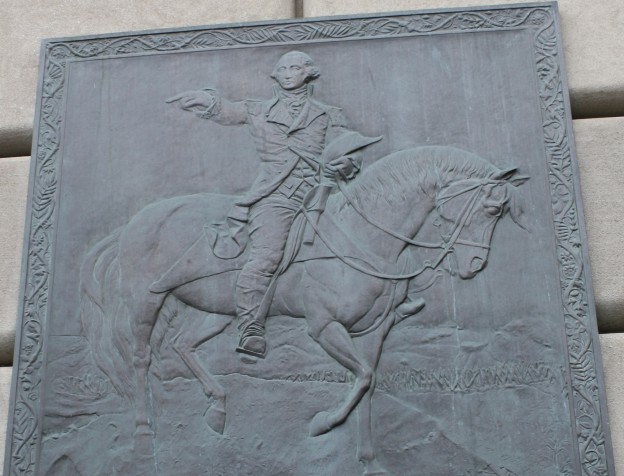
This formidable civic building stands on the site of the formerly sizeable Cobble Hill or “Cobleshill,” as it was known in the late 18th century. Before this steep hill was flattened in the mid-19th century, it was the location of the Cobble Hill Fort, from which it is believed that General George Washington oversaw the Battle of Brooklyn in 1776 (a plaque on the building commemorates this). During the War of 1812, the fort was reestablished as Fort Swift, named after General Joseph G. Swift. The Renaissance Revival style building resembles a Florentine palace, with its heavily rusticated façades, large arched windows and distinctive cornice held up by sculpted eagle brackets. It was originally home to the South Brooklyn Savings Institution, which formerly operated from 160 Atlantic Avenue at the corner of Clinton Street. The building now houses a grocery store, and is located in the Cobble Hill Historic District.

Red Hook Lane property line

Viewable inside 228 Atlantic Avenue

Red Hook Lane was a Native American trail that became a major artery through the center of Brooklyn beginning in 1760. It was a key route for the Continental Army during the Revolutionary War, especially during the Battle of Brooklyn in 1776. The trail eventually fell prey to the imposition of the street grid. Remnants of the Lane survive, including a block-long alley south of the Fulton Street Mall, between Adams and Smith Streets, as well as ghosts of the Lane’s configuration at 234 State Street and here at 228 Atlantic Avenue. The odd angle of the building, most prominently viewed by stepping inside to see the diagonal orientation of the tavern, reveals the original property line. The city officially de-mapped Red Hook Lane, making this building’s orientation all the more noteworthy to the neighborhood and the city.

314 Atlantic Avenue

c. 1920|

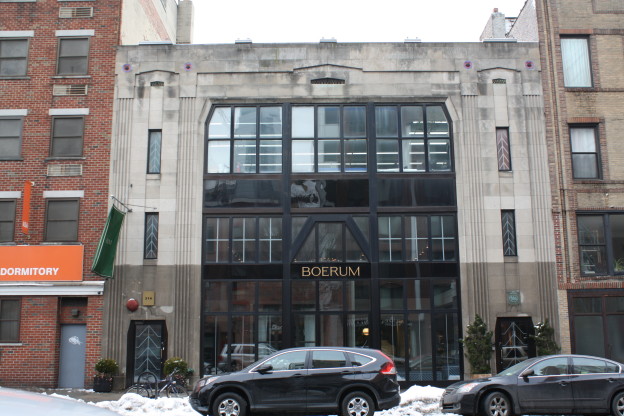
In the 1930s and 40s, this Art Deco gem housed an office and showroom for the National Cash Register Association. The structure has many fine Art Deco details, such as stylized, fluted pilasters capped with terra-cotta medallions, and doors and windows inlaid with branch-like mullion patterns. Interestingly, another similar business operated on the avenue to the east. A less remarkable building than 314, 388 Atlantic Avenue was once the home of the Standard Johnson Company, producer of electric coin counting machines.

Hoyt Street Community Garden

1975

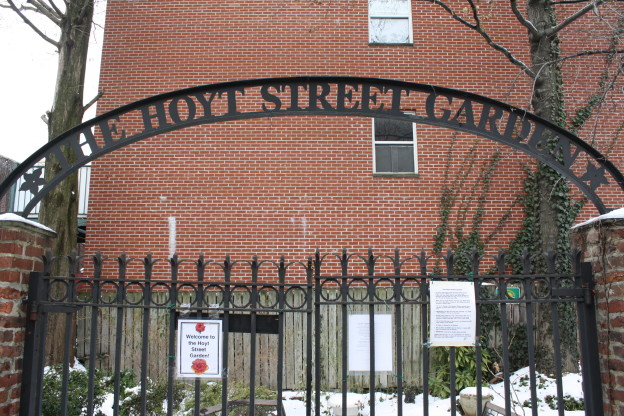
At the corner of Hoyt Street is a vibrant community garden. The 25-by-50-foot lot contains several trees, brick walking paths, benches and a mural designed by Margaret Cusack, one of the garden’s founders, which depicts the tree of life. The lot had been abandoned when the community took it over as a green space in 1975, and it still represents the importance of community and the power of neighborhood activism to improve the quality of life. The garden is often open to the public and is maintained by members of the community.

368 Atlantic Avenue

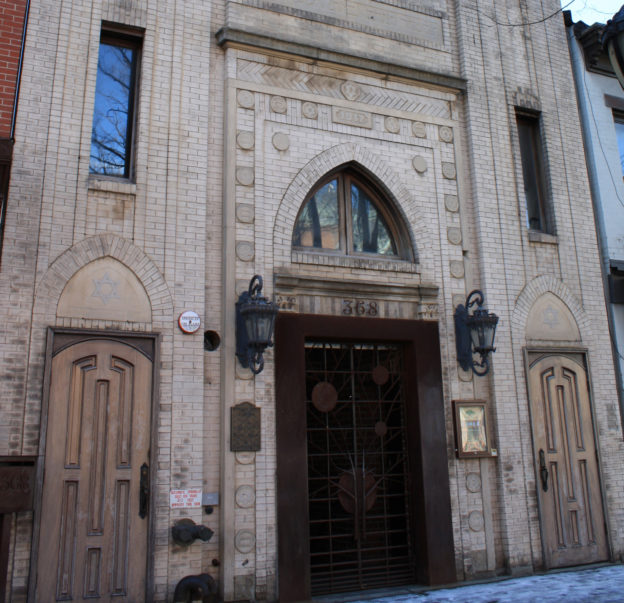
The architect and construction date of this building are unknown, but it was likely constructed as a residential building with a commercial ground floor. It was converted in 1917 into a Jewish school and synagogue called Talmud Torah Beth Jacob Joseph, at which point it gained its Moorish Revival façade, with intricate brickwork and medallions around the entrance. In the 1970s, the building was purchased by an antiques dealer, one of many in this part of Atlantic Avenue. In fact, the block between Hoyt and Bond Streets was once known locally as “Antiques Row,” as antiques dealers began operating businesses here in the 1960s and 70s. Their presence helped to revitalize the area, but many have since closed. In 2004, 368 Atlantic Avenue was converted into a night club, and became a catering hall and event space a few years later.

358-364 Atlantic Avenue; 375, 377, 377A and 387 Atlantic Ave.; 394-402 Atlantic Ave.; 405-409 Atlantic Ave.; 406-420 Atlantic Ave.

c. 1850s|

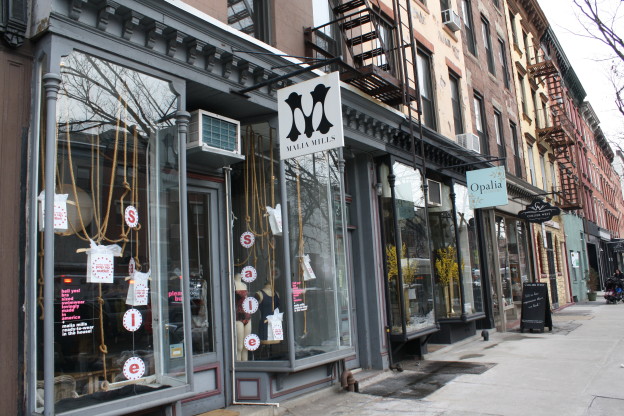
While there are many intact Victorian-era storefronts on Atlantic Avenue, the blocks between Hoyt and Nevins Streets contain a particularly dense concentration. It is believed that many of them date to before the Civil War due to the presence of St. Peter’s Episcopal Church (site #7a), since, in typical neighborhood development patterns, churches followed residential and commercial construction. A post-Civil War building boom led to the development of plate glass that made large storefront windows possible. Thus, these storefronts stand as evidence of Atlantic Avenue’s early history as a bustling shopping district. While this part of Atlantic Avenue is not protected by historic district status, it does benefit from designation as a special zoning district. In 1972, the combined efforts of the Mayor’s Office, the Office of Downtown Brooklyn Development and the NYC Department of City Planning created the Special Zoning District on Atlantic Avenue between Court Street and Flatbush Avenue. These bulk and use regulations aim to preserve the avenue’s scale and character, including original architectural features like its Victorian-era storefronts. In 2004, when the City created the Special Downtown Brooklyn District, Atlantic Avenue’s regulations were retained as the Atlantic Avenue Subdistrict.

403 Atlantic Avenue, 413-415 Atlantic Avenue

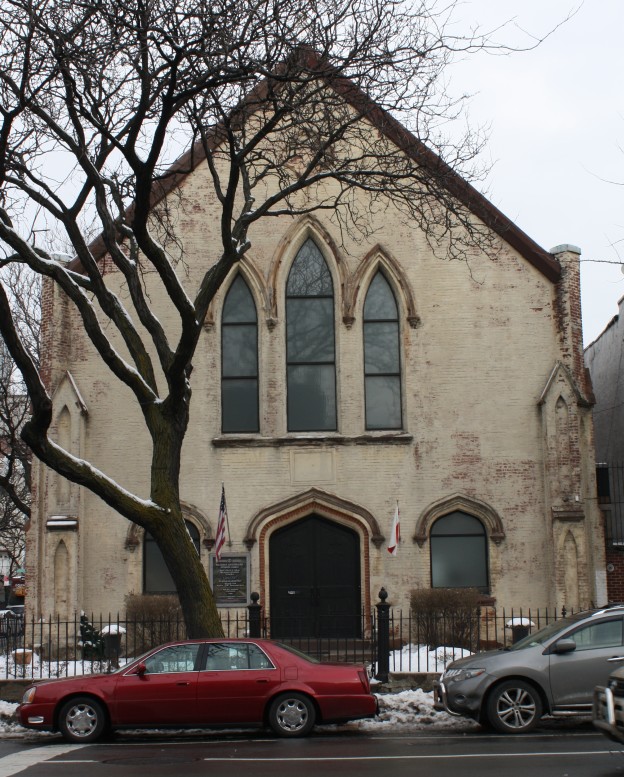
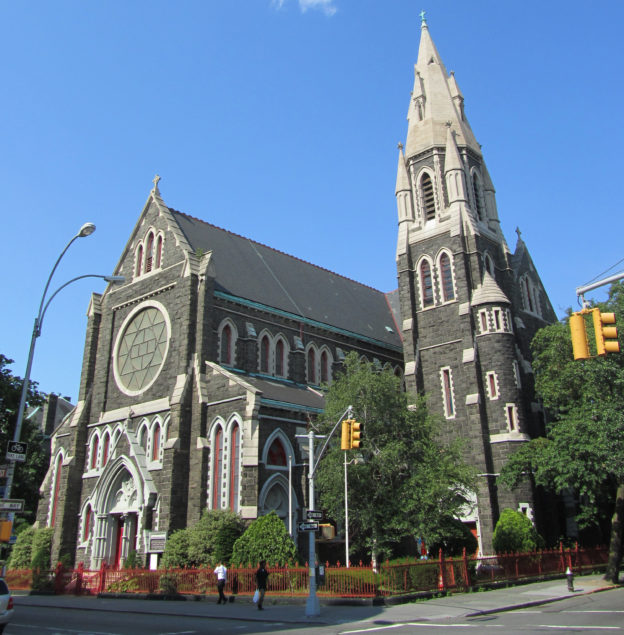
Two charming churches sit on the north side of this block. On the corner is St. Cyril’s of Turau Parish of the Belarussian Autocephalic Orthodox Church. The Gothic-inspired building features pointed arch windows, intricate brickwork and buttresses. The church was originally home to St. Peter’s Episcopal Church. A few doors to the east is a church commissioned by the Svenska Evangeliska Pilgrimskyrkan (Pilgrim Swedish Evangelical Congregational Church), another reminder of Atlantic Avenue’s once vibrant Swedish community. The beige brick structure was designed in the Romanesque Revival style with banded brick arches and a square tower with a pyramidal turret. It is now home to the House of the Lord Pentecostal Church.

423 Atlantic Avenue, 435-443 Atlantic Avenue

1932
c. 1880

Ex-Lax, short for “Excellent Laxative,” was invented in 1906 by Hungarian-born pharmacist Max Kiss in New York City, and opened its first factory that same year. By 1932, a larger headquarters was established on Atlantic Avenue that incorporated existing structures (435-443 Atlantic Avenue) and a new building (423 Atlantic Avenue). The existing structures had been home beginning in the 1880s to the Herman Themig Bottling plant, a wholesale and retail beer merchant for the Anheuser-Busch company. After Themig’s death in 1892, the plant resumed operation under the August Busch Company until 1903. Budweiser, introduced in 1876, was bottled here. After Ex-Lax was sold to a pharmaceutical company in 1981, the building was converted to residential use, making it one of Brooklyn’s earliest factory conversions.

510 Atlantic Avenue, 30 Third Avenue

Murray Klein, 1931
Frederick Lee Ackerman and Alexander B. Trowbridge, 1927

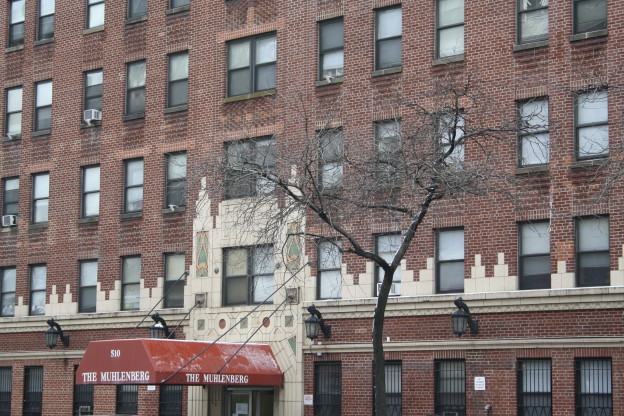
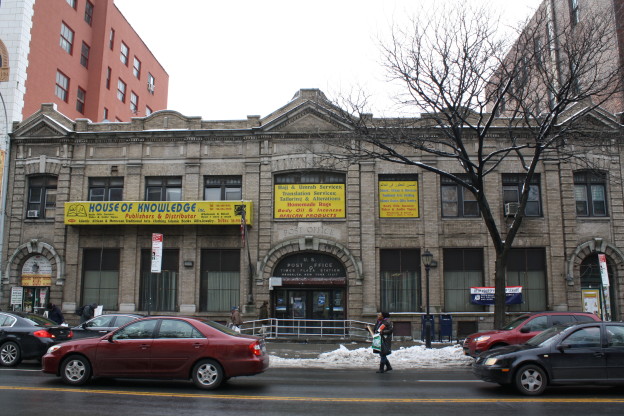
In the 1920s, a wave of development brought a series of civic structures to the eastern end of the Avenue, including the Post Office (site # 2), the Brooklyn YWCA and the Times Plaza Hotel. The latter, at 510 Atlantic Avenue, was designed in the Art Deco style as an economy-priced residential hotel for single, retired and working men only. The hotel fell on hard times in the mid-20th century and closed. In the 1990s, Lutheran Social Services acquired the building and turned it into the Muhlenberg Residence to provide care and housing for the needy. Today, the center provides apartments for the formerly homeless, with supportive services and programming. On the opposite corner is the Brooklyn YWCA, which was established in 1892, and moved here in 1927 from its original home at 376 Schermerhorn Street. This YWCA is noted as the nation’s first to racially integrate in 1943. The multi-use facility includes low-income housing for women, a pool and a theater. In 2010, a performing arts organization leased space in the building, including the theater, which was restored. Note the exuberant Beaux-Arts style commercial building immediately adjacent to the YWCA at 503 Atlantic Avenue, which features cast-iron columns at the base and a richly ornate bracketed cornice.

362 Schermerhorn St., a.k.a. 475 State St., 360 Schermerhorn Street, 59-75 3rd Ave.,72 3rd Ave.

c. 1840
Weary & Kramer, 1894-95; Dodge & Morrison, 1917-18 – National Register
Albert Kahn, 1929
1894

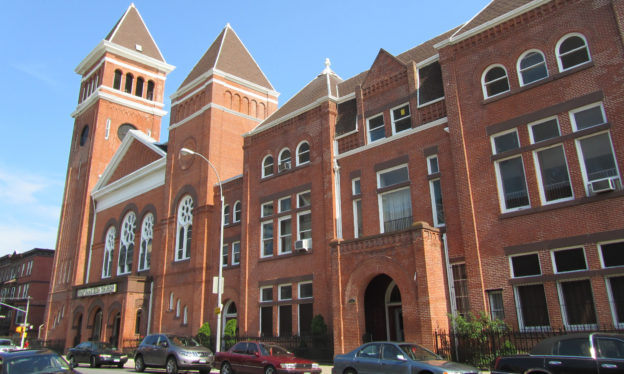
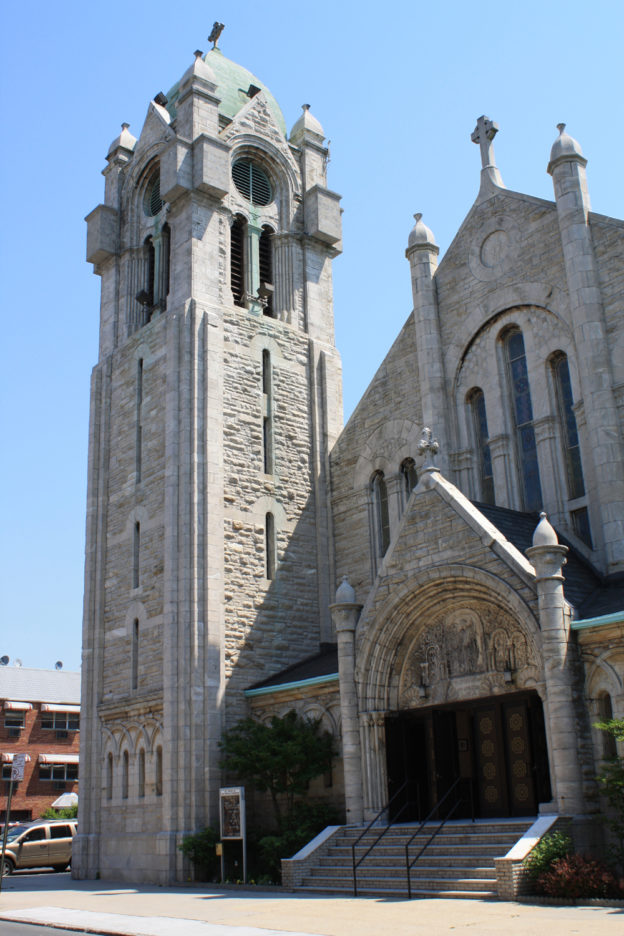
North and south of Atlantic Avenue on Third Avenue are grand civic buildings across from equally grand churches. 362 Schermerhorn Street was originally the Brooklyn Boys’ Boarding School. It later became Public School 15 (a sign on the Third Avenue façade still bears this name) and served as an infirmary during the Civil War. It now houses the Metropolitan Corporate Academy High School. Across the street is the former Baptist Temple (now the Recovery House of Worship), a brick and brownstone, Romanesque Revival style church rebuilt after a fire in 1917-18. Cross Schermerhorn Street for nice views of both of these buildings. South of Atlantic Avenue, at 59-75 Third Avenue, is a neo-Classical, limestone structure with Art Deco details built as the printing plant for The New York Times. The building still bears the newspaper’s name, and has retained its large windows, meant to display the printing, collating and folding of newspapers going on inside. Today it is part of The Math and Science Exploratory School (M.S. 447), Brooklyn High School of the Arts and the Kahlil Gilbran School. Across the street, at 72 Third Avenue, is a brick church with a prominent tower and lovely rose windows. It was built as the Swedish Evangelical Bethlehem Lutheran Church to serve the area’s significant Swedish population. In fact, in the late 19th century, Atlantic Avenue was often called “Swedish Broadway” or the “Swedish Colony.”

543 Atlantic Avenue

c. 1855 |

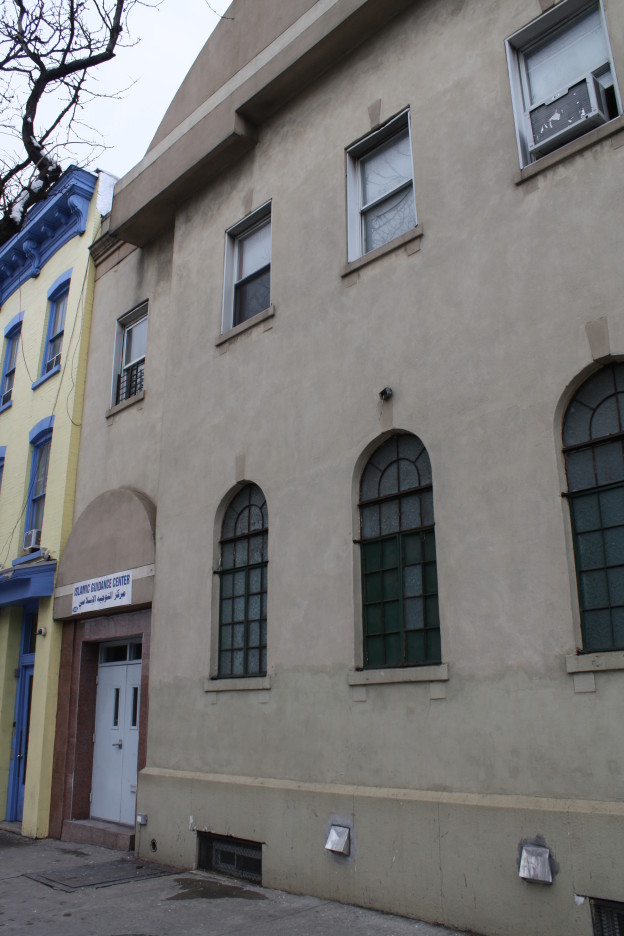
This now stucco-covered structure has had many lives. It was originally constructed as the Atlantic Street Baptist Church, a brick building dedicated in 1855. The building was subsequently home to St. Matthew’s English Lutheran Church, the Metropolitan Mission (Independent African Methodist Episcopal Church), the Swedish Baptist Church, the Salvation Army and the Brooklyn Tabernacle. Today it is home to the Ahlul Bayt Islamic Library. This fascinating turnover of cultures and denominations makes this seemingly insignificant building a great example of Brooklyn’s rich religious heritage. In fact, Brooklyn has long been known as the “Borough of Churches” for the many steeples that dot its landscape. Just west of this building, on the north side of the Avenue, note the row of brightly painted commercial buildings with intact storefronts.

552-554 Atlantic Avenue and 542 Atlantic Avenue

Henry I. Oser, 1928
c. 1925

The Art Deco store and office building at 552-554 Atlantic Avenue was originally called the Gross Building, after its first owner, realtor Joseph M. Gross. The six-story building replaced a group of mid-19th century rowhouses. Its original tenants were real estate companies, trade union offices and lawyers. Since 1977, it has been home to a mosque, cultural center and related stores. The building is clad in white glazed terra-cotta and features neo-Classical details, like swags, garlands, grand arches and pilasters. Next door, the U.S. Post Office Times Plaza Station at 542 Atlantic Avenue is a civic building with elaborate brickwork. Its upper floor once housed the headquarters of the Brooklyn Local 361 of the Bridge, Structural and Ornamental Ironworkers’ Union. Beginning in the 1920s, a group of men from Mohawk reservations in Quebec came to New York looking for work during the steel construction boom. After a landmark court case in 1926 recognized the Mohawk as a separate nation with rights to move freely between the United States and Canada, many Mohawks came to the city, settling in Boerum Hill and joining the union (it is believed that the presence of the headquarters at 542 Atlantic Avenue was the reason for their settlement in this part of the city). When the building boom came to an end in the late 1950s, the Mohawks began to move elsewhere, and the community dwindled. However, through some of its buildings, this part of Brooklyn still tells their story. Hank’s Saloon, at 46 Third Avenue, was formerly The Doray Tavern, a popular Mohawk hang-out, and Cuyler Presbyterian Church at 360 Pacific Street (now a private residence) offered services in the Iroquois language

Times Plaza and Atlantic Terminal and Times Control House

Times Plaza- Intersection of Flatbush, Atlantic, and Fourth Avenues
Times Control House -Heins & LaFarge, 1908;
restoration: diDomenico/Parsons Brinckerhoff, 2005

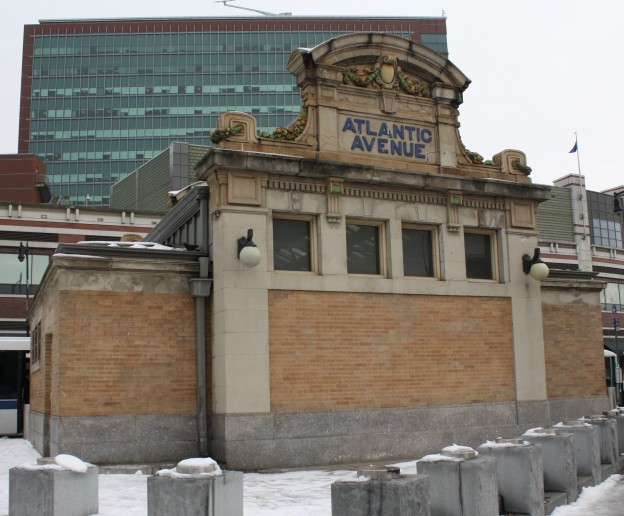
The intersection of Atlantic, Flatbush, and Fourth Avenues has been the location of the LIRR terminal since the 1830s. The terminal has had a number of different homes since then. The first was constructed around 1877, when steam trains were reintroduced from this location to extend eastward to Long Island. In 1907, two years after the LIRR began electrifying trains, a new Beaux-Arts style building replaced the earlier structure. That building, in severe disrepair, was demolished in 1988 after the railroad suffered decades of diminishing use as patrons increasingly favored automobiles and planes as modes of transport. The site lay virtually vacant for the next 15 years. The process of transforming the area into a shopping, entertainment and transit hub began in the early 2000s, and is still underway. The terminal’s present structure includes an entry pavilion and ticket office (completed in 2010) and a shopping mall (completed in 2004). In addition to the LIRR station, Atlantic Terminal is the city’s largest subway stop, serving nine train lines. While this overhaul has completely modernized the intersection, the Times Control House, a Flemish Revival style kiosk, still stands as a reminder of the terminal’s earlier history. Built as the entrance to the IRT subway, the kiosk was designed by Heins & Lafarge, the architects of many subway platforms and control houses across the city, few of which remain today. The kiosk was named after its location in Times Plaza, which itself was named for the nearby offices of the Brooklyn Daily Times (later acquired by the Brooklyn Eagle). The little building is clad in glazed terra-cotta and features polychrome ornament in the form of cartouches, swags, fruit and floral garlands. In the 1970s, the building was converted to modern uses and, at one point, covered with modern lettering. For a long time, it was abandoned as the size of its small lot was not conducive to other development. The building was meticulously restored in 2005. The Times Control House is listed on the State and National Register of Historic Places.

St. Augustine’s Roman Catholic Church & Rectory, Brooklyn

Address: 116-130 6th Avenue, Brooklyn;
Architect: Parfitt Brothers;
Constructed: 1888;
LPC Action: Public Hearings 2/8/1966; 3/8/1966; 7/8/1980;
LPC Backlog Hearing: Prioritized for designation (as part of the Park Slope Extension);

Park Slope Historic District Extension II Designated on April 12, 2016|

 LPC- Fact Sheet |Research File

HDC Testimony 

The Gothic Revival, High Victorian style church is known as “the Cathedral of Park Slope”. When it opened,The Brooklyn Daily Eagle declared St. Augustine Church “one of the finest examples of Gothic architecture in the country,” and later, “one of Brooklyn’s most picturesque church.” The church’s architectural significance placed it as one of the first slew of properties heard by the then-new Landmarks Preservation Commission in 1966. The Diocese of Brooklyn opposed any landmark designation and the church remains calendared ever since. St. Augustine’s is today a landmark of Brooklyn and Park Slope in all except official designation.

To learn more about St. Augustine’s Roman Catholic Church & Rectory click here


St. Barbara’s R.C. Church, Brooklyn

Address: Central Avenue at Bleecker Street;
Architect: Helmle & Huberty;
Constructed: 19071910;
LPC Action: Public Hearing in 1980;
LPC Backlog Hearing: Prioritized for designation  |

Designated – December 13, 2016

LPC-  Fact Sheet | Research File

HDC Testimony 

St. Barbara’s Roman Catholic Church is instantly recognizable from all around for its exuberant ornament and for the soaring height of its towers, rising above low-rise Bushwick. The yellow brick building with white and cream terra-cotta trim features elaborate exterior massing with a grand dome and two 175-foot tiered towers. Its entrance bay resembles a triumphal arch, with columns and a rounded pediment. The interior is equally elaborate in its Baroque-inspired design, with statuary, carvings, frescoes and stained glass windows. Its architectural style has been described as Spanish Mission Revival or neo-Plateresque, but it is likely that Helmle & Huberty were influenced by German Baroque ecclesiastical architecture, given that St. Barbara’s served a congregation of German immigrants in its early years. The church is said to be named for Barbara Epping, the daughter of local brewer Leopold Epping, who donated funds to construct the church. Many of its German parishioners worked in the breweries in Bushwick, including Epping’s. The congregation evolved over the years to serve the area’s changing population of Italians and, more recently, Latin Americans.

To learn more about St. Barbara’s R.C. Church the click here

Lady Moody-Van Sicklen House, Brooklyn

Address: 27 Gravesend Neck Road, Brooklyn, NY 11223;
Built:  c.1760-1810;
LPC Action: LPC held hearings for the in Lady Moody-Van Sicklen House 1970 and 2004;
LPC Backlog Hearing: Prioritized for designation;

Designated on April 12, 2016|

LPC- Fact Sheet | Research File

HDC Testimony 

The Lady Moody-Van Sicklen House is a rare surviving example of an 18th century Dutch-American farmhouse and a reminder of Brooklyn’s agricultural past. In addition to being one of the oldest houses in Brooklyn, it is also the borough’s only extant house of its age and type to be built of stone. While it is unlikely that any part of the house dates to her ownership of the property, the house sits on a lot once owned by Lady Deborah Moody, an English settler who founded Gravesend and one of the first women to be granted land in the New World. The house features a gable roof with overhanging eaves and an end chimney, typical features of 18th century Dutch-American farmhouses.

To learn more about the Lady Moody-Van Sicklen House click here


Holy Trinity Cathedral/Ukrainian Church in Exile, Brooklyn

Address: 177-181 South 5th Street;
Built: 1905;
Architect: Helme-Huberty & Hudswell;
LPC Action: Calendared 1966;
LPC Backlog Hearing: Removed from the calendar without prejudice|

LPC- Fact Sheet |Research File

HDC Testimony

Designated June 28, 2016|

177-181 South 5th Street in Brooklyn is remarkably intact despite its long history of adaptive reuse. When the Williamsburg Bridge opened in 1903, the area at the foot of the bridge flourished as a new hub. This Beaux-Arts building is one such product of this development, as it was originally constructed as the Williamsburg Trust Company in 1905. The Williamsburg Savings Bank went under by 1915 and at that time, the building was converted to serve as the Fifth Districts Magistrates Court. The court system changed, rendering the building obsolete for the courts system. In 1961, a Ukrainian immigrant population bought the building and has had an active congregation ever since.

To learn more about the Holy Trinity Cathedral/Ukrainian Church in Exile click here

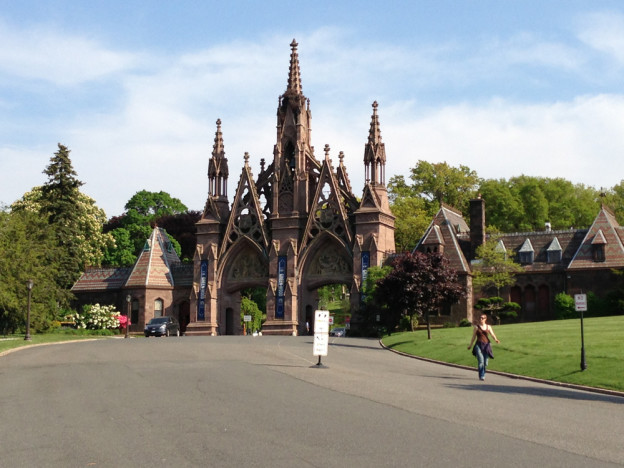
Green-Wood Cemetery, Brooklyn

Address: 5th Ave and 25th Street;
Built:  Founded 1838;
LPC Action: Calendared 1981;
LPC Backlog Hearing: Prioritized for designation ( chapel, caretaker’s residence, and visitors cottage);

Designated on April 12, 2016|

LPC- Fact Sheet | Research File

HDC Testimony 

Green-Wood Cemetery is a National Historic Landmark encompassing 478 acres with approximately 600,000 graves. The distinguishing Gothic Revival entrance was designed by Richard Upjohn, and the chapel was designed by Warren and Wetmore as a version of Christopher Wren’s Thomas Tower in Oxford.

To learn more about Green-Wood Cemetery click here

Coney Island Pumping Station, Brooklyn

Address: 2301 Neptune Avenue;
Architect:  Irwin S. Chanin;
Constructed: 1938;
LPC Action:   Public Hearing in 1980;
LPC Backlog Hearing: Removed from the calendar without prejudice|

LPC- Fact Sheet | Research File

HDC Testimony 

The Coney Island Pumping Station replaced an older, outdated station in 1937-38. The need for a high pressure water system in this area was dire, as the previous one failed during the Dreamland fire of 1911 and a catastrophic fire along the boardwalk in 1932. The new station, a project of the Works Progress Administration, was rendered, unusually for an industrial building, in the elegant Art Moderne style by prominent architect Irwin S. Chanin. It was his only public work. The elliptically-shaped building is faced in limestone over a granite base and originally featured prismatic glass windows with steel surrounds. The building stands in the center of a large grassy plot, which originally had symmetrical plantings. Three wide, concrete walks still lead to the station, and paired Art Deco statues of Pegasus, symbol of Neptune, originally flanked the entrance. The statues were removed in 1981 and put on display at the Brooklyn Museum, but advocates hope that someday they may be returned to their home in Coney Island.

To learn more about the Coney Island Pumping Station click here

183-195 Broadway, Brooklyn

Address: 183-195 Broadway;
Architect:  William B. Ditmars, Atlantic Iron Works Foundry;
Constructed:  1882;
LPC Action:  Public Hearings in 1980, 1981, 1984, 1990;
LPC Backlog Hearing:  Prioritized for designation  |

Designated – December 13,2016 |

LPC-Fact Sheet | Research File

HDC Testimony 

183-195 Broadway is considered one of the finest surviving cast-iron buildings in Brooklyn. Its iron was cast by the Atlantic Iron Works of Manhattan, which cast pieces for many buildings in Tribeca and Soho. The cast-iron façade remains intact, and features inventive ornamentation in the form of calla lilies, stylized drapery, and wreaths on the building’s pilasters. A similar spiral floral concept can be seen on other buildings, but the use of the calla lily is considered unique. The building was likely built as a shoe dealer’s factory and warehouse. In 1937, the building became home to the Forman Family, manufacturers of chromium tableware and metal gift items. Their signage remains between the second and third floors, though the building now houses loft-style apartments. While cast-iron buildings could once be found throughout Brooklyn, the four surviving cast-iron buildings clustered along this section of Broadway are among the borough’s only survivors, and the only substantial group outside of Manhattan.

To learn more about 183-195 Broadway click here

336-338 MacDonough Street

1872, Architect: Unknown|

This building is one of only four timber-frame houses in the Stuyvesant Heights district, which makes it one of the oldest structures in the area. This free-standing structure is also unusual as it was built for two family occupancy. It was designed in the French Second Empire style, and possesses many original features like its third story mansard roof, segmental arched entries and windows, and front porch.

Our Lady of Victory Roman Catholic Church

583 Throop Avenue;
Thomas Houghton,1891-1895|

The parish of Our Lady of Victory was organized in 1868.When this church was erected to replace a smaller wooden structure it was heralded by the Brooklyn Eagle as one to the most beautiful churches in the city. The Gothic style building is constructed of contrasting Manhattan schist and limestone, and its western facade features a stained-glass rose window. The interior includes a number of original features, such as the white marble alter designed by Thomas Haughton and decorative painting by Philadelphia artist Ferinand Baraldi.

Grand United Order of the Tents

87 MacDonough Street;
Architect: Unknown, 1863|

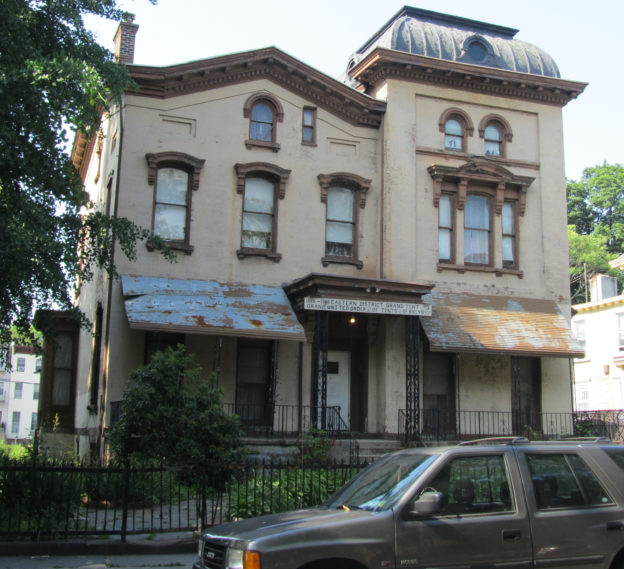
This villa-style home is one of the oldest surviving structures in the neighborhood and a vestige of  Bedford-Stuyvesant’s bucolic days. It was constructed for William A. Parker in 1863, who was a local hops and malt merchant. The house was later occupied by James McMahon, the founder and president of the Emigrant Industrial Savings Bank. Since 1945, this structure has been occupied by the United Order of the Tents. The United Order of the Tents was founded as part of the underground railroad, and after the Civil War, was officially organized as a charity and lodge. It is one of the oldest lodges for African-American women in the nation.

A.M.E. Zion Church

54 MacDonough Street;
George C. Chappell, 1889|

When it was constructed in 1889, what was originally built as the Tompkins Avenue Congregational Church was the largest structure of its denomination, with seating for over 2,000 people. This massive brick-and-granite structure presides over a corner lot, and its 140-foot-tall campanile dominates the block. In 1942 the congregation merged with and moved to the Flatbush Congregational Church, and the first African Methodist Episcopal Church took title to the Italianate style structure.  

Stuyvesant Avenue Homes

391-399, 402-410, 411-419 Stuyvesant Avenue ;
William Debus,1910|

These homes were part of the final wave of rowhouse development in Bedford-Stuyvesant.  These elegant, neo-classical structures drastically compare with their brownstone and red-brick neighbors because of their limestone cladding. This shared materiality gives the impression of a single, large unit, a common aesthetic throughout this neighborhood. The choice of limestone as a material was indicative of the amassed wealth of the middle class that resided in this neighborhood in the early twentieth century.

Birthplace of the Teddy Bear

404 Tompkins Avenue, 1880s, Architect: Unknown|

404 Tompkins is a typical red-brick tenement building with a pressed-metal cornice. It also happens to be the birthplace of the teddy bear. At the turn of the 20th century, the ground-floor commercial space was occupied by  and whose ground store commercial space was once occupied by Rose and Morris Mitchom Russian-Jewish immigrants, who became another great immigrant success story in New York City. President Theodore Roosevelt was known for his near-fanatical hunting hobby, but in 1902 he spared the death of a baby bear. Political cartoons depicted the bear in the papers, and the Mitchoms turned the bear as a stuffed novelty toy. The Mitchoms received permission from the White House to use the term ‘teddy bear’ for their creation. The name stuck, and their bear became so popular that full-time production was devoted to producing teddies. The Mitchoms’ invention became the symbol of the Republican Party in 1904, and eventually grew to form the Ideal Toy Company, which remained in the family until the 1970s. The original teddy bear survives, and can be viewed at the Smithsonian Institute, in Washington D.C.

Newtown Creek Wastewater Treatment Plant

3239 Greenpoint Avenue 1965-79;
expansion: Polshek Partnership, 2009|

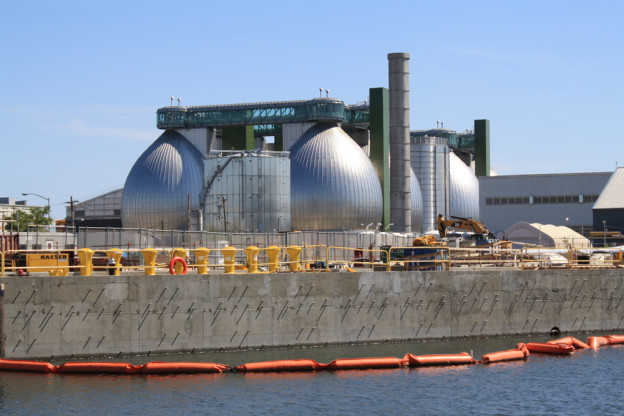
The largest of the city’s 14 wastewater treatment plants, the Newtown Creek Wastewater Treatment Plant was constructed in 1965-79 and underwent a vast upgrade and expansion in 2009. It features futuristic buildings with swooping roofs and a series of immense, stainless steel, egg-shaped “digesters”. The 3.5-mile Newtown Creek, a major industrial waterway in the second half of the 19th between Brooklyn and Queens. As one of America’s most polluted industrial waterways, it was designated a Federal Superfund site by the U.S. Department of Environmental Protection in 2010. Along with the plant’s modernization, a nature walk around the creek was laid out and the plant established a visitors’ center that runs monthly tours of the facility. The nature walk, from which visitors can get a good view of the egg digesters, begins at the eastern edge of Paidge Avenue.

Greenpoint Manufacturing and Design Center

1205 Manhattan Avenue;
1868|

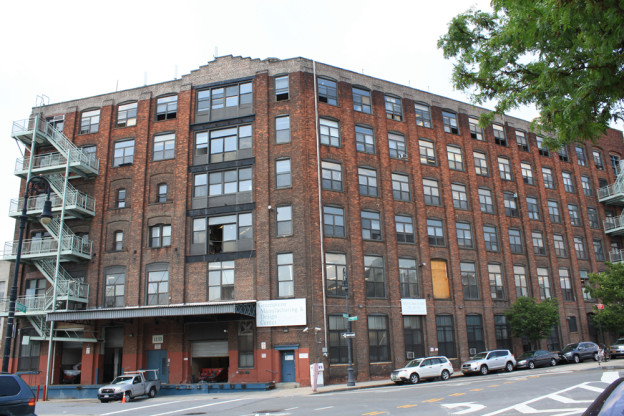
The former Chelsea Fiber Mill, a complex of four buildings, was constructed by Standard Oil just after the Civil War to manufacture rope and textiles for the U.S. Navy. By 1891, four more buildings were added, and many Greenpoint residents worked here, especially during the two World Wars. In 1974, the buildings went into foreclosure, and the city leased the space to artists until the mid-1980s, when the North Brooklyn Economic Development Corporation purchased the complex. In 1994, it was acquired by the Greenpoint Manufacturing and Design Center, a non-profit whose mission is to rehabilitate vacant manufacturing buildings for use by small companies. It is now home to roughly 75 small businesses and artist tenants.

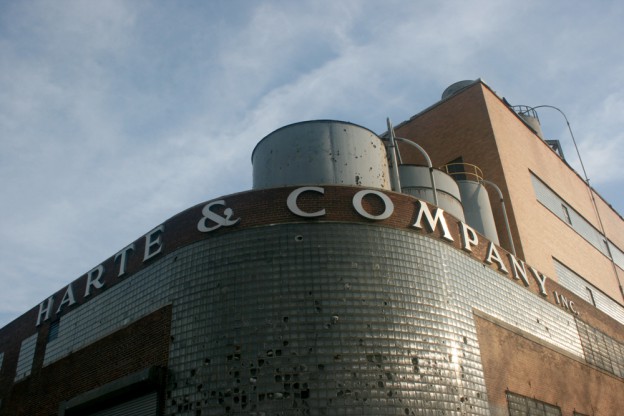
Harte & Company Building

280 Franklin Street;
c. 1930|

This Art Moderne factory building makes a striking contribution to this streetscape and the fabric of Greenpoint. Its distinctive curved corner at the intersection of Commercial and Franklin Streets was built of glass block. The company name, which wraps around the curve, still graces the building, though its manufacturing days are over.

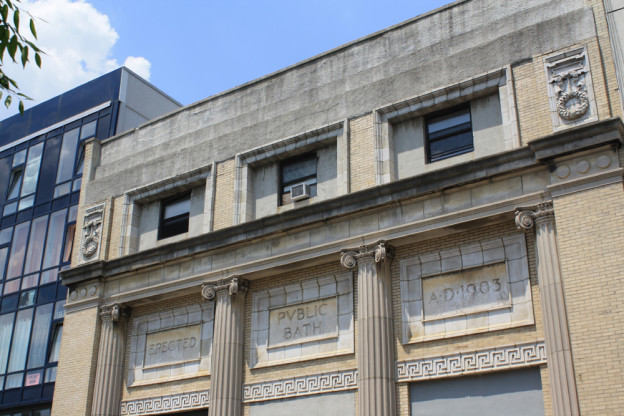
Public Bath

139 Huron Street;
1903|

In 1895, after a lengthy movement to provide bathing facilities for the poor, the state legislature passed a law requiring municipalities of 50,000 or more to offer free bathhouses. Between 1901 and 1914, 16 such facilities were built across the city, including this one. As baths became more common in the home, their use dwindled, and this one ceased operation in 1959; it is now home to artists’ studios. The building features elements of ancient Greek and Roman architecture, including Ionic pilasters and a terra-cotta frieze with Greek key motif.

The Astral Apartments

184 Franklin Street;
Lamb & Rich, 1885-86|

This ornate Queen Anne-style apartment building looks like it was built for the wealthy, yet its significance derives in part from its construction as workers’ housing for Charles Pratt’s oil refinery in Williamsburg. In the mid-19th century, housing conditions were very poor, with people packed into tenements with little light and air. This building’s amenities included kitchens and toilets in each apartment, bathing facilities in the basement, a lecture hall and library, ground-floor cooperative stores, and removable “buttoned” windows in the stairwells and rear courtyards for ventilation, all of which was added without legislative pressure. Pratt, Brooklyn’s wealthiest man, a prominent philanthropist and funder of Pratt Institute, believed that healthy environments foster healthy individuals, and thus productive citizens. He commissioned the prestigious firm of Lamb & Rich to design the building, drawing upon examples of humane workers’ housing in America and Europe. The brick and brownstone Queen Anne-style building features stepped gables, projecting bays, chimneys and arched windows along its top story. The projecting central entrance on Franklin Street rises to the full height with a round-arched four-story recess. Two imposing cornices – one in terra cotta at the fifth story and a corbelled one at the top – add to the building’s grandeur.

94-100, 114-124, 130 Kent Street, Church of the Ascension, St. Elias Greek Rite Catholic Church

builder: James R. Sparrow, Jr., 1863-64;
builder: James R. Sparrow, Sr., 1867-68;
builder: Neziah Bliss, 1858-59;
121-129 Kent Street Henry Dudley, 1865-66;
149 Kent Street church: William B. Ditmars, 1869-70; school: W. Wheeler Smith, 1879|

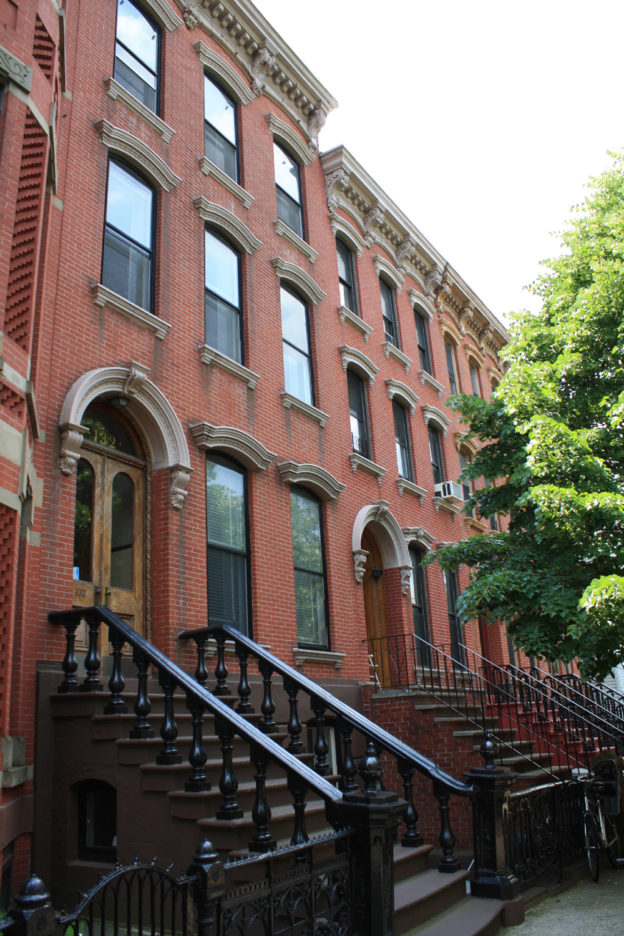
Another of the neighborhood’s most notable blocks, this street features rowhouses in a variety of styles, including Italianate and French Second Empire. Highlights include the Italianate brick houses at numbers 94-100, a row of four with round-arch entrances and mansard roofs; numbers 114-124, a row of six dwellings with cast-iron lintels and sheet metal cornices; and number 130, with an elaborate cornice and portico with fluted Corinthian columns supporting an entablature and a round-arch entrance. Church of the Ascension, a granite structure with brownstone trim, evokes a small country church. Its architect was a famous proponent of the Gothic Revival style in America, of which this church is an early example. St. Elias Greek Rite Catholic Church, formerly the Reformed Dutch Church of Greenpoint, combines elements of the Romanesque Revival and Victorian Gothic styles, both popular in the post-Civil War period. Its brick and stone façades have round-arch openings, polychromatic ornament and a columned portico entrance. Its polygonal Sunday school building mimics a medieval Italian baptistery, but another Victorian touch can be found in the handsome wooden porch on its east end. Each site is located within the Greenpoint Historic District, and the State and National Register Historic District boundaries.

Former Mechanics and Traders Bank

144 Franklin Street;
Alonzo B. Jones;
ca. 1895|

This Renaissance Revival structure features a rich texture comprised of rough-cut brownstone at the base and brick and red terra-cotta on the upper floors. Its bays consist of impressively-scaled arches separated by equally monumental pilasters with Corinthian capitals. Separating the arched bays from the bracketed cornice is an ornate frieze. Attention is drawn to the Greenpoint Avenue façade, whose central bay is flanked by oval windows that further accentuate the building’s Renaissance inspiration. The Former Mechanics and Traders Bank is located within the Greenpoint Historic District, and the State and National Register Historic District boundaries.

Eberhard Faber Pencil Company Historic District

98 West Street c. 1870;
100-106 West Street c. 1860s;
37 Greenpoint Avenue S.A. Valentine, 1881;
47-61 Greenpoint Avenue Frederick H. Klie, 1923-24|

The Eberhard Faber Pencil Company, which introduced America to the German method of mass-producing lead pencils, moved from Manhattan to Brooklyn after a fire destroyed its factory in 1872. It remained in Greenpoint until 1956, becoming one of Brooklyn’s most prosperous companies and employing hundreds of workers, most of whom were women. The complex, which encompasses almost the entire block, contains eight buildings, mostly designed in the German Renaissance Revival style. 98 and 100-106 West Street, the latter of which is the oldest building in the complex, were purchased in 1872. 37 Greenpoint Avenue, acquired in the 1880s, features brownstone window lintels incised with the company’s star logo, which is in keeping with the neo-Grec style popular at that time. The Art-Deco-style 47-61 Greenpoint Avenue, the newest and most prominent building in the district, features massive glazed terra-cotta pencils at the upper floors of its six stories, proudly exhibiting the building’s legacy.

Greenpoint Terminal Market Complex

West Street between Greenpoint Avenue and Calyer Street;
c. 1890s|

Originally home to the American Manufacturing Company, the largest nationwide manufacturer of maritime rope in its time, this complex of 16 buildings was once Brooklyn’s second largest industrial enterprise. As industry moved out of the area in the 1980’s, the buildings fell into disrepair, and by the 1990’s, became overrun with squatters and wildlife, gaining the moniker “Forgotten City.” Much of the complex was destroyed in 2006 by one of the worst fires in the city’s recent history, with 350 firemen called to contain it. The surviving buildings were repurposed as artists’ studios, office space, and start-up businesses. Along West Street, note the wooden block pavers – a once ubiquitous paving material rarely seen in the city today.

St. John’s Evangelical Lutheran Church, Greenpoint Reformed Church, 119-125, 122-124, and 139-151 Milton Street

155 Milton Street, Theobold Engelhardt, 1891-92;
138 Milton Street, Thomas C. Smith, 1866-67;
Thomas C. Smith, 1876;
Theobold Engelhardt, 1889;
Thomas C. Smith, 1894|

Milton Street between Franklin Street and Manhattan Avenue is one of the neighborhood’s most picturesque blocks, with rows of houses designed in the neo-Classical, Queen Anne and Italianate styles. The block features two lovely churches: St. John’s Evangelical Lutheran and Greenpoint Reformed Church. St. John’s was built in the German neo-Gothic style of brick with terra-cotta ornament. It features a flying buttress at its western corner, lancet windows and a plaque above the central arched window carved with the church’s name in German. Its architect, Theobold Engelhardt, also designed numbers 122 and 124 across the street, the latter of which now serves as the St. John’s parish house. Designed in the Queen Anne style as near twins, their rich brownstone and ironwork details differ slightly, lending visual interest and dimension. The Greenpoint Reformed Church was originally the Greek Revival home of Thomas C. Smith, owner of the Union Porcelain Works and a local architect/ builder. On this block, Smith is also responsible for numbers 119-125 and 139-151, which is a particularly distinctive row with arched, recessed loggias at the third floors. Each site is located within the Greenpoint Historic District, and the State and National Register Historic District boundaries.

Keramos Hall

857-861 Manhattan Avenue;
Thomas C. Smith;
1887|

This Swiss chalet-style structure, which originally housed commercial enterprises, offices, and space for civic organizations, was constructed by Thomas C. Smith, the owner of the Union Porcelain Works. The blue and white tiles on the risers of the entry stairs were produced by Smith’s company and were most likely installed to advertise his business. The fanciful building had fallen into disrepair and had long been clad in vinyl siding until a restoration to its original appearance, which included the recreation of its central tower, was completed in 2013. Keramos Hall is located within the Greenpoint Historic District, and the State and National Register Historic District boundaries.

St. Anthony of Padua Church

862 Manhattan Avenue;
Patrick Charles Keely;
1875|

With its 240-foot spire, St. Anthony of Padua is a dramatic neighborhood centerpiece, especially when viewed from Milton Street. Designed in the Victorian Gothic style, it is the most impressive of the many churches in Brooklyn designed by Patrick C. Keely, a prolific ecclesiastical architect whose works spanned the country. Decorative features include original carved tympana in the three arched entrances, keyed stone enframements, carved stone and Minton tile bandcourses and diamond panels, and pediments with clock faces at the base of the spire. Flanking the church is the modest convent at 878 Manhattan Avenue and the Gothic Revival rectory at number 862, which features pointed-arch windows with carved tympana and a cornice with iron cresting. The church is located within the Greenpoint Historic District, and the State and National Register Historic District boundaries.

128-132 Noble Street and Union Baptist Church

James H. Balston, 1868-69;
151 Noble Street 1863-65|

128, 128A and 130 Noble Street form a trio of Italianate rowhouses designed by architect/builder, James H. Balston, who lived at number 128A. Architecture as a profession did not fully emerge until around the time of the Civil War. However, even through the 19th century century, many architects of Brooklyn rowhouses principally worked on interior layouts, as exterior design elements were often pulled from catalogs and entire façade designs were frequently repeated. Many of Greenpoint’s rowhouses were developed this way, but are, nonetheless, very attractive in their uniform elegance. These houses feature high stoops with cast-iron railings, entryways with wooden double doors and round-arch lintels, segmental-arched cast-iron window lintels and fanciful cornices. The Union Baptist Church, originally the First Baptist Church of Greenpoint, was designed in the Romanesque Revival style and features a central section with a steeply pitched roof flanked by projecting square towers. All are capped with a corbelled cornice and graced with arched window and door openings. The Romanesque Revival style was most popular in the 1850s, but lasted into the 1860s, when this church was built. It was favored by Protestant faiths, such as the Baptists, for its simplicity and lack of deeply-rooted symbolism.128, 128A and 130 Noble Street and Union Baptist Church are located within the Greenpoint Historic District, and the State and National Register Historic District boundaries.

133-135 and 137 Oak Street

Philemon Tillion, 1901;
Theobold Engelhardt, 1887|

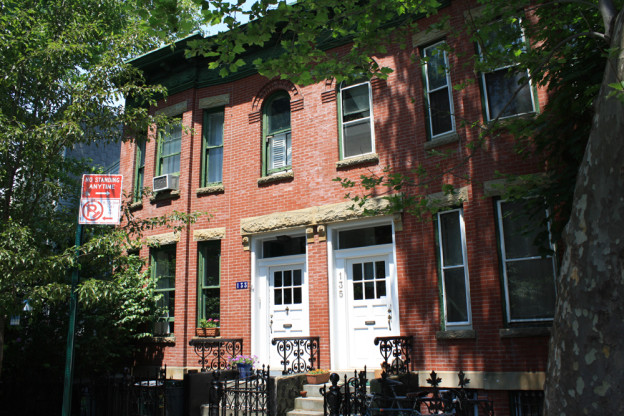
133 and 135 Oak Street, mirror images of one another, were designed with Romanesque and Renaissance Revival elements. Architectural features include rusticated stone lintels, brick arches, full-height projecting bays, ornate iron gates and galvanized iron cornices. 137 Oak Street is an Italianate structure that originally served as the Greenpoint Home for the Aged. This building is set back from the street by a large front lawn surrounded by an iron fence, and its design incorporates decorative brickwork, Romanesque Revival arches, a central projecting qabay with a triangular pediment, an iron balcony on the second story and an ornate, bracketed iron cornice. 133-135 and 137 Oak Street are located within the Greenpoint Historic District, and the State and National Register Historic District boundaries.

Greenpoint Savings Bank

807 Manhattan Avenue;
Helmle & Huberty, 1906-08|

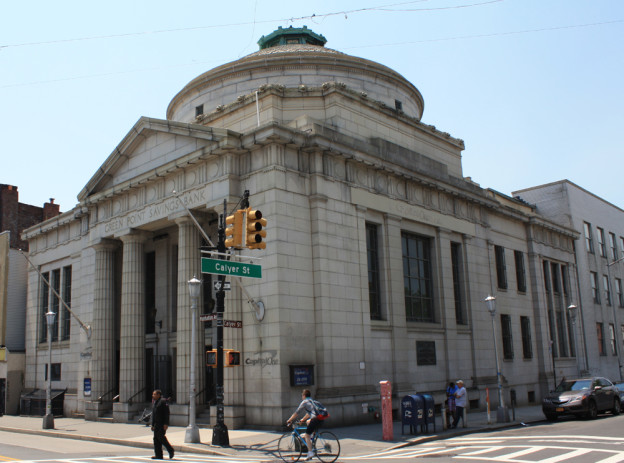
The Greenpoint Savings Bank, established in 1868, was housed in four different buildings in the neighborhood prior to commissioning this grand structure. Designed by the same firm responsible for the Shelter Pavilion in Monsignor McGolrick Park, this neo-Classical, Roman-style, limestone bank features a granite base, a recessed portico with four Doric columns topped with a triangular pediment, a large dome and patterned slate shingles. The Greenpoint Savings Bank is located within the Greenpoint Historic District, and the State and National Register Historic District boundaries.

Sidewalk Clock

753 Manhattan Avenue;
ca. 1860s|

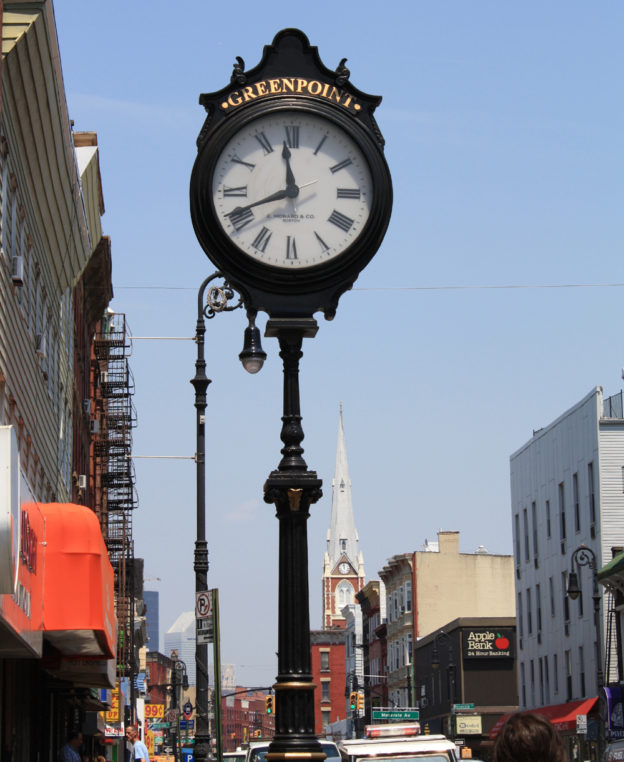
This is one of the city’s few cast-iron sidewalk clocks introduced in the 1860s that remain today. The clocks were installed by store owners not only as conveniences for shoppers, but as advertisements for their businesses. Manufactured by the Boston-based E. Howard Clock Company, this clock has a rectangular base, fluted column and double-sided face. No longer advertising a business, the clock features the word “GREENPOINT” in gold paint. Along with seven others across the city, the clock was designated an individual landmark in 1981.

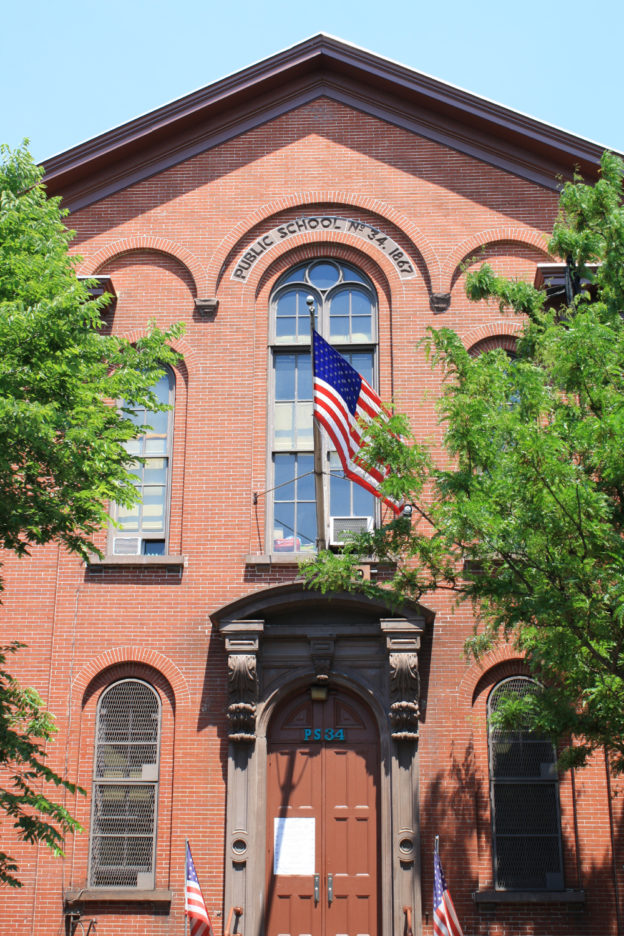
Public School 34, The Oliver H. Perry School

131 Norman Avenue;
Samuel B. Leonard, 1867-70;
additions: James W. Naughton, 1887-88|

Constructed by the city of Brooklyn to accommodate the influx of residents to Greenpoint in the mid-19th century, the architects of this Romanesque Revival school building were both Superintendents of Buildings for the Brooklyn Board of Education (Leonard: 1859-1879; Naughton: 1880-1898). The brick building features a gabled front façade with arched windows, a rusticated base and an ornate brownstone entrance enframement with pilasters and foliated brackets. The side wings along Norman Avenue were added in 1887-88 and feature shallow hipped roofs, arched windows and ornament that complements the style of the earlier building. The school was designated a New York CIty Individual Landmark in 1983.

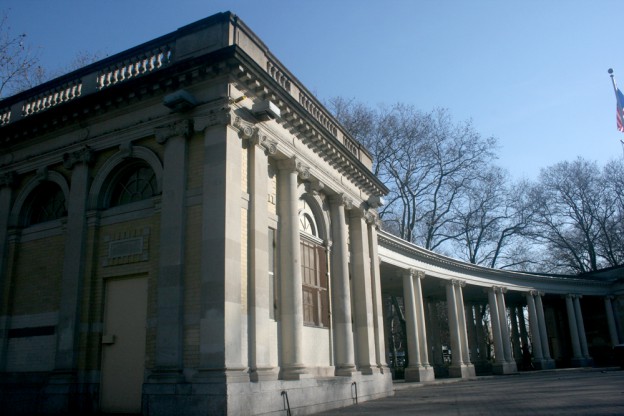
Monsignor McGolrick Park Shelter Pavilion

Helmle & Huberty, 1910;
John Ericsson (Monitor and Merrimac) Monument;
Sculptor: Antonio de Filippo, 1938|

Originally called Winthrop Park, this park was renamed in 1941 in honor of Monsignor Edward J. McGolrick, the Pastor of St. Cecilia’s Church. Its interior pathways are lined with shade trees, and its exterior perimeter is bordered by modest residential architecture. A highlight is the Shelter Pavilion, a Beaux-Arts comfort station that recalls the Grand Trianon at the Palace of Versailles. The structure features two end pavilions connected by a crescent-shaped open arcade of paired columns. In front of the pavilion is a statue commemorating the Greenpoint natives who lost their lives in World War I. Also within the park, the John Ericsson Monument is named for the engineer who built the Monitor, America’s first iron-clad warship, in Greenpoint in 1862. The park and pavilion were designated a New York CIty Individual Landmark in 1966.

St. Stanislaus Kostka Vincentian Fathers Church

Humboldt Street;
1903-04|

This Gothic Revival church, with a capacity of 1,250 worshippers, houses the largest Polish Catholic congregation in Brooklyn. In fact, the flanking stretches of Humboldt Street and Driggs Avenue were renamed Pope John Paul II Square and Lech Walesa Place, who each made visits to the parish. The church’s most marked feature is its spires that stand tall over the neighborhood. They are asymmetrical to one another, octagonal in shape and richly ornate.

St. Cecilia’s Catholic Church

84 Herbert Street;
Thomas Henry Poole;
1891-93|

The congregation of St. Cecilia’s formed in 1869 and originally occupied a small wood-frame church built in 1871. Over the course of the fifty-year leadership of Rev. Father McGolrick (1857-1938), the congregation vastly grew and the church set out to construct a larger building. This structure, which can hold roughly 1,400 people, is constructed of Georgia marble and limestone, and its altar is made of a cream-colored, French limestone called Caen stone. It features an imposing corner bell tower, capped with a copper roof.

Green-Wood Cemetery

At Sunset Park’s northern border is the beautiful Green-Wood Cemetery. Opened in 1838, it was the city’s first rural cemetery and its first great park (Central and Prospect Parks would not be built until later in the century). People from all over the city travelled to enjoy its lush surroundings, putting this rural neighborhood on the map before any major development took place here. The cemetery extends from 20th Hamilton Parkway to Fourth Avenue, encompassing 478 acres in the heart of Brooklyn. Its rolling hills, specimen trees, ponds and beautiful grave sites continue to draw visitors. The entire site is a National Historic Landmark.

The cemetery is home to the highest topographical point in Brooklyn, roughly 200 feet above sea level. This is a site in the Battle of Brooklyn, which took place on August 27, 1776, America’s first battle after signing the Declaration of Independence. A bronze statue entitled Altar to Liberty: Minerva by Frederick Ruckstull was erected on the site in 1920, in commemoration of the battle. Minerva’s arm is outstretched toward the Statue of Liberty across New York Harbor.

In addition to the cemetery’s lavish mausoleums and memorials, other architectural marvels include the cemetery gates and chapel, which are both designated New York City landmarks. The brownstone gates were designed in the Gothic Revival style in 1861 by Richard Upjohn, the famed church architect who is best known for designing Trinity Church in Lower Manhattan. The chapel was constructed in 1911 after designs by Warren and Wetmore, architects of Grand Central Terminal, and is a reduced replica of Christopher Wren’s Thomas Tower at Christ Church College in Oxford, England.

Among the noted residents of the cemetery are DeWitt Clinton (1769–1828), who, as Governor of New York, was largely responsible for the construction of the Erie Canal; Henry Steinway (1797–1871), founder of Steinway & Sons, piano manufacturers; Samuel F. B. Morse (1791–1872), painter and inventor of the telegraph; William M. “Boss” Tweed (1823–1878), infamous New York politician and leader of Tammany Hall; Nathaniel Currier (1813–1888) and James Merritt Ives (1824–1895), famous printmakers; Susan Smith McKinney-Steward (1846- 1918), the first black female doctor in New York State and third in the country; Louis Comfort Tiffany (1848–1933), decorative artist best known for his works in stained glass; Jean-Michel Basquiat (1960-1988), artist; and Leonard Bernstein (1918-1990), musician, composer and conductor.
Chinatown

Eighth Avenue between 42nd and 68th Streets|

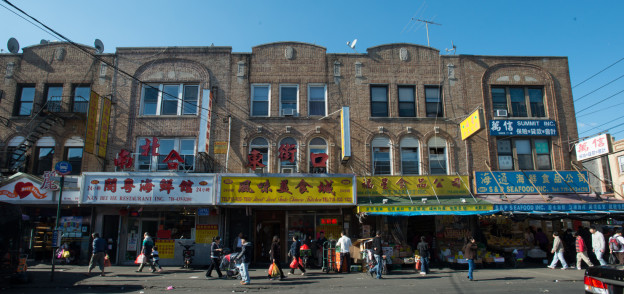
This is the third Chinatown in New York City. Chinese immigrants made their way to Brooklyn from Chinatown in Manhattan in the 1980s, traveling on the N train from Canal Street to 62nd Street. Because the station is above-ground and open-air, the Chinese immigrants nicknamed it “Blue Sky Station,” which also references the relatively suburban environment of this Brooklyn neighborhood.

Our Lady of Perpetual Help and St. Alphonsus School

526 59th Street Franz Joseph Untersee, 1905-28;
5902 Sixth Avenue 1902-03|

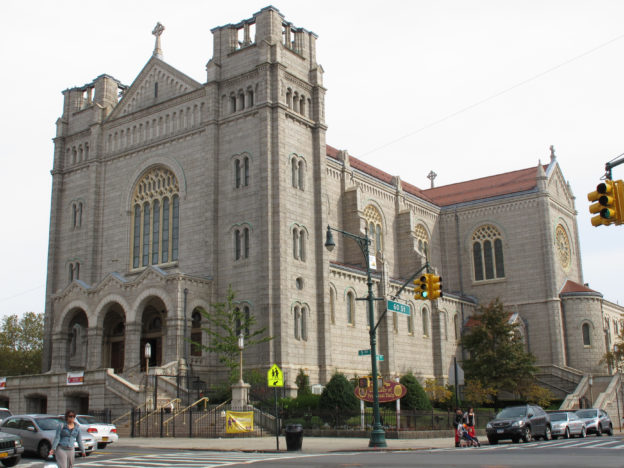
The largest religious edifice on Long Island, the basilica of Our Lady of Perpetual Help occupies an entire block. The granite Romanesque Revival basilica is a “double church” with two levels for worship. The ground floor was completed in 1909 and the second floor was completed in 1928. In its early years, the parish consisted mainly of Irish congregants. Today, some Irish remain, but the congregation is largely Hispanic and Chinese. Its subsidiary buildings include the Romanesque Revival brick rectory with Gothic Revival details and terra-cotta trim, which is to the rear of the basilica, and the St. Alphonsus School on Sixth Avenue, which predates the basilica by several years. The school was designed in the Ruskinian Gothic style with fanciful beige and black brickwork, pointed-arch door and window openings and a central statue above its entry.

59th Street between Fourth and Fifth Avenues

411-471 Henry Spicer, 1895;
412-440 Frank S. Lowe, 1896;
444-468 Henry Pohlmann, 1902|

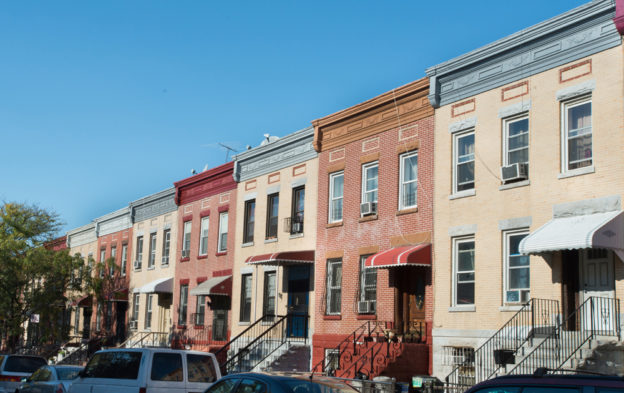
This block showcases some of the rowhouse architecture that defines Sunset Park. On the north side are 26 houses, unusual for their flat-fronted façades, all designed and built by the same person in the same year. Across the street are two sets of 13 houses by two different architects, but all of them feature projecting bays, which creates an interesting contrast with the north side’s flat wall.
Bay Ridge Savings Bank

5323 Fifth Avenue;
1926|

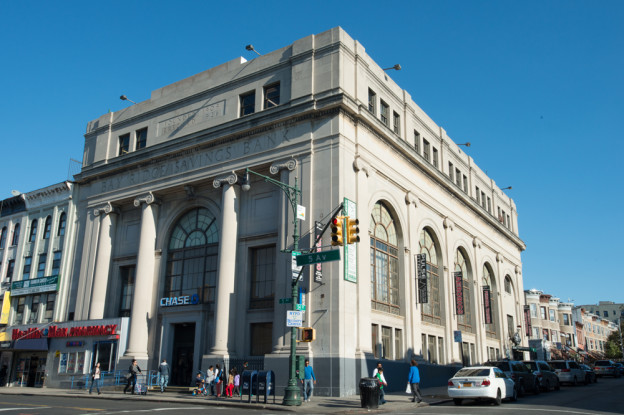
The most prominent commercial building along this section of Fifth Avenue, this Classical Revival limestone bank features Ionic columns and pilasters along both its Fifth Avenue and 54th Street façades and grand arched window openings. Though it now functions as a Chase Bank, the original company name, foundation date and date of the building’s construction still grace its crown.

5404-5420 and 5424 Fifth Avenue

William H. Abbott Jr., 1897;
J. H. Nadigan, 1897|

Designed for a mix of uses, Fifth Avenue contains buildings with retail shops at ground level and residential units above. In addition to these, the avenue is also home to religious institutions, firehouses, police stations, schools, banks and other commercial properties. One of the most architecturally distinguished sections is numbers 5404-5420, a Renaissance Revival row featuring projecting angled iron bays and metal window lintels. The brick Queen Anne building at number 5424 stands out for its pronounced corner turret and projecting bay on its 55th Street façade, which are both made of pressed metal.

Former Dr. Maurice T. Lewis House
404 55th Street;
Harde & Short;
1907|

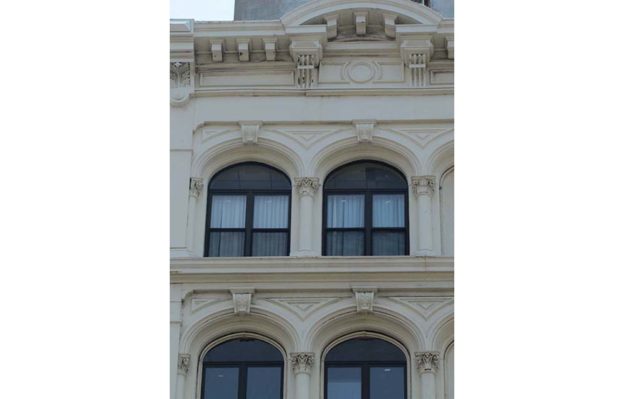
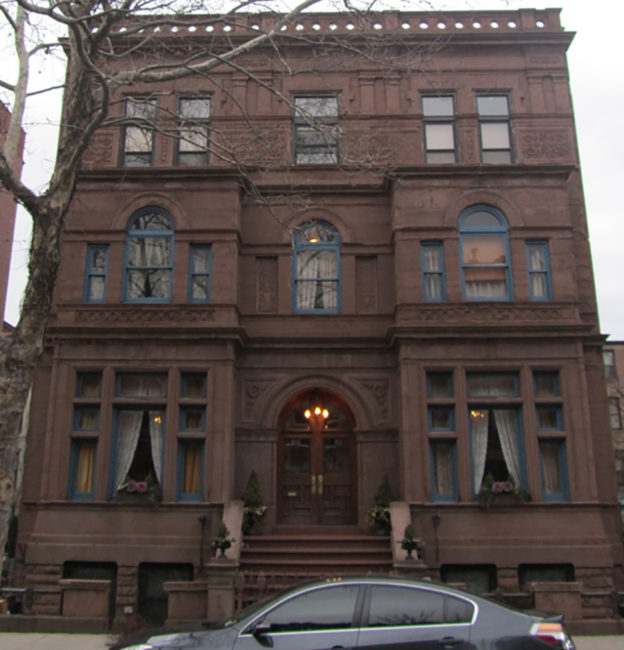
The neighborhood’s only freestanding mansion originally belonged to the director of the nearby Bay Ridge Savings Bank. The Renaissance Revival brick structure with a rusticated limestone base was designed by Harde & Short, a prestigious firm that was also responsible for many grand apartment houses, including the fanciful, terra-cotta-adorned Alwyn Court on Seventh Avenue and West 58th Street in Manhattan.

Former Evangelical Lutheran Church of the Incarnation and St. Jacobi Evangelical Lutheran Church

5323 Fourth Avenue;
Harold T. Brinkerhoff, 1927-28;
5406 Fourth Avenue 1908-10|

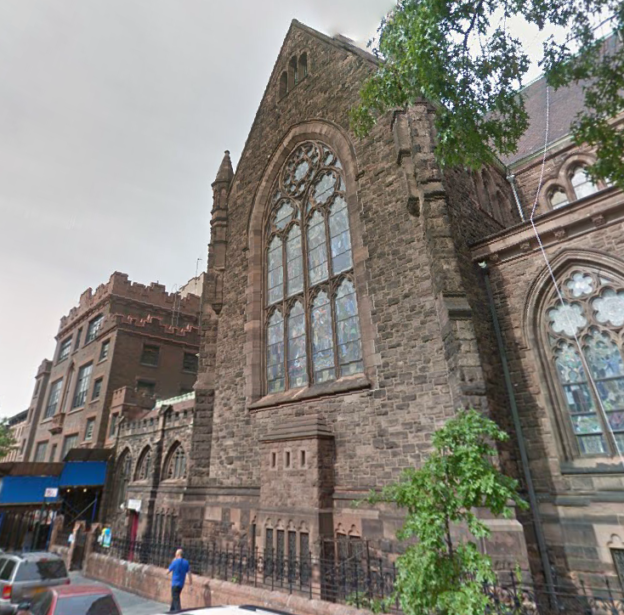
On the corner of 54th Street and Fourth Avenue are two magnificent Lutheran churches designed in the Gothic Revival style. The former Evangelical Lutheran Church of the Incarnation features red and orange brick with cast stone trim and a large pointed-arch stained-glass window dominating its Fourth Avenue façade. The building next door, which is part of the complex, was the congregation’s original church, designed by Bannister & Shell and built in 1908. St. Jacobi, which once offered services in German for area immigrants, features beige brick, a pyramidal spire with copper dormers and a grand crenellated entry with three pointed-arch doorways.

St. Andrew’s Episcopal Church

4917 Fourth Avenue;
Lawrence B. Valk & Son;
1893|

This Romanesque Revival church is Sunset Park’s oldest church. Valk was a prolific designer of churches throughout the United States, many in this same Romanesque style. The church is graced with many unusual and charming features, including the arches of varying heights and widths on the front façade and a skinny column running up the side of its bell tower, capped with a small turret and modest cross.

4701-4721 Sixth Avenue

Henry Pohlman of Pohlman & Patrick;
1904|

This lovely row of Renaissance Revival houses between 47th and 48th Street Streets also employs limestone cladding and features elegant carvings, including a dragon-like motif, projecting bays and columns around its entryways. To break up the repetition, Pohlman clad the houses on either end in brownstone, creating a “bookend” effect. Walk along the pretty blocks on 47th or 48th Street toward Fourth Avenue to get to St. Andrew’s Episcopal Church, 4917 Fourth Avenue.

514-560 44th Street

Thomas Bennett;
1908|

Distinctive rowhouses line both Sixth Avenue and its side streets in this part of Sunset Park. This row of Renaissance Revival limestone houses forms an elegant streetscape sloping down the hill from Sixth Avenue. Limestone experienced a surge in popularity after the 1893 World Columbian Exposition in Chicago, which was dubbed “the white city” for its use of light stone cladding. The exposition made a great impression on American architects, including Thomas Bennett, who resided in Sunset Park and designed over 600 rowhouses in the area.

566, 570 and 574 44th Street and 4404 Sixth Avenue

Eisenla & Carlson;
1913-14|

In addition to the construction of new apartment buildings for cooperative ownership, the Finnish Home Building Association purchased already-built apartment houses and converted them into co-ops. These four buildings on the south side of Sunset Park are also outstanding in their architectural details, which include Beaux Arts ornament, ornate brickwork, and beautifully detailed iron and glass canopies on numbers 566 and 570.

Alku and Alku Toinen

816 & 826 43rd Street;
Eric O. Holmgren;
1916-17|

In 1916, 16 families formed the Finnish Home Building Association and broke ground on two cooperative apartment buildings, Alku (meaning “beginning”), and Alku Toinen (toinen meaning “two”), the nation’s first non-profit, cooperatively-owned apartment buildings. At the time, the concept was so new that the state classified the buildings under the Department of Agriculture, which regulated cooperative farms, rather than as housing. Roughly 10 years later, Sunset Park became home to Brooklyn’s “Finntown”, with roughly 50 more co-op apartment buildings and a cooperative shopping complex.

Sunset Park

Seventh Avenue between 41st and 44th Streets;
Herbert Magoon with Aymar Embury II, Harry Ahrens and others;
1934-36|

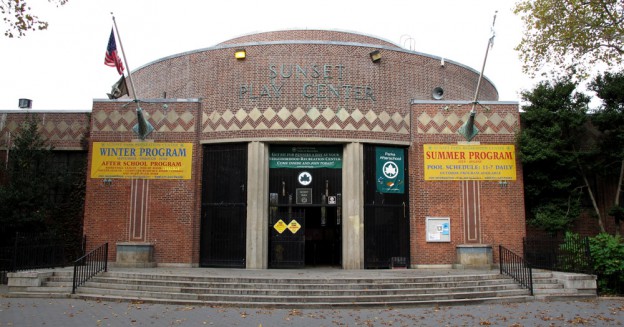
In 1891, the city of Brooklyn, planning for future growth, set aside 14 acres for Sunset Park, which was enlarged to 24.5 acres in 1903. The park affords views of Manhattan, New York Harbor and, more locally, St. Michael’s tower. At the park’s eastern edge, the play center was one of several built across the city during the Great Depression by the Works Progress Administration. The facility was constructed of low-cost brick and cast concrete and employed details characteristic of the Art Moderne style, including sleek curvilinear forms, decorative brickwork and diamond-patterned cast stone. The bathhouse features a one-and-a-half-story center rotunda flanked by corner piers and lined with stacked cylindrical brick walls.

442-472 40th Street, between Fourth and Fifth Avenues

Eisenla & Carlson;
1912-13|

With increased demand for housing after the arrival of the subway, there was a push to construct larger, multi-family dwellings in Sunset Park. This row of three-story tenements contained two apartments per floor, housing six families each. The Renaissance Revival brick tenements feature gabled pediments, accentuated bays, limestone trim and rusticated stone entryways.

Fourth Avenue

Before walking north to 40th Street, peek down 43rd Street between Fourth and Fifth Avenues at the brownstone rowhouses (circa 1898-1904) that form a topographically elegant streetscape. In the 1890s, Fourth Avenue was planned as a “parkway” to South Brooklyn, with planted malls down its center, much like Park Avenue in Manhattan. Unfortunately, the malls were demolished when the subway arrived in Sunset Park in 1915 to make way for vents. Until the 1950s, when car ownership and vehicular traffic were on the rise, Fourth Avenue’s sidewalks were roughly eight feet wider than they are today, to accommodate the popular 19th and early 20th century pastime of “promenading.” The east side of the Avenue is in the National Register historic district.

St. Michael’s Roman Catholic Church

4200 Fourth Avenue;
Raymond F. Almirall;
1905|

The 200-foot tower of St. Michael’s was the second tallest building in Brooklyn after the Williamsburgh Savings Bank until the early 21st century, when high-rise residential towers began to sprout up across the borough. The tower’s egg-shaped dome recalls the famous basilica of SacréCœur in Paris, a French connection made through its École des Beaux Arts-trained architect. Almirall also designed the Emigrant Industrial Savings Bank Building at 51 Chamber Street in Manhattan, as well as most of the campus of Seaview Hospital in Staten Island.

Former 68th Police Precinct Station House and Stable

4302 Fourth Avenue;
Emile Gruwe;
1886|

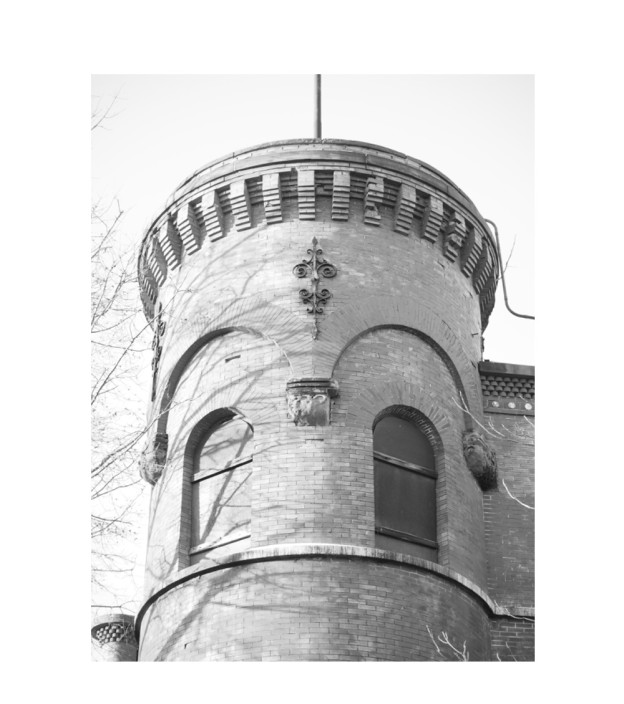
Due to its growing population in the 1880s, Brooklyn expanded its police force and built precincts borough-wide. Sunset Park’s station was renumbered several times, but eventually became the 68th City, and thus the boroughs’ police forces, consolidated in 1898. The station house and stable were designed in the Romanesque Revival style with Venetian and Norman Revival ornament, including brick molded cornices, arched openings, brownstone moldings and stone bandcourses with carved dogs’ faces and Byzantine leafwork. The station house has a crenellated corner tower and a projecting pavilion on Fourth Avenue. The buildings, connected by a one-story brick passage, have been vacant since 1970 and are in a severe state of disrepair. The station house was designated a New York City Individual Landmark in 1983.

Former Sunset Park Courthouse

4201 Fourth Avenue;
Mortimer Dickerson Metcalfe;
1931|

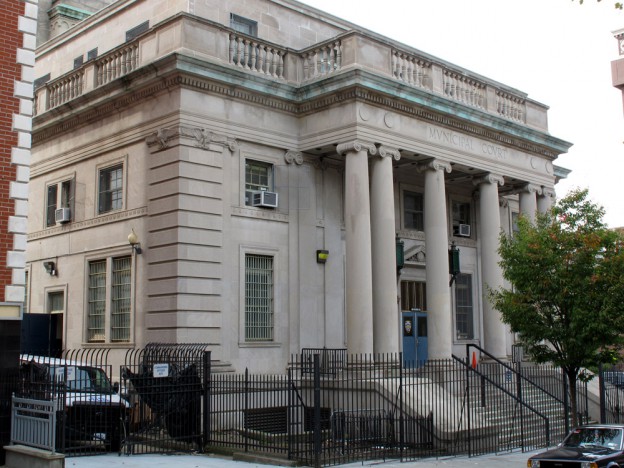
This Classical Revival courthouse was built to house the magistrates’ and municipal courts. Its architect gained prestige for assisting with the design of Grand Central Terminal roughly 20 years before this commission. The courthouse features grand porticos on both the 42nd and 43rd Street façades with Ionic columns, quoins, eagle capitals, limestone details and moldings. The courthouse was designed a New York City Individual Landmark in 2001.

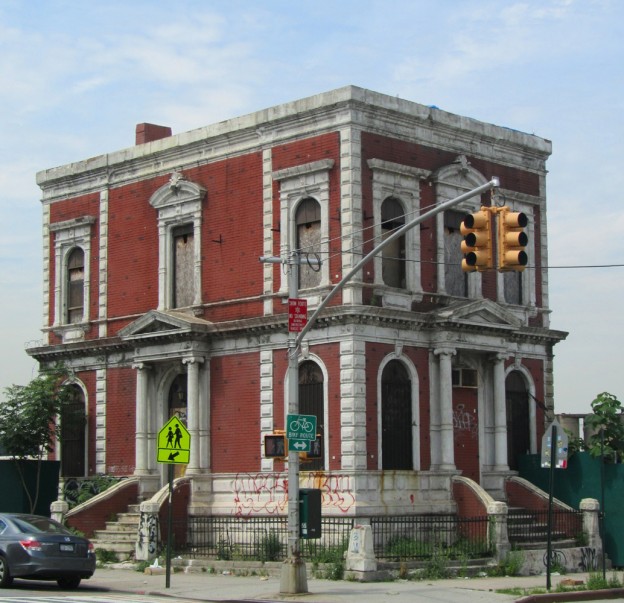
333 CARROLL STREET

19th century|

This former shoe factory is a symbol of triumph for preservation in the neighborhood. A controversial project that would have converted the old factory to condos included an out-of-scale rooftop addition that was found to be an illegal extension and would have had a negative impact on the block and the neighborhood. A Stop Work Order was issued in September of 2006, and the large steel addition has since been removed from the top floor of the historic building. This project led to community demand for a downzoning, and the building currently sits waiting to be appropriately redeveloped.

CARROLL STREET BRIDGE and ENGINE HOUSE

Brooklyn Department of City Works;
Robert Van Buren, Chief Engineer;
1888–89|

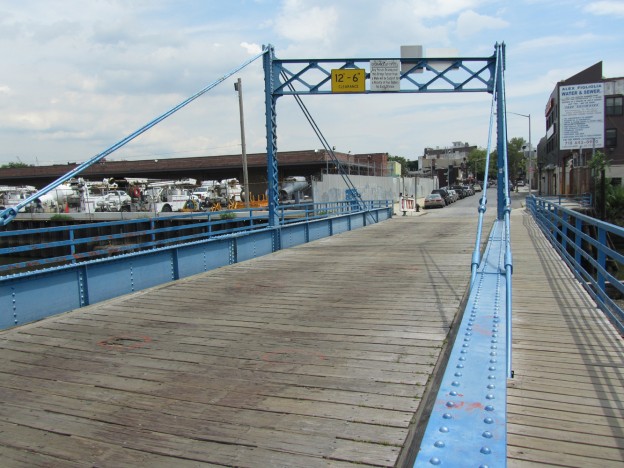
The Carroll Street Bridge, a New York City individual landmark, is one of four of the oldest retractile bridges in the United States. It continues to operate today essentially as it did when it first opened. The bridge rolls horizontally on wheels on steel tracks to allow shipping to pass. The bridge is drawn in and out by cables from the engine or operator’s house on the west side of the canal and opens a 36-footwide channel in the canal. There is an original Belgian block approach, and the bridge is wooden-planked. From the bridge, one can view the wooden cribbing along the banks of the canal. The canal was originally constructed all of timber cribwork laid horizontally, dating from 1866 to 1930.

2ND STREET ROWHOUSES

57–97 2nd Street;
1880s|

These brick rowhouses contain a high degree of historic integrity, such as original wood cornices, sandstone lintels and sills, and ornate cast-iron gates and fences. This row is especially interesting because the houses rise only two stories, as opposed to the three and a half that is typical of the neighborhood.

4TH STREET ICEHOUSE AND BREWERY COMPLEX

4th Street and Hoyt Street;
1904–ca. 1930s|

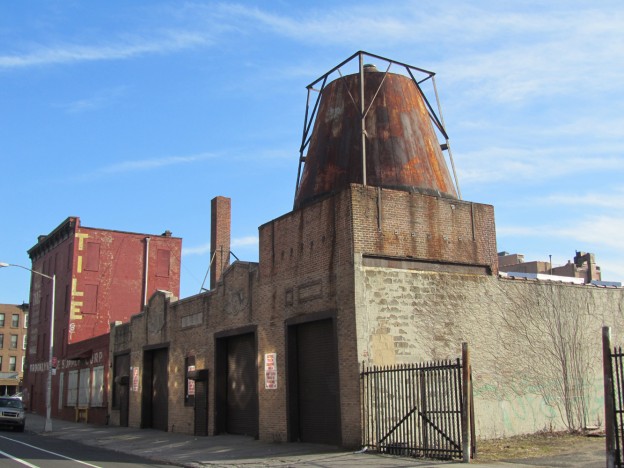
The earliest company known to have occupied this complex was the Empire City Hygeia Ice Company in 1904. Two years later a six-story building was also constructed, serving the Leonard Michel Brewing Company and containing a brewhouse, ice storage and freezing tanks. By 1939 the entire complex was occupied by the Ebling Brewing Company, but since 1950 the complex has not been affiliated with beer or brewing.

9TH & 10TH STREET SUBWAY VIADUCT

1933|

This 4,400-foot-long steel trestle was completed in 1933 to carry the IND subway. The viaduct, which houses the Smith/9th Street subway stop, crosses the Gowanus Canal and, at 87½ feet above the canal, is the city’s tallest. Beneath the viaduct is a beautiful vista looking north along the canal. The shape of the waterway bending north retains that of the 19th-century commercial waterway, and its docks, basins, bulkheads and industrial buildings are still used today.

T. H. ROULSTON, INC.

70–124 9th Street;
ca. 1910|

Thomas Roulston was the son of an Irish immigrant who was a grocery-clerk-turned-owner in Brooklyn. By 1888, Roulston owned three groceries, and this lot was purchased for the construction of a large grocery warehouse. The building served as the central warehouse for the Roulston company, which grew to more than 300 stores in the five boroughs. The building and the business were sold after his death in 1951 by his son. All of the buildings in this complex were built at the same time and are Renaissance Revival in style with corbeled cornices and segmentally arched windows.

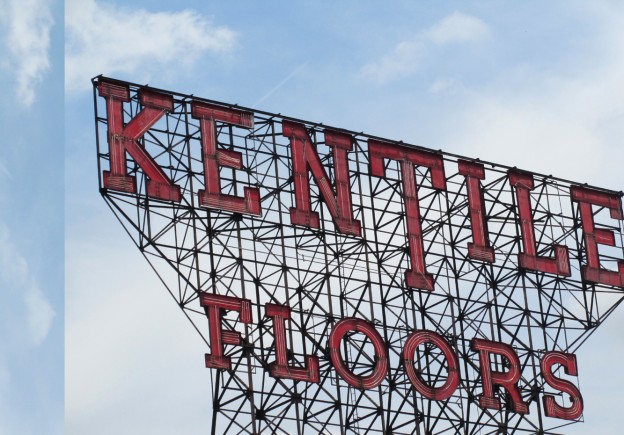
KENTILE FLOORS SIGN

9th Street and 2nd Avenue;
1949|

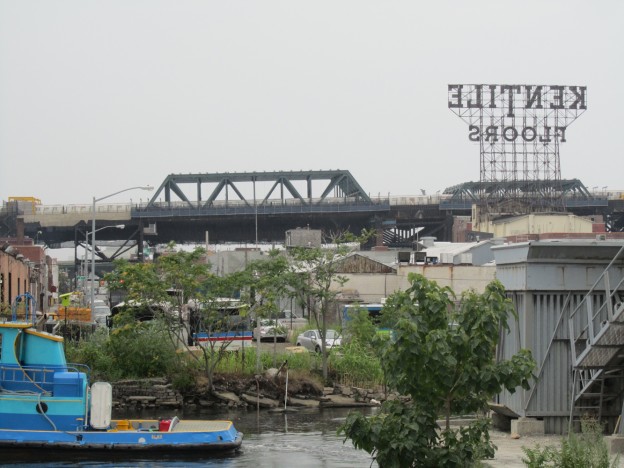
The Kentile Floor Company, founded by Arthur Kennedy in 1898, opened its third location here in 1949. Kentile was a pioneer in the “do-it-yourself ” industry of home improvement. Advertisements featured housewives putting in the floor tiles themselves, implying the simplicity of installation. While Kentile has not been present here since the 1990s, the site is still used for manufacturing.

The sign was dismantled in 2014. The Gowanus Alliance is trying to erect the sign in another location.

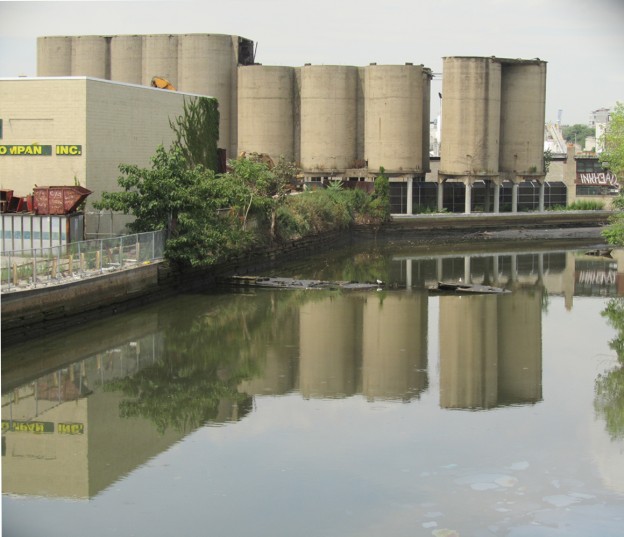
BURNS BROTHERS COAL POCKETS

2nd Avenue;
1915–38|

Coal was one of the major freights shipped on the canal in the 19th and 20th centuries. Initially, coal was used for domestic heating and cooking, and it later was burned to generate electricity. Coal pockets were used to move and store the coal from barges on the canal to wagons and, later, trucks for delivery. The eight pockets closest to the water were built between 1915 and 1924, and by 1938 there were 10 more. These 40 and 50-foot tall structures are no longer used today but remain as relics of the canal’s crucial transportation role.

EAGLE CLOTHING FACTORY SIGN

6th Street and 4th Avenue;
1951|

This sign hovers above what was once the Eagle Clothing Factory, which moved to Gowanus and built a brand-new factory here in 1951. The factory had many modern amenities such as adequate space and lighting, air-conditioning and a recreational roof garden. The company owned this property until 1989, and the sign remains as it has been for 60 years in this neighborhood.

The sign was removed in 2013.

SOMERS BROTHERS TIN BOX FACTORY (AMERICAN CAN FACTORY)

232 3rd Street;
ca. 1886|

Within a year of its opening, this factory was producing 1,800 tin boxes per week and within a decade grew to be a company with more than 150 employees. Oil, pumped from iron tank boats on the Gowanus Canal, powered the factory. The company sold this location to the American Can Company in 1901. Today the building retains a functional use as spaces for designers, artists and manufacturers. Visually, it is a testament to Gowanus’ industrial past and its ability to adapt to serve current production needs. Sonic Youth recorded its first three albums at this complex.

NEW YORK & LONG ISLAND COIGNET STONE COMPANY BUILDING

370 3rd Avenue;
William Field & Son;
1872–73|

This New York City individual landmark is the sole survivor of a factory complex that originally was five acres large and spanned from 3rd to 6th Streets along the Gowanus Canal. It was constructed as the showpiece, and served as the office, of the New York & Long Island Coignet Stone Company, one of the first companies in the United States to industrialize the production of concrete. Not surprisingly, it is the oldest known concrete structure in New York City. The building features a poured-in-place foundation and original pre-cast concrete stones and blocks on the upper stories. It is also likely that the floors are reinforced concrete. The company was named for François Coignet, who patented Beton Coignet Concrete in France in the 1850s, and produced the material at this location. Concrete was cast in molds and was much more affordable than chiseling natural stone. A large-scale modern supermarket project surrounding the building was approved in 2012.

BRT POWERHOUSE

322 3rd Avenue;
1902|

This massive eight-story Romanesque Revival style building served as the powerhouse for the Brooklyn Rapid Transit Corporation, or BRT. The BRT owned every steam railroad, elevated line and streetcar in Brooklyn at the turn of the 20th century, and this enormous building burned coal to generate electricity for all of the trains. Coal was fed from the canal bank via a coal elevator to a cement tunnel connecting the coal pit and the larger boiler building. The currently vacant building, the only remnant of what originally was an extensive complex, is under threat by neglect and abandonment.

450-460 UNION STREET

aka The Green Building;
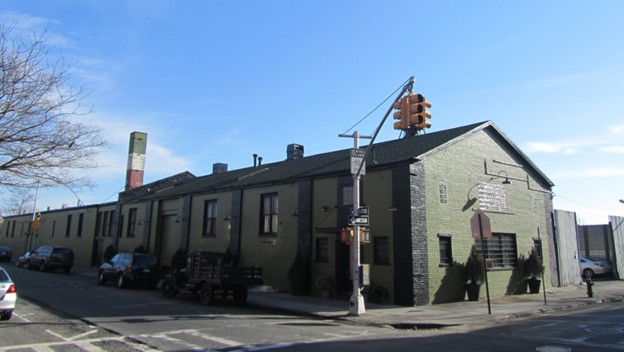
Ca. 1948|

This site has hosted a variety of industry since the Gowanus first began to operate shortly after the Civil War and is reflective of how long industry has characterized the area. It was previously home to Thomas Paulson & Son, a brass foundry. In 2002, plans were made for the demolition of the building and its subsequent replacement with a luxury residential tower. After much community outcry and two years of discussion with the Board of Standards and Appeals, the site was not granted a residential rezoning and the building was saved. The building is being adaptively reused as an event space and serves as a symbol of the strength of the Gowanus community’s determination to preserve its industrial heritage

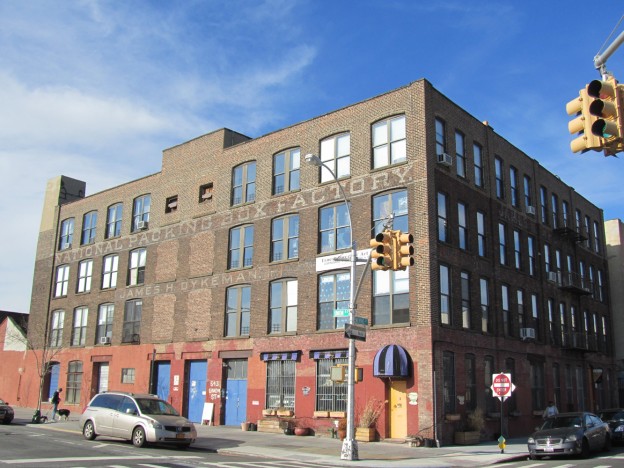
NATIONAL PACKING BOX FACTORY

543 Union Street;
Robert Dixon;
ca. 1910|

James A. Dyckeman commissioned architect Robert Dixon to construct this industrial building for his box factory. Eventually the business increased and became a five building complex. A portion of this building burned in 1932, and by 1936, Dyckeman’s company was bankrupt. Other industries that have operated here include brass and cabinet manufacturing. The building is still in use today and is currently home to Proteus Gowanus, an interdisciplinary gallery and reading room. Housed within Proteus is Gowanus Hall, a museum dedicated to the history of the canal itself.

EUREKA GARAGE

638–44 Degraw Street;
1923|

This auto garage on the south side of Degraw Street is a survivor of the early presence of the automobile in New York City. Eureka shops were an early chain of automotive repair establishments. The building is constructed of tan brick laid in Flemish bond with decorative panels featuring automobile tires with wings, evidencing the building’s original use. The façade is largely original and intact.

BROOKLYN NEWS BUILDING

209–215 3rd Avenue;
1919|

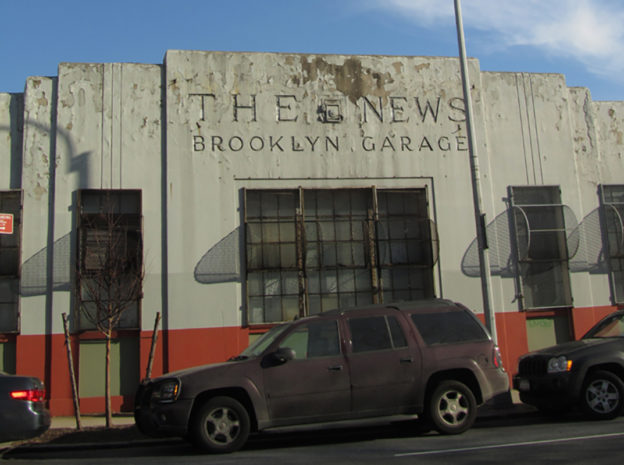
This building once functioned as the printing and distribution garage for the New York Daily News. The single story structure features vertical piers which break up the strong horizontal massing. The signage on the building reads “The News Brooklyn Garage” and features an image of a stylized camera. The News was once known as “New York’s Picture Newspaper” and continues to feature a camera as part of its logo to this day.

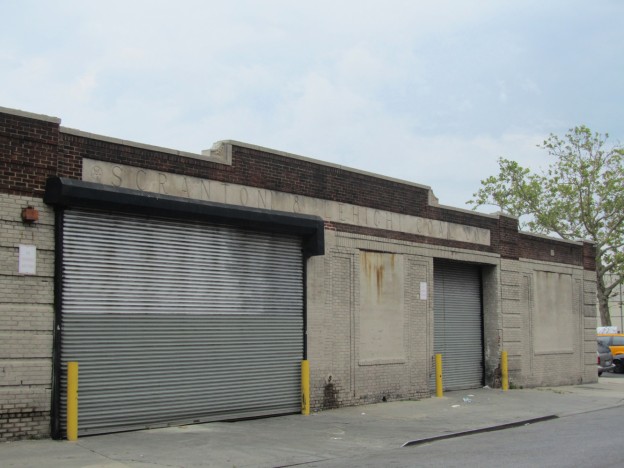
SCRANTON AND LEHIGH COAL COMPANY

233 Nevins Street/236 Butler Street;
Early 20th century|

This building survives as a relic of the once prolific commodity of coal shipment on the Gowanus Canal. According to a transcription from Brooklyn Genealogy, “Lehigh and Scranton coals have no rivals as powerful heat producers and sustain combustion in a manner that insures the greatest economy as household and manufacturing fuels.” See also the Burns Brothers Coal Pockets on 2nd Avenue.

R. G. DUN AND COMPANY BUILDING

239–57 Butler Street/206 Nevins Street;
1914|

This four story factory was commissioned by Robert Graham Dun and completed by the Moyer Engineering and Construction Company in 1914. This reinforced concrete structure features decorative, blue terra-cotta detailing which contrasts with the overall gray-colored concrete materiality. The printing industry faded from this building in the 1960s and the use shifted to the manufacturing of plastic products. Subsequently, the building remained vacant for many years but has recently been zoned for residential use.

ASPCA MEMORIAL BUILDING

233 Butler Street;
Renwick, Aspinwall & Tucker;
1913|

The American Society for the Prevention of Cruelty to Animals opened its Brooklyn headquarters here in 1913. The organization was formerly located in a basement at 114 Lawrence Street, and this building on Butler Street was the result of generous donations by wealthy philanthropists, including the Bowdoin and Schermerhorn families. When it was completed, it was larger than the Manhattan location and had a formal lobby and reception space. The roof design even included a terrace that functioned as a dog run. The ASPCA occupied this space until 1979, and the building has since been a musical-instrument repair shop.

GOWANUS/DOUGLASS STREET PUMPING HOUSE

209 Douglass Street;
1905–11|

The pumping house was constructed as part of the flushing system of the canal. It is still in use today, and the exterior remains largely intact despite the removal and reconstruction of much of the original equipment during the 1990s.

THE JOHN C. KELLY HOUSE

THE JOHN C. KELLY HOUSE;
247 Hancock Street;
Montrose Morris, 1880s|

This impressive house, one of relatively few free-standing structures in Bedford-Stuyvesant, was designed and built for the well-to-do Irish immigrant John Kelly. Completely clad in brownstone, this three-story Renaissance Revival mansion features first- and second-story projecting bay windows; a recessed rounded-arch entry; stone stoop and railings; and belt courses, carved panels, pilasters and a stone cornice and balustrade. The house’s sheer size, triple the width of most single-family structures in Brooklyn, coupled with the ornate stone cladding, results in a monumental and handsome residence.

THE BOYS’ HIGH SCHOOL

THE BOYS’ HIGH SCHOOL;
832 Marcy Avenue;
James W. Naughton, 1891–92|

The monumental Boys’ School was designed in the Romanesque Revival style and features quintessential design elements, such as rounded-arch windows and doors, dormer windows, gables, terra-cotta ornament, smooth brick façades and a rough-cut ashlar stone foundation. The imposing corner towers create a picturesque silhouette between this massive structure and the sky. Along with the Girls’ High School, it was the first public secondary school in New York City, and both were designated New York City landmarks in 1983.