Archives

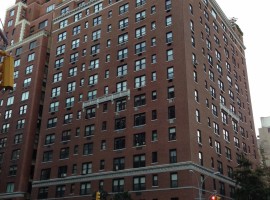
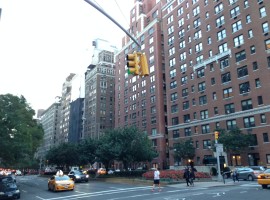
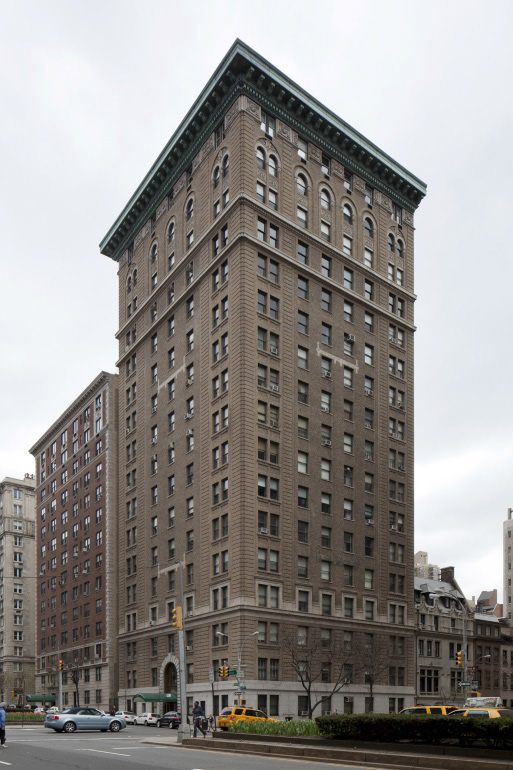
Park Avenue, Manhattan

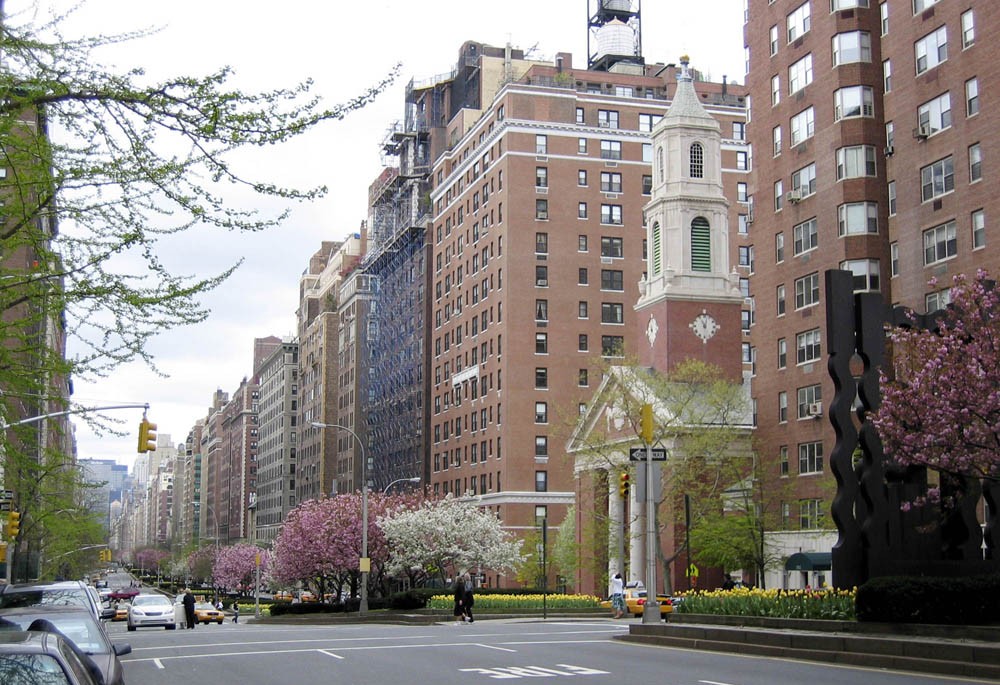
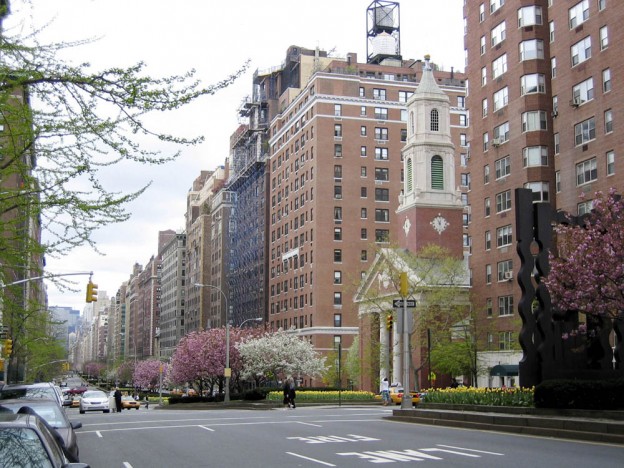
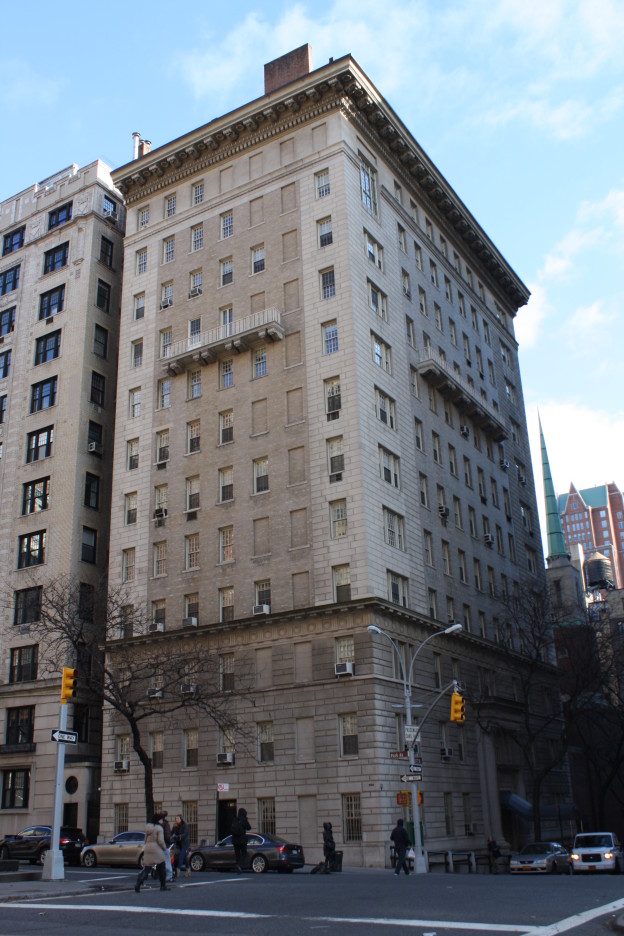
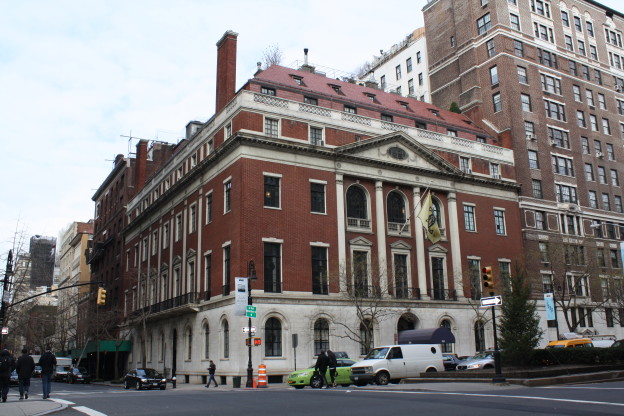
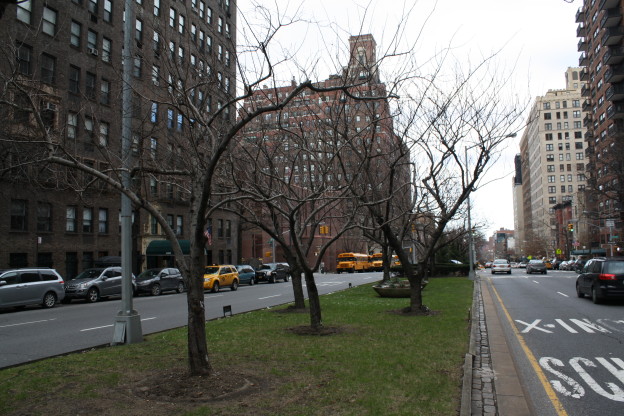
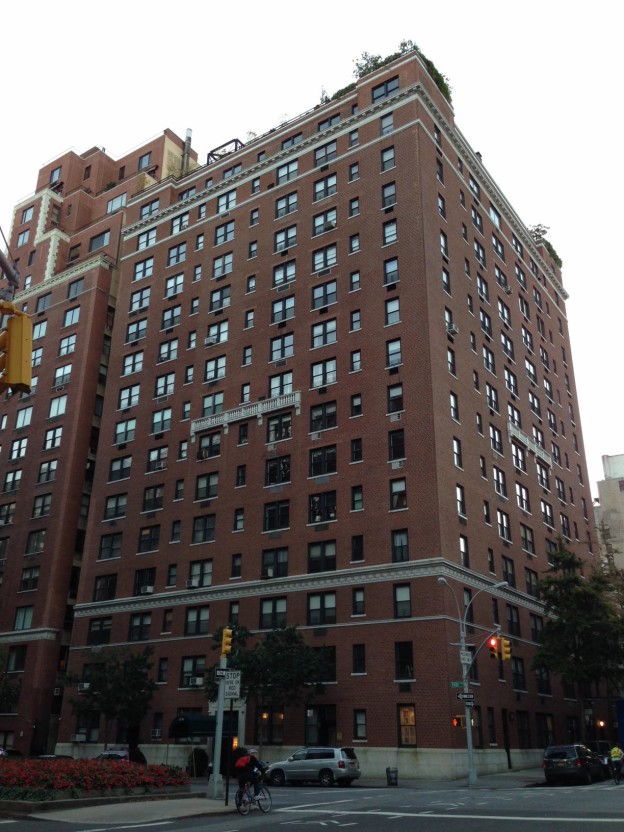
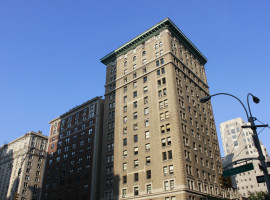
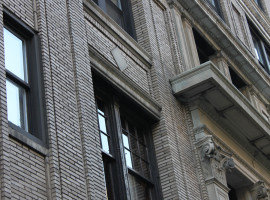
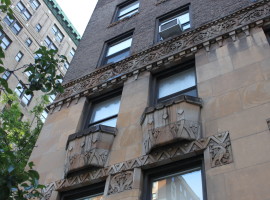
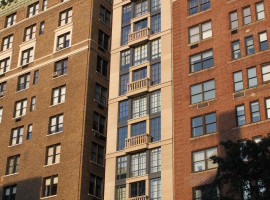
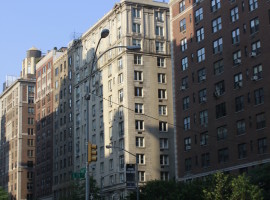
Park Avenue, today a coveted address, was once neglected. In 1831, the New York and Harlem Railroad was granted use of what was then known as Fourth Avenue for its train tracks. Starting 1837, steam engines heading to and from Grand Central spewed sparks and noise through vents. Per new legislation the trains were moved below ground and eventually electrified. As a result the street was paved over and the vents were turned into beautifully landscaped malls. Perhaps the most important contributor to Park Avenue’s special character is its apartment buildings, whose largely uniform heights form continuous street walls. The buildings were designed by respected architects in popular styles, including: Gothic Revival, Renaissance Revival and Art Deco. Among the notable architects were: George and Edward Blum, Rosario Candela, J. E. R. Carpenter, George F. Pelham and Emery Roth. Today much of Park Avenue is a designated historic area.

To learn more about Park Avenue click here

Squadron A Armory

1339 Madison Avenue;
John R. Thomas, 1895; 
Park Avenue side: Morris Ketchum, 1969;
Madison Avenue façade: NYC IL, NR-P, NR-D|

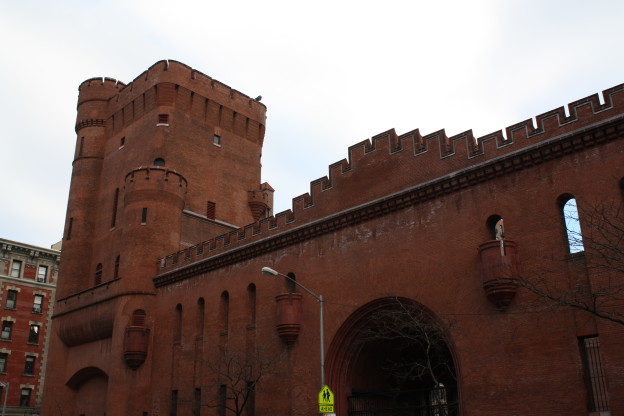
In 1884, a group of gentlemen horseback riders formed the “First New York Hussars” or “First Dragoons,” and by 1889, its 53 members became Troop “A.” By 1895, the group became Squadron “A,” and served in the Spanish American War and in World War I as the 105th Machine Gun Battalion. The armory was built for Squadron A and, true to its roots, included roughly 100 horse stalls. At one time encompassing the entire block, the building was partially demolished in the 1960s. The Madison Avenue side was saved by an emergency action by the Landmarks Preservation Commission, which designated it a city landmark. This façade is notable for its two large crenellated towers. The Park Avenue side was demolished to make way for a school, but was replaced with a building that evokes the original complex, which now houses the Hunter College Elementary and High Schools.

1209, 1211, 1213, 1215, 1217 Park Avenue and 112, 114 East 95th Street

Flemer & Kohler, 1889-90; 1209;
redesign: Lucien David, 1960-62; 1211; 
redesign: William L. Bottomley, 1922; 
NRHP-D|

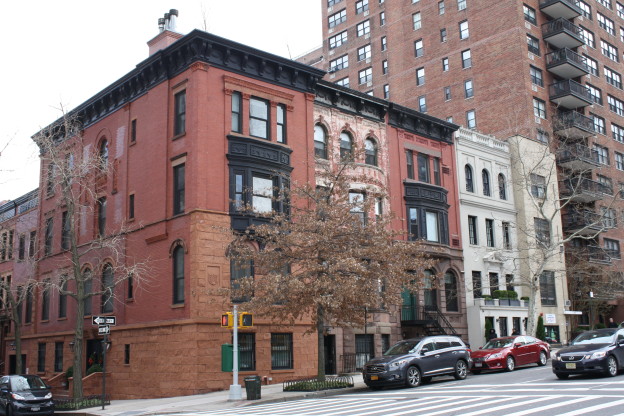
These seven rowhouses that wrap the corner of East 95th Street were built by one developer. The houses on Park Avenue were designed in the Renaissance Revival style, while the narrower ones on East 95th Street were designed in the Queen Anne style. 1209 and 1211 Park Avenue were significantly altered in the 20th century, the former in a Modern style when it was converted to a school, and the latter in the neo-Georgian style.

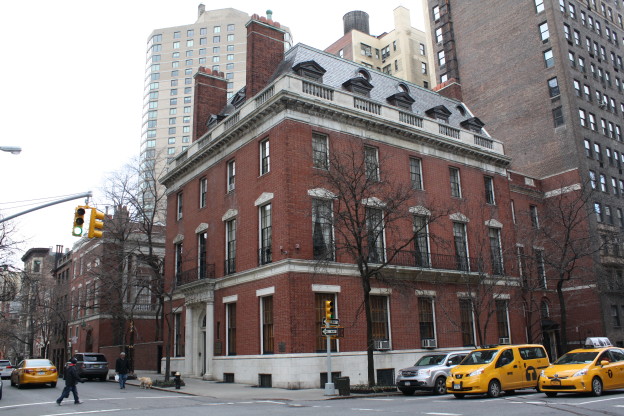
Former George F. Baker Mansion

69-75 East 93rd Street;
Delano & Aldrich;
1917-18 and 1928-29;
NYC ILs, NYC HD, NR-P, NR-D|

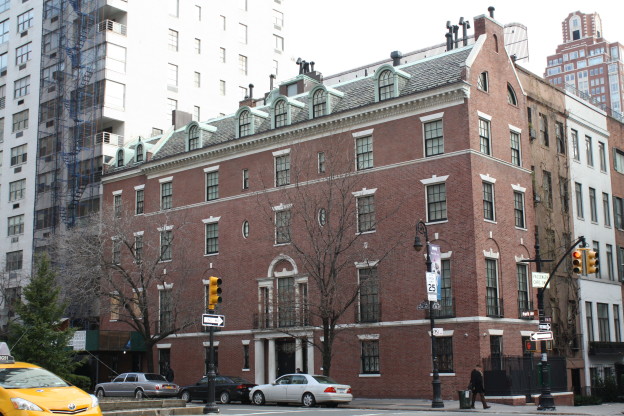
This L-shaped, red brick and limestone complex was built in two phases by two different owners. The three-story building that abuts Park Avenue was built for banker Francis F. Palmer. In 1928, banker and philanthropist George F. Baker, Jr. purchased the house and added the L-shaped ballroom wing, set back from the street by a courtyard. On the other end, a garage with apartments above was also constructed. The Synod of Bishops of the Russian Orthodox Church Outside of Russia purchased the house and ballroom wing in 1958. The garage wing remains a private residence.

Mount Prospect/Mount Pleasant

Park Avenue at East 93rd Street|

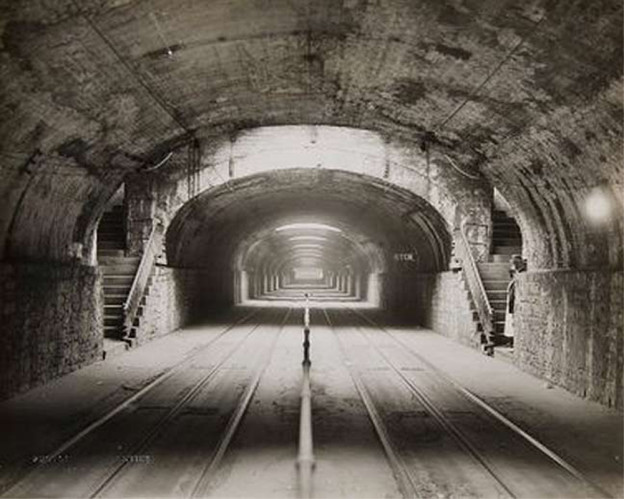
Though many of its slopes were flattened when the street grid was imposed in the early 19th century, the Upper East Side’s natural topography is quite hilly. The slope at this section of Park Avenue was once prominent, and was referred to as “Mount Prospect” or “Mount Pleasant.” In 1837, a railroad tunnel was cut through the hill to bring day-trip visitors to upper Manhattan. A grand hotel, Prospect Hall, was built near what is now East 93rd Street. Situated on 12 acres, visitors could take in views of the city, as well as Long Island and New Jersey.

(Note- Picture shown is the Park Avenue tunnel. Picture from Forgotten NY )

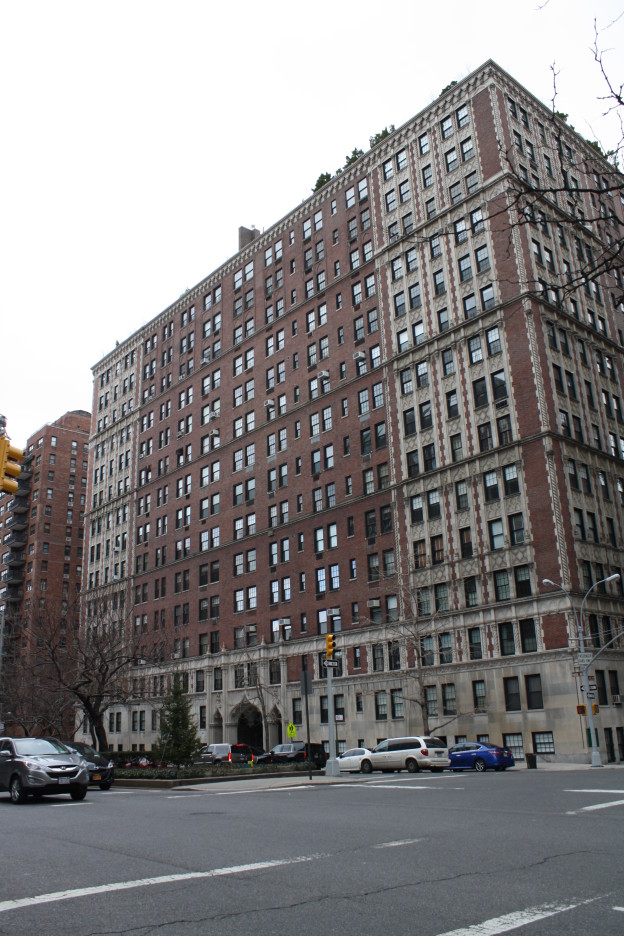
1185 Park Avenue

Schwartz & Gross, 1928-29 – NYC HD, NR-D|

Occupying the entire blockfront, this enormous Gothic Revival style apartment building is accessed through a grand triple-arched doorway leading into a landscaped interior courtyard and to the building’s six lobbies. The five bays on either end of the building resemble bookends, as their windows are surrounded by cream-colored, ornamental terra-cotta. Across the street, 1192 Park Avenue now stands where the home of prominent brewer George Ehret once stood. The brownstone mansion was built in 1878 (demolished 1928) when the area was largely unoccupied, but its location was convenient to Ehret’s Hell Gate Brewery on the East River. As one of the first “fine” residences on upper Park Avenue, the mansion inspired other prominent families to move here.

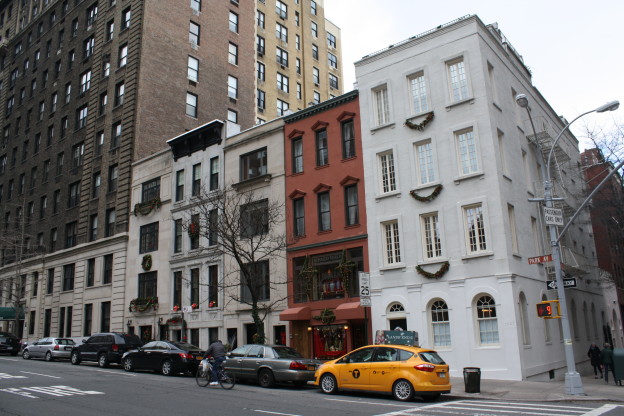
1141 Park Avenue,1143 Park Avenue,1145 Park Avenue,1147 Park Avenue,1149 Park Avenue

John Sullivan, 1884-85);
John Sullivan, 1884-85; altered: Emery Roth, 1924);
John Sullivan, 1884-85; redesigned: Emery Roth, 1920-21
John Sullivan, 1884-85;
John Sullivan, 1884-85; redesigned: Emery Roth, 1917;
NYC HD, NR-D|

Aside from 1141 Park Avenue, which was originally a flats building for three families, these charming buildings were built as single-family rowhouses. All five of them, which were designed in the neo-Grec style, have undergone significant alterations or wholesale façade redesigns since their construction in the 1880s, but 1147 Park Avenue retains the most of its original façade configuration.

Brick Presbyterian Church

1140-1144 Park Avenue;
York & Sawyer, 1938-40;
parish house: 1948-49 –
NYC HD, NR-D|

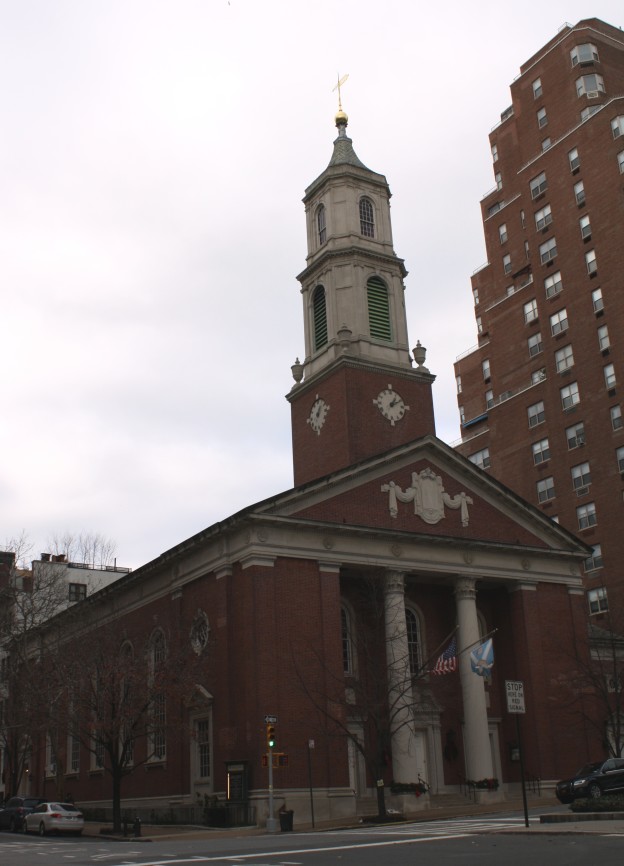
The congregation of Brick Presbyterian Church dates back to 1767. Its original home was the “old Brick Church” at the corner of Beekman and Nassau Streets. After a stay in midtown, the church merged with the Park Avenue Presbyterian Church in the 1930s and constructed this lovely building. In reference to the congregation’s roots, the church was designed in the neo-Georgian style popular during the Colonial period.  It features a temple front and a polygonal tower topped by a ball finial. There is a chapel extension on the north façade, and the parish house is around the corner at 62 East 92nd Street. The church interior was fashioned after St. Paul’s Chapel, a contemporary of the original Brick Church.

1095 Park Avenue, 1100 Park Avenue

Schwartz & Gross, 1929-30 – NYC HD, NR-D;
De Pace & Juster, 1929-30– NYC HD, NR-D|

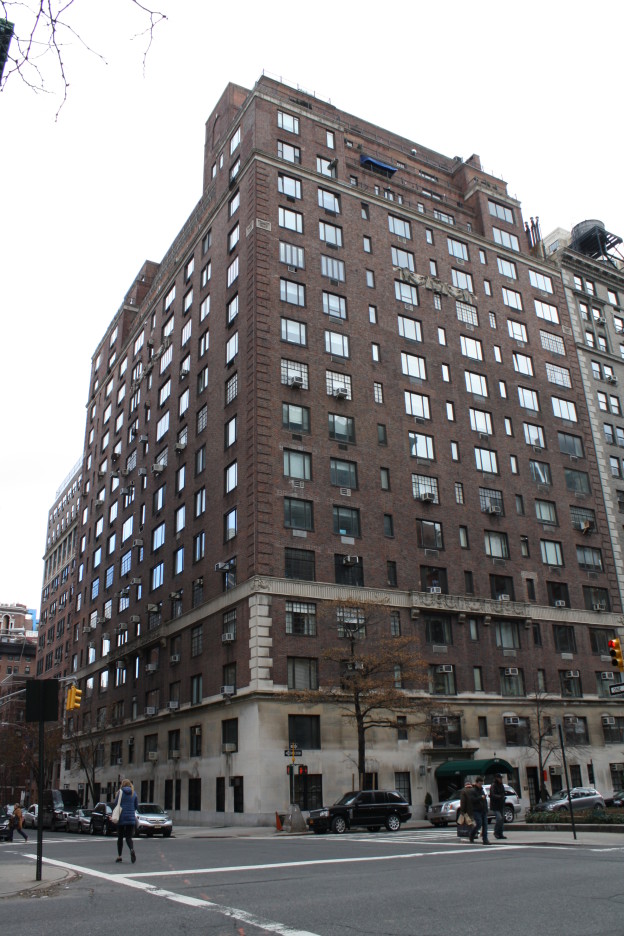
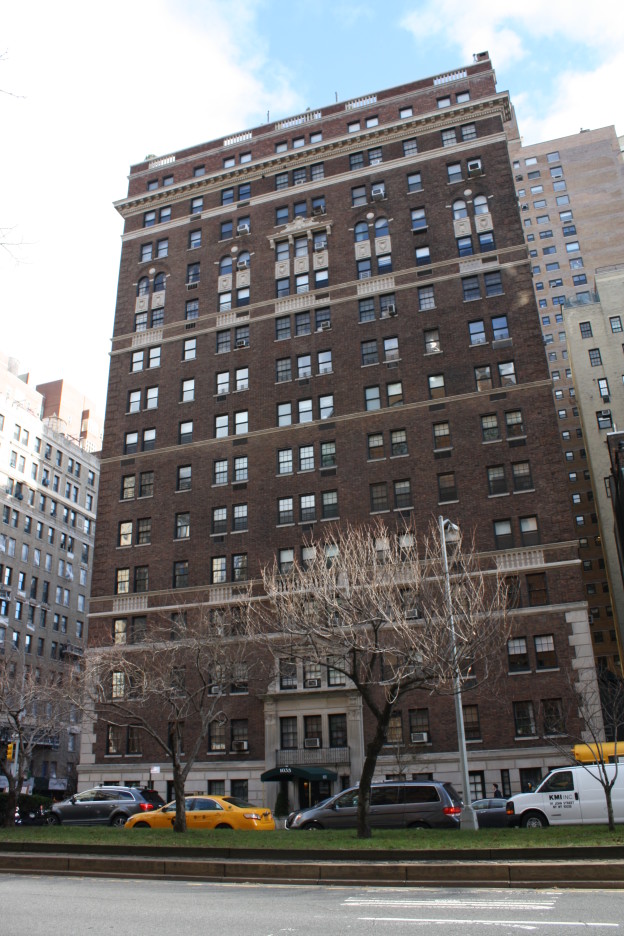
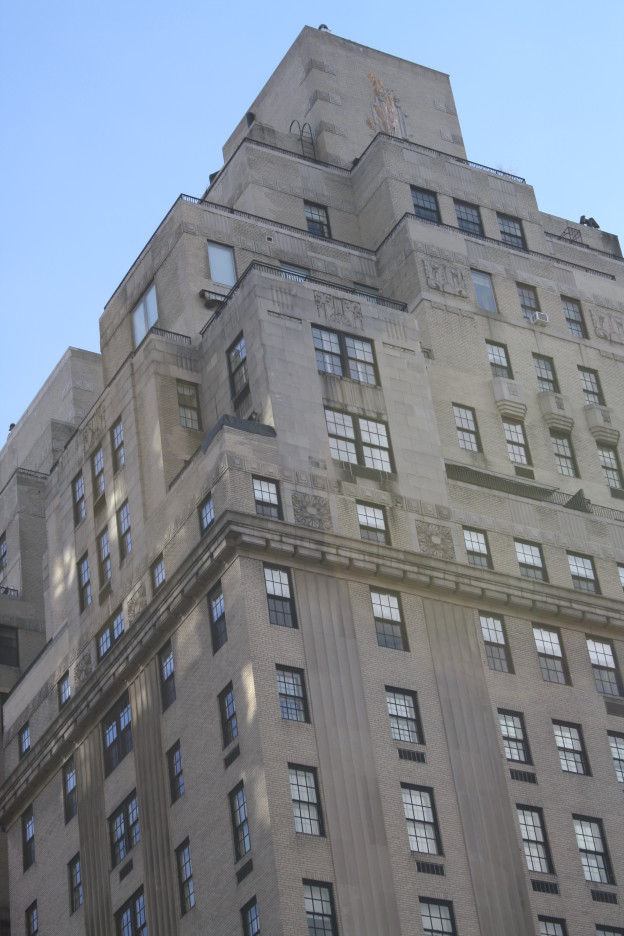
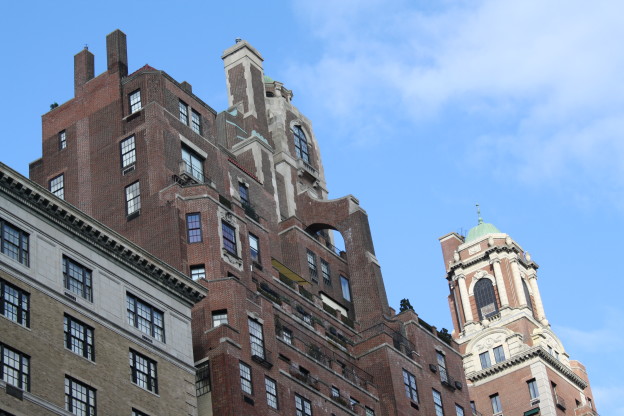
In 1929, the New York State Legislature passed the Multiple Dwelling Law, requiring better standards for safety, health and access to light and air. Its benefits for the city’s poor were great, but on Park Avenue, the law translated into a design trend toward terraced upper floors, like those on 1095 and 1100 Park Avenue. The law also introduced water tanks to the urban landscape for drinking water and fire protection. On Park Avenue, water tanks were concealed behind rooftop pavilions, which fit right in with the stepped architectural silhouette that had become trendy during the Depression era, forming a crown at the top of the entire ensemble.

1080 Park Avenue, 1082 Park Avenue

Frederick T. Camp, 1886-87; Harry Hurwit, 1927-28 – NYC HD, NR-D;
redesign: Augustus N. Allen, 1925 – NYC HD, NR-D|

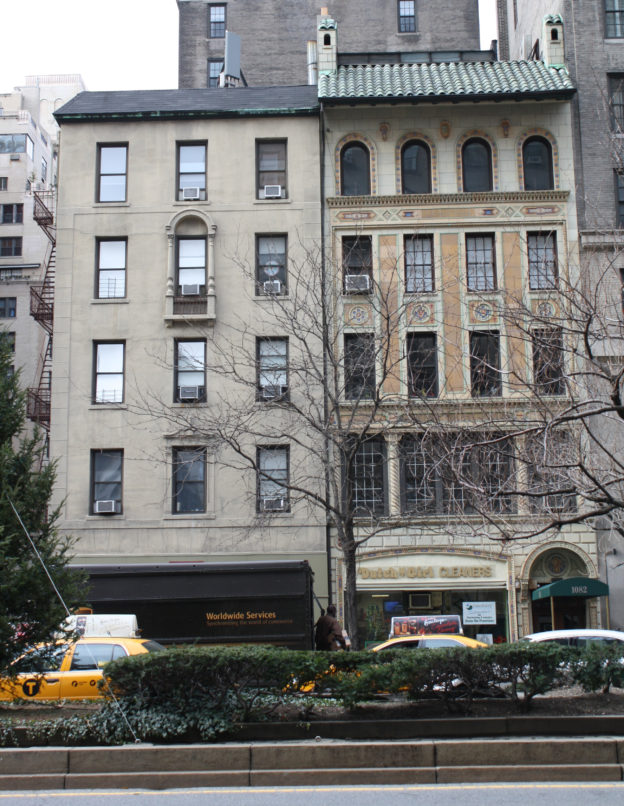
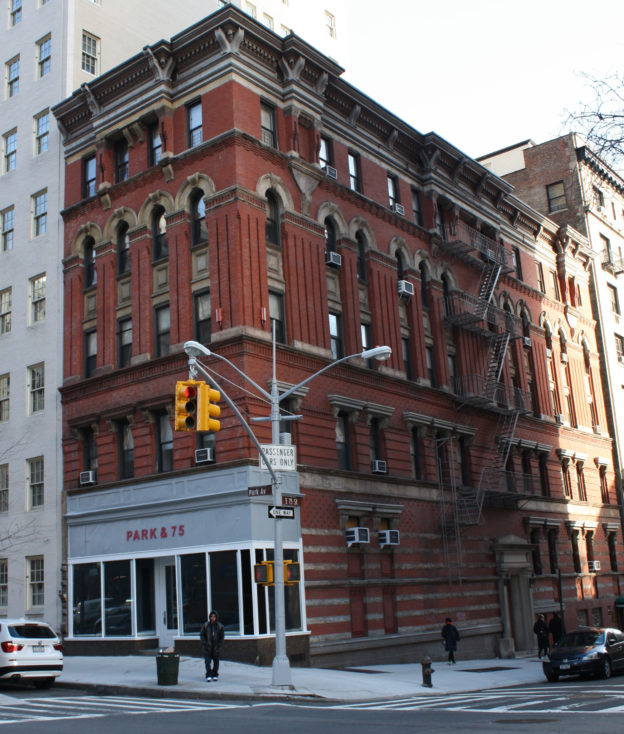
These two, low-scale structures were constructed in 1887 as tenements. 1082 Park Avenue was redesigned in the Mediterranean Revival style with arched window openings and intricate, vibrant terra-cotta ornament. Both have retained their commercial storefronts, which is a rarity for Park Avenue.

1035 Park Avenue, 1040 Park Avenue

Henry C. Pelton, 1925-26 – NYC HD, NR-D;
Delano & Aldrich, 1923-25 – NYC HD, NR-D|

Originally constructed for the Park Avenue Methodist Episcopal Church, 1035 Park Avenue was designed to relate to the adjoining church (now the Park Avenue United Methodist Church), particularly its Venetian arches. Catty-corner to the building is 1040 Park Avenue, whose eclectic ornament includes a frieze with sculpted tortoises and hares. Interestingly, the building does not have a cornice, which is unusual for a Renaissance Revival style building. It did, however, have one of the Avenue’s earliest penthouse apartments, which became fashionable in the 1920s. Though intended as servants’ quarters, the top floor was transformed by famed magazine publisher Condé Nast into a 5,000-square-foot duplex designed by actress and interior decorator Elsie de Wolfe. The building was also briefly home to Jacqueline Kennedy after she left the White House

1020 Park Avenue, 1036 Park Avenue, 1065 Park Avenue

Wechsler & Schimenti, 1963 – NYC HD, NR-D;
Gustave W. Iser, 1956 – NYC HD, NR-D;
Stephen C. Lyras, 1969-73 – NYC HD, NR-D|

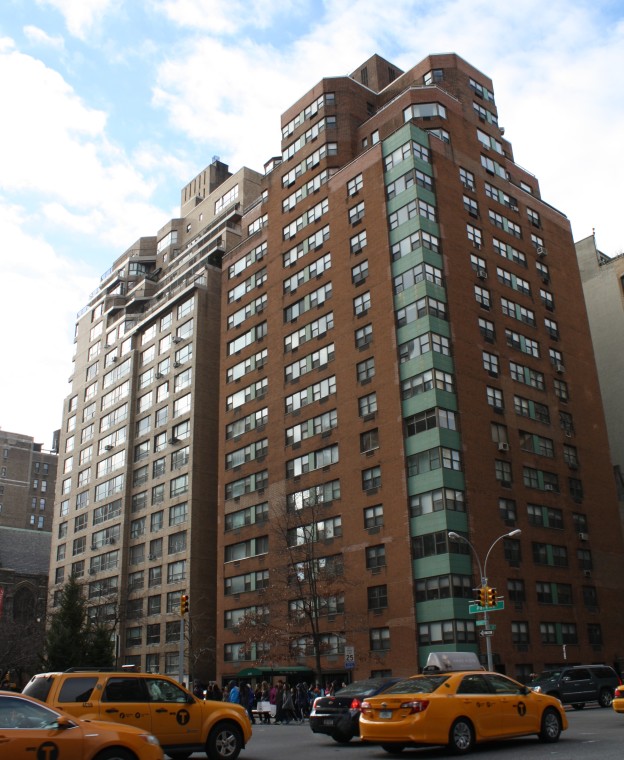
A lull in construction during the Depression and World War II gave way to a building boom in the post-war period, during which these three buildings were constructed. 1020 Park Avenue’s base is clad in travertine marble, a popular material at the time. 1036 Park Avenue features stripes of blue-green ceramic panels on both façades, with wider panels on the corner. Many architects of the Modern era employed color in place of ornament to give buildings depth and character. Both buildings are distinctive for their asymmetrical massing at the top stories, which created private terraces. In 1961, the city passed a zoning code to encourage the construction of free-standing towers. 1065 Park Avenue, which took the place of a tenement, was one of the avenue’s few buildings to be inspired by the “tower in the park” concept. Its 30-story height was achieved by setting the building back and within a small landscaped plaza.

Park Avenue Christian Church, 1000 Park Avenue

Bertram Goodhue of Cram, Goodhue & Ferguson;
1909-11–
NYCHD, NR-D;
Emery Roth;
1915 –
NYC HD, NR-D|

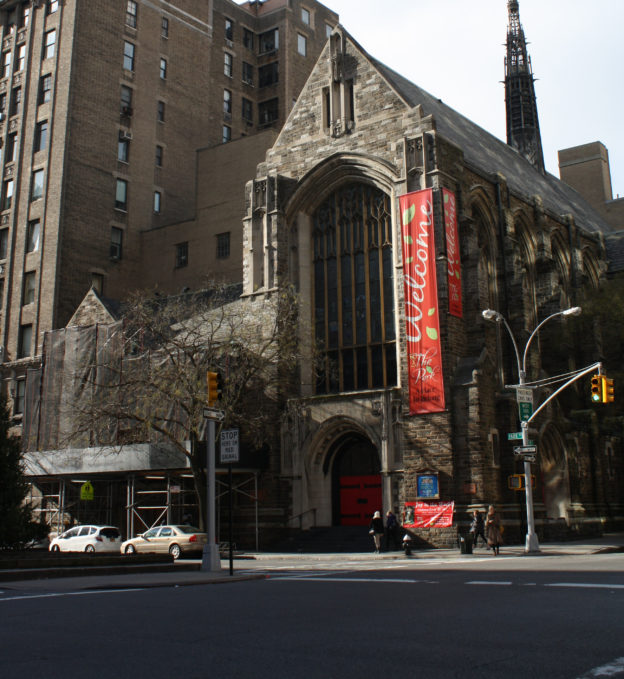
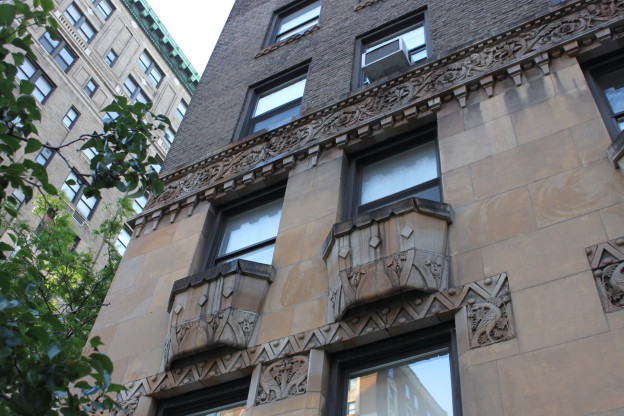
This magnificent French Gothic Revival style church is clad in grey Manhattan schist, and features a pointed arch stained glass window and a 70-foot lead fleche, cast in Birmingham, England, by Henry Hope & Sons to emulate the one at Sainte Chapelle in Paris. Goodhue also designed the adjacent rectory in the same style of the same grey schist. In 2014, controversy over its demolition led to the designation of the Park Avenue Historic District. The Gothic Revival style 1000 Park Avenue was designed to complement the church and rectory, and features intricate details like statuettes of medieval warriors and builders, animal reliefs, coats of arms and foliated moldings. The building is unusual for Emery Roth, who mostly favored the Classical or Art Deco styles.

Lewis G. and Nathalie B. Morris House, Reginald & Anna DeKoven House

1015 Park Avenue;
Ernest Flagg, 1913-14 – NYC HD, NYC IL, NR-P, NR-D ;

1025 Park Avenue John Russell Pope;
1911-12
– NYC HD, NYC IL, NR-D|

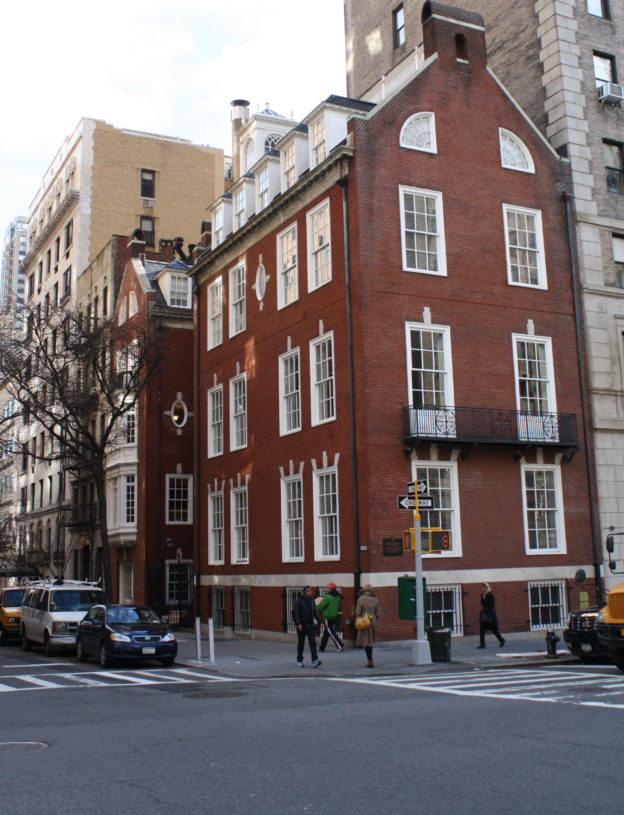
These two townhouses were constructed on property owned by lawyer Amos R. E. Pinchot. In 1910, Pinchot commissioned a grand house for himself at 1021 Park Avenue (demolished 1930), and purchased a considerable amount of property nearby. At the time, little was built this far north, making Pinchot a neighborhood pioneer. Constructed for Lewis Gouverneur and Nathalie Bailey Morris, 1015 Park Avenue is a distinctive neo-Federal mansion that faces East 85th Street. Upon Mr. Morris’ death in 1968, the house became the headquarters of several private charitable foundations. 1025 Park Avenue was built for Reginald DeKoven, a popular composer and music critic. The house was designed in the Jacobean Revival style, a reprise of an English style popular during the Renaissance and named for King James I. The house’s Jacobean features include two prominent bay windows and an arched entrance flanked by columns and pilasters.

Church of St. Ignatius Loyola

980 Park Avenue;
parish hall/rectory: Patrick C. Keely, 1881-83;
church: Schickel & Ditmars, 1895-1900, NYC IL;
school: Schickel & Ditmars, 1899-1900 – NYC HD, NR-P, NR-D|

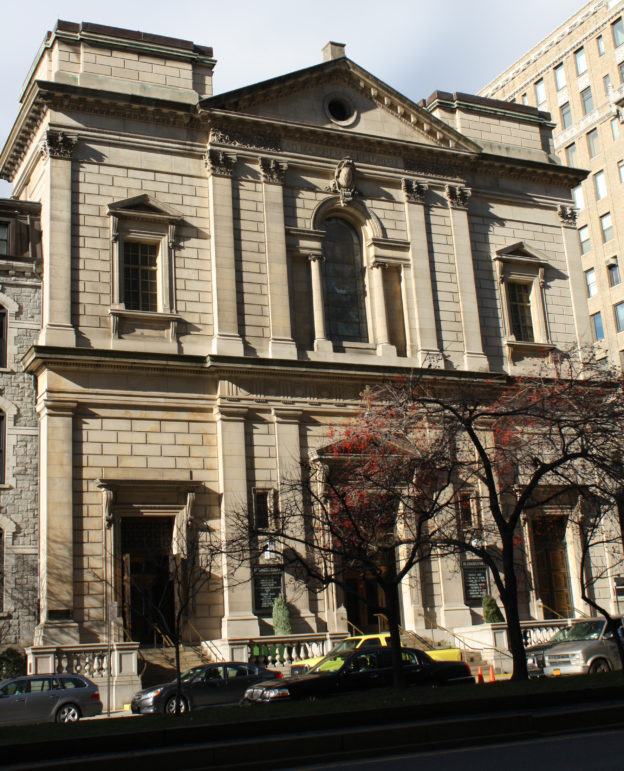
One of the first institutions on Fourth Avenue was the parish of St. Lawrence O’Toole, which initially acquired property on both sides of the railroad tracks at East 84th Street. Its first building was erected in 1854. The parish, later incorporated as St. Ignatius Loyola (founder of the Jesuits in 1541), expanded in the 1880s, beginning with the construction of a four-story parish house and residence hall. The church itself was designed in the Italian Renaissance Revival, in homage to the architecture that was popular during St. Ignatius’ lifetime. It was one of the first houses of worship in the city to use steel roof beams and trusses for fireproofing. Its two upper towers were never realized. In 1899, the Loyola School was established to educate the sons of wealthy Catholics (it became co-educational in 1973), for which the limestone building at the corner of East 83rd Street was built.

949 Park Avenue, 985 Park Avenue, 1055 Park Avenue

C3D Architecture, 2008-11 – NYC HD, NR-D;
Costas Kondylis and Partners, 2005-08 – NYC HD, NR-D;
Kohn, Pedersen, Fox Associates with H. Thomas O’Hara, 2005-09 – NYC HD, NR-D|

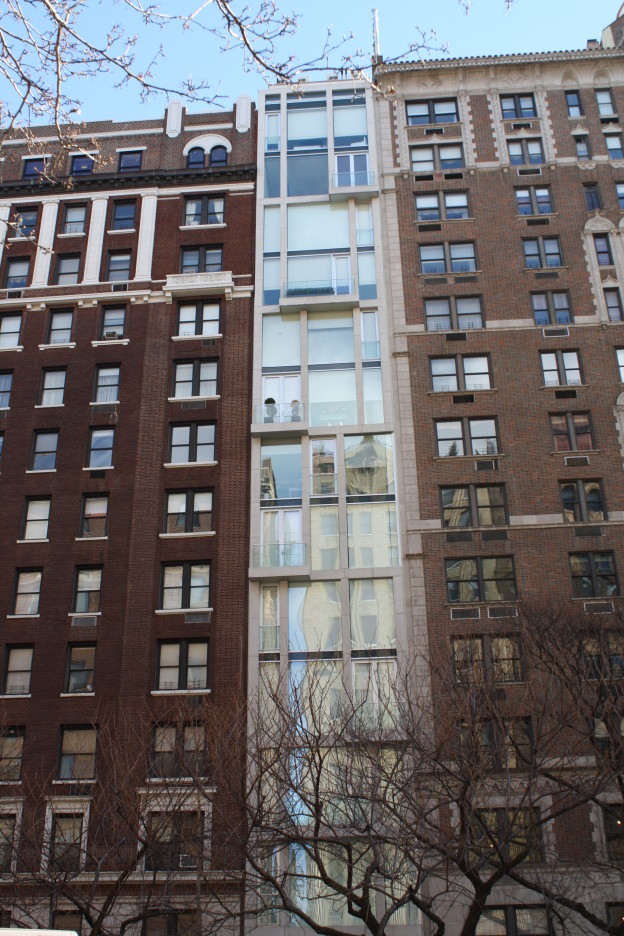
On the east side of Park Avenue, three new apartment buildings were constructed in the late 2000s and early 2010s. Because they were all built on small lots, having replaced low-rise 19th century buildings, they are strikingly similar in their tall and narrow footprints, as well as in their glassy materiality. Another new building, designed by Barry Rice Architects, began construction in 2013 at 1110 Park Avenue. While some find them to be stark intrusions, others believe these buildings represent the latest chapter in the avenue’s history.

940 Park Avenue, 944 Park Avenue

George & Edward Blum, 1925-26 – NYC HD, NR-D;
George F. Pelham, 1929-30 – NYC HD, NR-D|

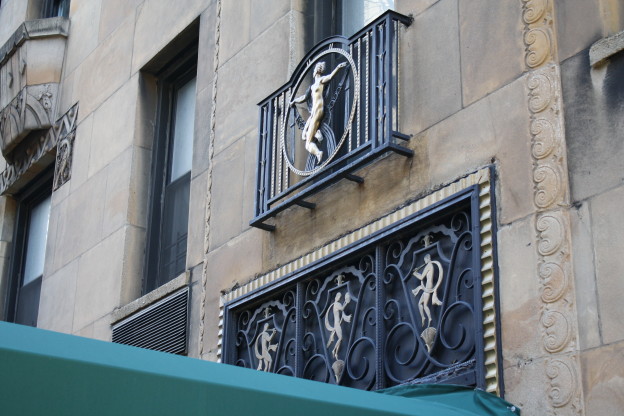
Directly abutting one another are two noteworthy examples of Art Deco style apartment buildings. One of the earliest examples of the style on Park Avenue, 940 features stylized ornament, which is most prominent on the East 81st Street façade. Decorative ironwork motifs include female nudes and children tending gardens. 944 Park Avenue is a bit more restrained, but has stylized pilasters and terra-cotta “frozen fountain” reliefs.

893 Park Avenue, 903 Park Avenue

Sloan & Robertson, 1929 – NYC HD;
Warren & Wetmore and Robert T. Lyons, 1912-13 – NYC HD, NR-D|

Developers Leo and Alexander M. Bing were the most prolific developers on Park Avenue, having constructed at least seven apartment buildings. One of the most notable was the Renaissance Revival style 903 Park Avenue, which, at 210 feet, was considered one of the tallest apartment buildings in the world upon completion. The luxury building was designed with one very large apartment per floor. Across East 79th Street is the striking 893 Park Avenue. Its Art Deco style has some powerful Classical motifs, including monumental fluted pilasters.

890 Park Avenue

James E. Ware;
1884-85 – NYC HD|

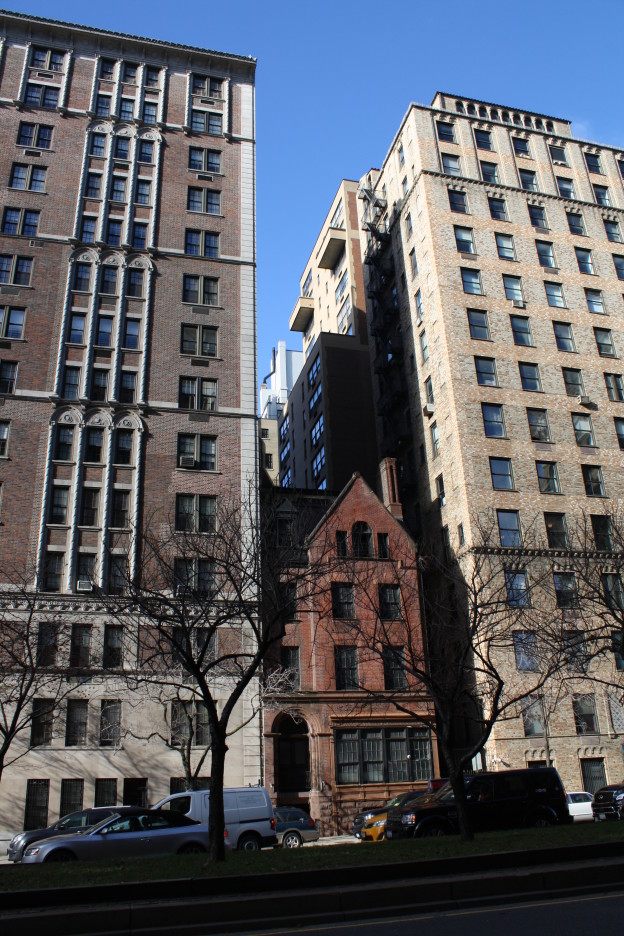
Wedged between two 14-story, 1920s apartment buildings is this five-story rowhouse, which, with its gable roof, pedimented dormer and chimney, appears quaint in comparison. Originally one of a group of rowhouses that wrapped around East 79th Street, this brick and brownstone house’s front stoop was removed in 1929 and its entrance was converted into a round-arch window with columns and a fanlight.

865 Park Avenue, 925 Park Avenue

Pollard & Steinem, 1907-08 – NYC HD;
Delano & Aldrich, 1907-08)– NYC HD, NR-D|

As the first tall apartment buildings to be constructed on Park Avenue, 865 and 925 Park Avenue set the standard for the avenue’s principal building type. Both designed in the Renaissance Revival style, the buildings share similar architectural features, such as rusticated stone bases, buff-colored brick, decorative metalwork and projecting cornices. Their heights, which are also similar (12 stories for 865 Park Avenue and 14 stories for 925 Park Avenue), set the precedent that formed Park Avenue’s now iconic street wall.

821 Park Avenue, 957 Park Avenue

unknown architect, c. 1890 – NYC HD;
John Hauser, 1898-99 – NYC HD, NR-D|

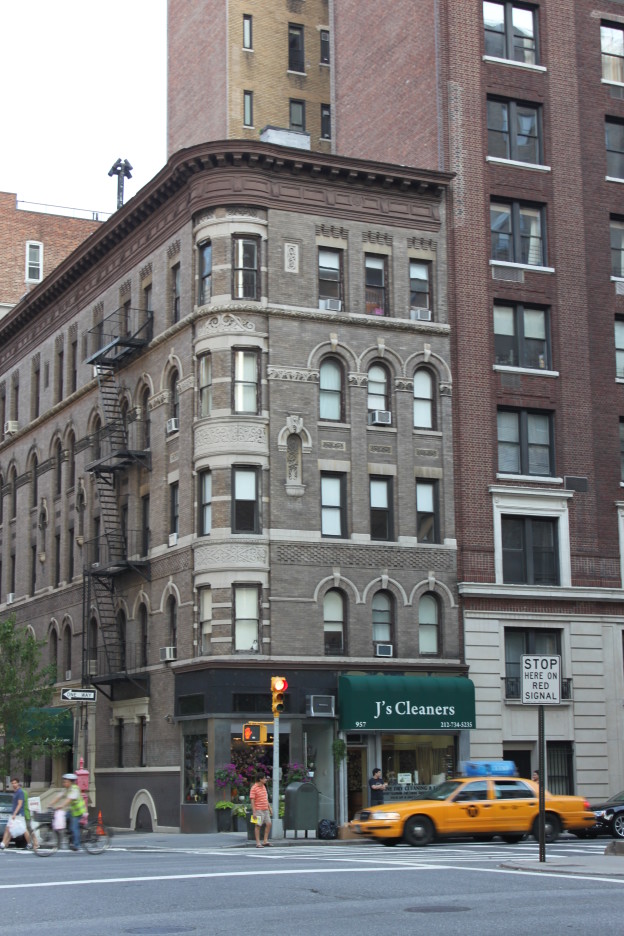
Seven blocks apart, these two corner buildings are two of Park Avenue’s only remaining tenements. They share not only a building type, but a Renaissance Revival architectural vocabulary, which includes rusticated bases, double-height pilasters topped by arched window surrounds and projecting rooftop cornices. 821 Park Avenue had been one of a row of seven called The Terrace. 957 Park Avenue, which originally had a saloon on the ground floor, had been one of four nearly identical tenements with commercial bases.

720 Park Avenue, 730 Park Avenue, 770 Park Avenue, 778 Park Avenue, 784 Park Avenue

Rosario Candela, 1928-29;
Lafayette A. Goldstone, 1928-29;
Rosario Candela, 1929-30;
Rosario Candela, 1929-31;
Emery Roth, 1928-29;
NYC HD|

Along the west side of Park between 70th and 74th Streets is a series of contiguously constructed apartment buildings that feature varied massing and setbacks at their crowns, including elaborate towers and chimneys. 770 Park Avenue even features massive buttresses supporting its central rooftop tower. These five buildings were designed in the Renaissance Revival style, some with Jacobean Revival and neo-Georgian details. The view of this stretch of Park Avenue, either from the south or the north, is quite magnificent.

709 and 711 Park Avenue

Bassett Jones;
1882-85;
NYC HD|

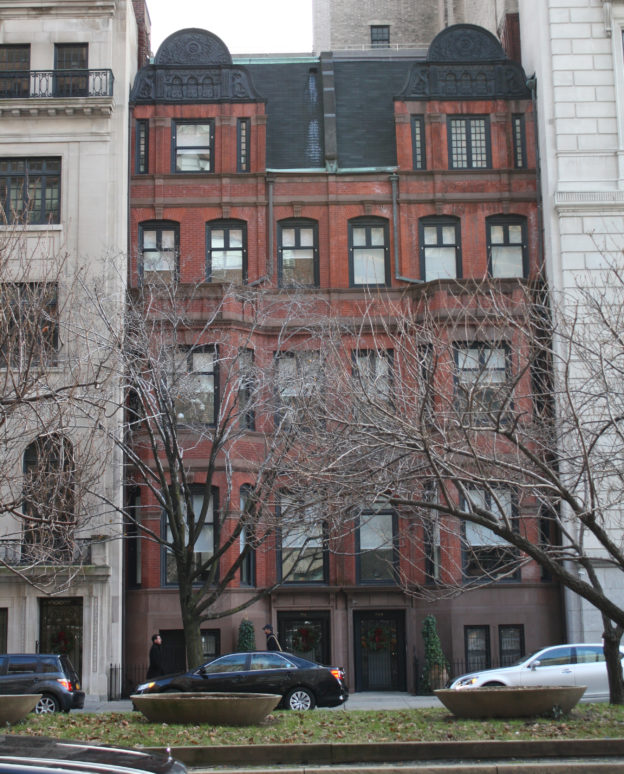
Some of the earliest single-family residences on Park Avenue, these two Queen Anne style rowhouses were once part of a row of ten along the entire blockfront. The most marked feature of the five-story, brick and brownstone houses are their grand arched pediments. The wave-like rhythm of these arches was a distinctive characteristic of this part of Park Avenue when all ten were still standing.

680 Park Avenue, 684 Park Avenue,686 Park Avenue ,690 Park Avenue

McKim, Mead & White, 1909-11;
McKim, Mead & White, 1925-26;
Delano & Aldrich, 1917-19;
Walker & Gillette, 1916;
all: NYC ILs, NR-P|

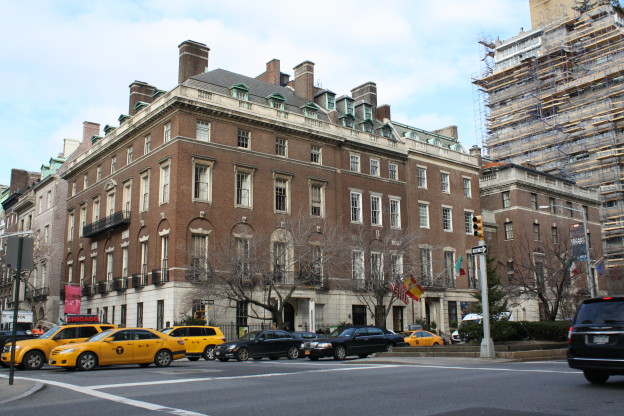
On the west side of Park between East 68th and 69th Streets is an architecturally cohesive group of neo-Federal townhouses, referred to as the Pyne-Davison Row. 680 Park Avenue was built for banker and philanthropist Percy Rivington Pyne. In 1960, Nikita Kruschchev gave a press conference on the balcony when he stayed there during a visit to the United Nations. 684 Park Avenue was built for Percy Pyne’s daughter, Mary, and son-in-law Oliver D. Filley. In December of 1964, before the city passed the Landmarks Law to enable the legal protection of historic buildings, plans were underway to demolish 680 and 684 Park Avenue. A last minute purchase by the Marquesa de Cuevas, the former Margaret Rockefeller Strong, granddaughter of John D. Rockefeller, saved the buildings, along with 49 East 68th Street. The Marquesa donated 680 Park Avenue to the Center for Inter-American Relations (absorbed into the Americas Society in 1985), and sold 684 Park Avenue to the Queen Sofia Spanish Institute, stipulating that changes could not be made to its exterior. The threat to these buildings was one of many that underscored the great need for a law to protect the city’s architectural heritage. 686 Park Avenue was built for William Sloane, president of the home furnishings store W. & J. Sloane. In 1958, it was purchased by the Republic of Italy for its Istituto Italiano di Cultura. 690 Park Avenue was built for banker Henry Pomeroy Davison and his wife Kate Trubee. In 1952, it became the residence of the Consul General of Italy.

Seventh Regiment Armory

643 Park Avenue;
Charles W. Clinton;
1877-79;

NYC HD, NYC IL, NYC INL, NR-P, NHL|

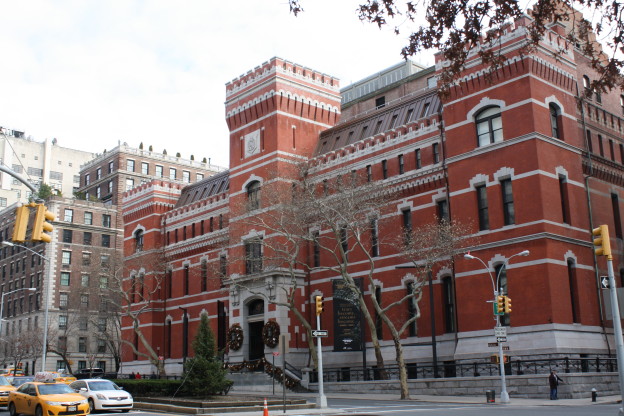
The Seventh Regiment was formed in 1806 from four volunteer militia companies, and served in the War of 1812, the Civil War and both World Wars, as well as aided in subduing numerous civilian disorders. In 1880, after years of using various buildings, its own grand armory, designed in the style of a fortified castle, opened to much fanfare. Often referred to as the “silk stocking regiment,” its members were socially prominent. As such, the building features lavish interiors designed by noted artists and architects, including Louis Comfort Tiffany, Stanford White, the Herter Brothers and Pottier & Stymus, among others. Much of the first and second floor interiors are protected by landmark designation. Because the drill hall was used for maneuvers, the 55,000-square-foot space required very high ceilings. Normally used for train sheds, enormous iron trusses span the enclosure to support the roof. It remains one of the largest unobstructed spaces in the city, and has been used for a variety of functions. From 1900 to 1963, the National Indoor Tennis Championships were held here, and since 1902, the Knickerbocker Greys, a junior cadet corps for school boys, has used the space for drills. In 2006, the Park Avenue Armory Conservancy took over the building with a mission to restore its historic spaces and transform it into a world-class venue for the performing and visual arts.

600 Park Avenue, 601 Park Avenue

James Gamble Rogers, 1910-11 – NYC HD;
Walter Lund & Julius F. Gayler, 1919-20 – NYC HD|

Across the street from one another are two grand mansions. 600 Park Avenue was built for businessman Jonathan Bulkley and his wife Sarah Tod. After their deaths in 1939 and 1943, the Renaissance Revival mansion sat empty until 1946, when the Swedish Government purchased it as its Consul General’s residence. In 2009, the house became the residence of the Swedish Ambassador to the United Nations. 601 Park Avenue, a neo-Federal mansion with 100 feet of Park Avenue frontage, was built for sugar wholesaler Thomas A. Howell. A long, half-elliptical stair hall occupies the center of the house and all of its rooms face the avenue. Interestingly, this house was left on the market for almost two decades, unable to find a buyer from 1989 to 2008.

Third Church of Christ Scientist, Central Presbyterian Church, 580 Park Avenue

583 Park Avenue, Delano & Aldrich, 1922-24– NYC HD;
593 Park Avenue, Henry C. Pelton and Allen & Collens, 1920-22 – NYC HD;
J. E. R. Carpenter, 1923 – NYC HD|

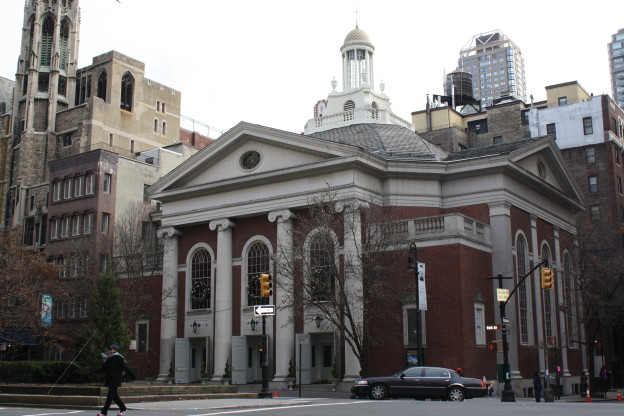
Two contiguously constructed churches stand on this block. The Third Church of Christ Scientist is a lovely example of the neo-Georgian style, its red brick façades graced with a grand columned portico and its central dome crowned by a balustrade and cupola. In 2006, the pews were removed from the interior so the space could also be used for events. The construction of the Central Presbyterian Church building was partly funded by the Rockefellers. Its Gothic Revival style is evidenced by its rough granite cladding, a large pointed arch window and intricately carved octagonal tower. Across the street, note the stylized colonnade formed by a series of pilasters at the base of 580 Park Avenue, which occupies the entire blockfront.

Colony Club, Union Club of the City of New York

564 Park Avenue;
Delano & Aldrich, 1914-16 – NYC HD;

701 Park Avenue;
Delano & Aldrich, 1930-31 – NYC HD|

Park Avenue has two of the city’s early private clubhouses, both designed by Delano & Aldrich. The Colony Club, which still operates, was the first women’s group in the city to erect a clubhouse, though this neo-Georgian building is the club’s second home. Its first home at 129 Madison Avenue is an Individual Landmark. The Union Club was established in 1836, making it the oldest private club in the city and the third oldest in the country. This Renaissance Revival structure is its sixth home, which includes card and backgammon rooms and squash courts.

Park Avenue Malls

Park Avenue’s iconic malls were born in the mid-1870s, when the railroad vents were covered with shrubs and surrounded by simple iron fences. In 1894, residents formed the Park Avenue Association, which, by the 1920s, had the vents fully covered over. Private donations in 1929 and 1931 led to the planting of roughly 7,000 trees from 34th to 96th Streets. Another private donation in 1946 introduced flowering varieties. In 1969-70, the malls and fences were redesigned by Clara Coffey. The Park Avenue Malls Planting Project Committee formed in 1980 to establish and maintain a uniform planting plan. Today, planting, maintenance and the annual holiday tree lighting (since 1945), is funded and performed by the Carnegie Hill Neighbors and the Fund for Park Avenue.

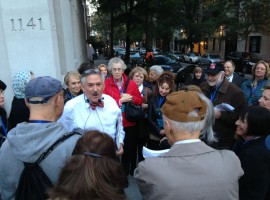
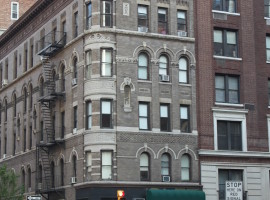
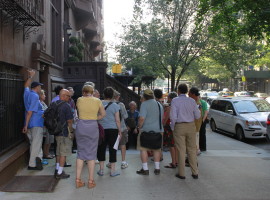
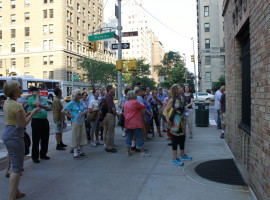
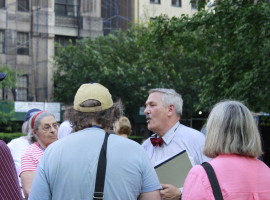
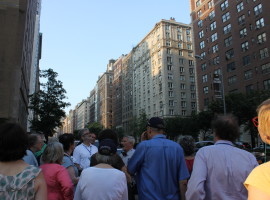
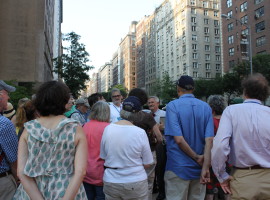
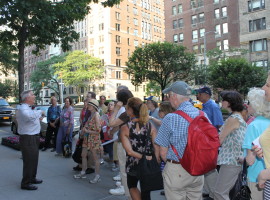
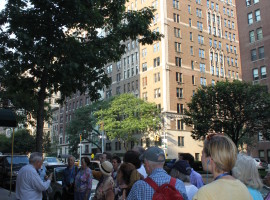
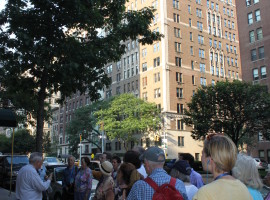
Park Avenue, Manhattan October Tour Pictures

Park Avenue, Manhattan
Monday, October 6, 6:00PM (Walking Tour)

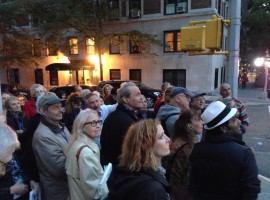
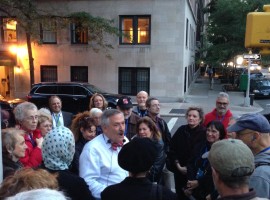
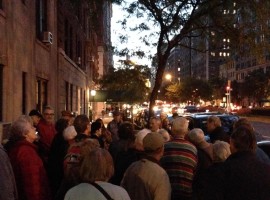
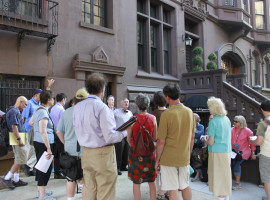
The June 17 Six to Celebrate tour of the newly designated Park Avenue Historic District quickly sold out and was extremely well received. As such, Urban Historian Justin Ferate conducted a second tour – beginning at Park Avenue at 91st Street and traveling south along the avenue. The upper segment of the new district boasts of elegant apartment houses by such impressive architects as J.E.R. Carpenter, George & Edward Blum, Mott B. Schmidt, Emery Roth, Mills & Bottomley, and others. In addition, we viewed religious structures by some of America’s noteworthy ecclesiastical design firms: Patrick C. Keely, Cram, Goodhue & Ferguson, and Schickel & Ditmars.

Park Avenue, Manhattan – Walking Tour

Monday, October 6, 6:00PM (Walking Tour)

The June 17 Six to Celebrate tour of the newly designated Park Avenue Historic District quickly sold out and was extremely well received. As such, Urban Historian Justin Ferate will conduct a second tour – beginning at Park Avenue at 91st Street and traveling south along the avenue.  The upper segment of the new district boasts of elegant apartment houses by such impressive architects as J.E.R. Carpenter, George & Edward Blum, Mott B. Schmidt, Emery Roth, Mills & Bottomley, and others. In addition, we’ll view religious structures by some of America’s noteworthy ecclesiastical design firms:  Patrick C. Keely, Cram, Goodhue & Ferguson, and Schickel & Ditmars.

Join us on this walking tour of New York City’s premier historic boulevard. Learn more about the histories of these remarkable architectural treasures and the effort to protect Park Avenue’s historical and architectural significance for future generations.

To Register For The Tour Click Here 

Six To Celebrate Tours- Park Avenue, Manhattan-Pictures

Park Avenue, Manhattan
Tuesday, June 17, 2014 (WALKING TOUR)

After a years-long preservation campaign by a coalition of residents, activists and community groups, 2014 is Park Avenue’s year! In February, the Landmarks Preservation Commission held an important Historic District hearing to landmark Park Avenue’s unprotected blocks, and in April, the Commission voted to landmark the district! The City Planning Commission will vote next week and City Council is expected to vote in the coming months. Tour guide Justin Ferate led this walking tour of New York City’s premier historic boulevard and explained about the effort to protect Park Avenue’s historical and architectural significance.

Park Avenue Designated!!

On April 29th the Landmarks Preservation Commission designated the Park Avenue Historic District!! The district extends from the northeast corner of 79th Street to the south side of 91st Street, and contains approximately 64 buildings. Park Avenue was named one of HDCs Six to Celebrate groups in 2014. We have been working closely with many groups to advocate for the protection of Park Avenue for years. We testified in favor of the designation at the February 11, 2014 hearing.

“Historic buildings on this iconic avenue date from 1856 into the mid-20th century in an impressive array of 19th-century rowhouses and flats buildings, grand mansions, impressive institutional buildings, and distinctive 20th-century apartment buildings. In just a few blocks, the history of the growth of Park Avenue and Carnegie Hill is told by this important collection of buildings. The architecture is equal to that already designated on the Upper East Side, and many of the same notable architects, including Emery Roth, Rosario Candela, and Delano & Aldrich, designed structures both within and outside of the existing district boundaries. When combined with unique layout of Park Avenue and its planted malls, these buildings create the “special sense of place” the New York City Landmarks Law uses to describe historic districts.”
To read our full testimony click here .

To read the Designation Report and view the boundary map click here

Six to Celebrate Tours 2014

Meeting Location Information Will Be Sent To Those Who Have Registered A Week Prior To The Tour 

 ——————————————————————————————————

Atlantic AvenueAtlantic Avenue, Brooklyn
Saturday, June 14, 11:00AM (WALKING TOUR)
SOLD OUT !!
View Pictures of the Tour
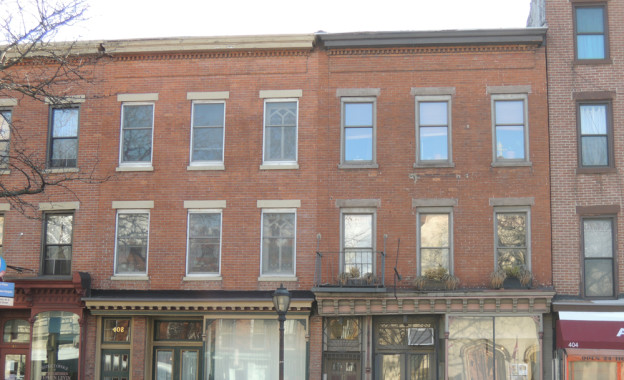
A commercial thoroughfare for more than one hundred years, Atlantic Avenue is a diverse retail and dining destination connecting the historic neighborhoods of Boerum Hill, Brooklyn Heights and Cobble Hill. Join us as tour guide Joe Svehlak leads this walking tour between 4th Avenue and Hicks Street, discussing Atlantic Avenue’s architecture, social and commercial history, as well as areas that have been more recently redeveloped.


Forest Close, QueensForest Close
Saturday, June 7, 11:00AM (WALKING TOUR)
SOLD OUT !!
View Pictures of the Tour
Led by architectural historian Barry Lewis, this walking tour will cover some of the highlights of Forest Hills, one of the city’s most beautiful suburban-style communities developed in the early 20th century. Featured on the tour is Forest Close, a nook of 38 neo-Tudor houses surrounding a communal garden. Designed in 1927 in the spirit of the garden city movement, Forest Close can be described as an enclave within an enclave, its private orientation and country-inspired architecture lending charming appeal.


Park AvenuePark Avenue, Manhattan
Tuesday, June 17, 6:00PM (WALKING TOUR)
SOLD OUT !!
View Pictures of the Tours
After a years-long preservation campaign by a coalition of residents, activists and community groups, 2014 is Park Avenue’s year! In February, the Landmarks Preservation Commission held an important Historic District hearing to landmark Park Avenue’s unprotected blocks, and in April, the Commission voted to landmark the district! Votes by the City Planning Commission and City Council are expected in the coming months. Join tour guide Justin Ferate on this walking tour of New York City’s premier historic boulevard and learn more about the effort to protect Park Avenue’s historical and architectural significance.


From Yiddish to Chinese and Beyond: A Walking Tour of Historic Libraries in ChinatownSeward Park Branch, exterior, west façade, 2010 (HDC)
Thursday, July 10, 6:00 PM (WALKING TOUR)

View Pictures of the Tour 
Visit two of the busiest Carnegie libraries in the New York Public Library system as well as other sites of interest between and near them, including one of the oldest graveyards in New York, Al Smith’s childhood home, and Knickerbocker Village, a forerunner of later urban renewal projects. The tour, led by John Bacon, HDC board member and Director of Planned Giving at The New York Public Library, will start at the McKim, Mead and White-designed Chatham Square Library and conclude at the Seward Park Library, which became a New York City landmark in 2013.


Madison Square North, ManhattanMadison Square North
Sunday, September 14, 11:00AM (WALKING TOUR)

SOLD OUT !!
View Pictures of the Tour 

This architecturally diverse neighborhood includes pre-Civil War rowhouses, late 19th century hotels, early 20th century loft and commercial structures, and the remaining buildings of the famous Tin Pan Alley. To better reflect the neighborhood’s boundaries, local residents and advocates have submitted a Request for Evaluation to the Landmarks Preservation Commission to expand the Madison Square North Historic District. Join us as HDC Board member and Madison Square North expert Marissa Marvelli leads a walking tour of this fascinating neighborhood.


Staten Island CemeteryStaten Island’s Historic Cemeteries
Saturday, September 27, 11:00AM (TROLLEY TOUR)

SOLD OUT !!
View Pictures of the Tour 

Celebrate Halloween early with a visit to Staten Island’s historic places of memory and rest. Led by Lynn Rogers, executive director of the Friends of Abandoned Cemeteries of Staten Island, this trolley tour will explore three cemeteries dating to the early 19th century. Stops will include the Marine Hospital/Quarantine Station Cemetery, where thousands of Irish Famine Immigrants were reinterred in April 2014; the Staten Island/Fountain Cemetery & Native American Burial Ground, a haunted site and the city’s largest abandoned cemetery (8 acres); and Lake Cemetery, a working class cemetery where many Civil War and WWI Veterans were buried.


Park Avenue, Manhattan
Monday, October 6, 6:00PM (Walking Tour)

SOLD OUT !!
View Pictures of the Tour 

The June 17 Six to Celebrate tour of the newly designated Park Avenue Historic District quickly sold park avenue tour out and was extremely well received. As such, Urban Historian Justin Ferate will conduct a second tour – beginning at Park Avenue at 91st Street and traveling south along the avenue. The upper segment of the new district boasts of elegant apartment houses by such impressive architects as J.E.R. Carpenter, George & Edward Blum, Mott B. Schmidt, Emery Roth, Mills & Bottomley, and others. In addition, we’ll view religious structures by some of America’s noteworthy ecclesiastical design firms: Patrick C. Keely, Cram, Goodhue & Ferguson, and Schickel & Ditmars.

Join us on this walking tour of New York City’s premier historic boulevard. Learn more about the histories of these remarkable architectural treasures and the effort to protect Park Avenue’s historical and architectural significance for future generations.

A Tale of Three Carnegies: A Tour of Historic Libraries in Harlem and the South Bronx
Saturday, October 18, 2:00PM (WALKING TOUR)

SOLD OUT !!

cornershot

Following the July tour of Carnegie libraries in Chinatown, John Bacon, HDC board member and Director of Planned Giving at The New York Public Library, will return to lead another tour of Carnegie libraries in Harlem and Mott Haven. In Harlem, we will visit the 115th Street and Harlem Libraries, and view the impressive Mount Morris Historic District in between. Bring your Metrocard, as we will then hop on the subway to the South Bronx to visit the beautiful Mott Haven Library and take in its notable children’s floor.