Archives

Historic Public Libraries, New York City

The New York Public Library (NYPL) was formed in 1895 with the consolidation of three private corporations: the Astor Library (founded by John Jacob Astor in 1849), the Lenox Library (founded by James Lenox in 1870) and The Tilden Trust (a fund established in 1886 by Samuel J. Tilden). The NYFCL also joined this consolidation in 1901 in order to benefit from Carnegie’s gift of $5.2 million for 67 library branches to be built between 1901 and 1929 (56 are still standing). Carnegie’s only stipulation was that the city acquire the sites and establish building maintenance plans. To design the buildings, the NYPL organized a committee of architects: Charles F. McKim, Walter Cook and John M. Carrère. In order to stylistically link the branches and save money, the committee decided on a uniform scale, interior layout, character and materials palette for the buildings.

To read more about New York City’s Historic Public Libraries click here

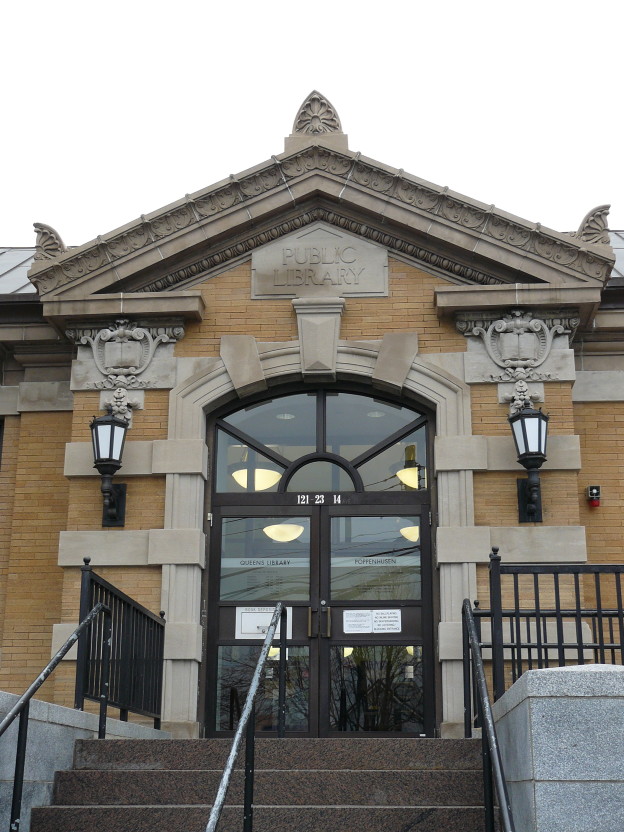
Poppenhusen Branch, QBPL, Queens

121-23 14th Avenue;
Heins & La Farge, 1904;
NYC IL|

The only Carnegie-funded library to be designed by the noted firm of Heins & La Farge, this building resembles those contemporaneously designed by the firm for the Bronx Zoo’s Astor Court. The firm was also responsible for a number of the city’s subway stations and for early designs of the Cathedral of St. John the Divine. The citizens of College Point donated the land for the library and the books were donated by the Poppenhusen Institute, founded in 1868 by German-American businessman Conrad Poppenhusen as a kindergarten and community center. The stipulation of the institute’s gift was that the library would bear its name. The Classical Revival style library is clad in yellow Roman brick with limestone trim, and features a projecting entrance bay with stone banding and a broken pediment above the arched doorway, an ornate cornice with stone shells and two stone cartouches with reliefs of open books. A rear addition was constructed in 1937. The Poppenhusen Branch was designated a New York City Individual Landmark in 2000

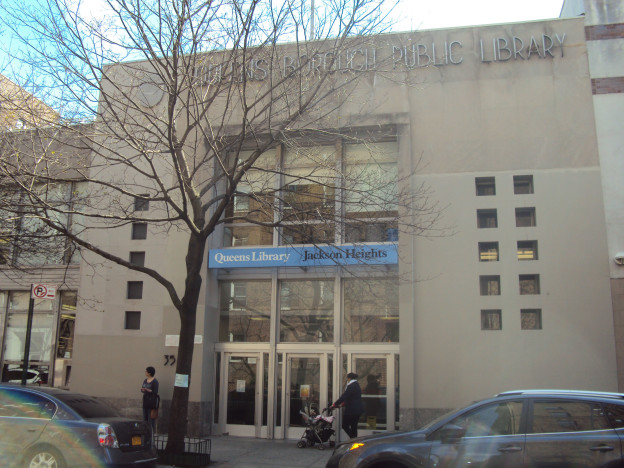
Jackson Heights Branch, QBPL, Queens

35-51 81st Street;
S. Keller, 1949-52;
NYC HD|

A relative latecomer amongst the early 20th century garden apartment buildings and homes that characterize the Jackson Heights Historic District, the Jackson Heights Branch was constructed just after World War II. The building is an excellent example of the International Style with its simple, asymmetrical and unornamented facade. The cast stone and glass building with a flat roof occupies a large midblock site. The box-shaped entryway includes a recessed bay made up of three glass and aluminum doors with transoms and windows rising to the second floor. On either side of the entrance bay are two vertical rows of small square window openings, which provide some of the only ornament on the façade. Above the entrance, the raised metal letters and numbers identifying the library still retain their mid-century typeface. The Jackson Heights branch is located in the Jackson Heights Historic District.

Flushing Branch, QBPL, Queens

41-17 Main Street;
Polshek Partnership, 1998|

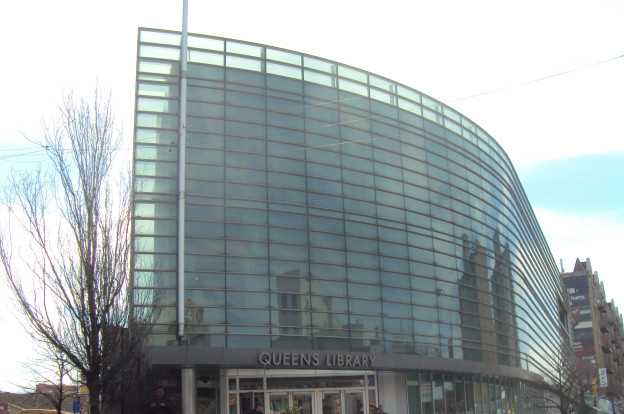
The Flushing Branch of the QBPL was Queens’ first public library. Established as the Flushing Library Association in 1858 and open to members as a subscription library, it became a free circulating library in 1869. In 1906, a Carnegie-funded structure designed by Lord & Hewlett in the Georgian Revival style replaced the wood frame building on this site. The Carnegie building was demolished in the mid-1950s and replaced with a Modern style building, completed in 1957. In 1993, that building was demolished to make way for the branch’s latest phase, a sweeping glass and steel structure completed in 1998.

Central Library, QBPL, Queens

89-11 Merrick Boulevard;
Kiff, Colean, Voss & Souder, the Office of York & Sawyer, 1966;

renovation: Gensler, 2013;
Children’s Library Discovery Center: 1100 Architect and Lee H. Skolnick Architecture and Design Partnership,; 2011|

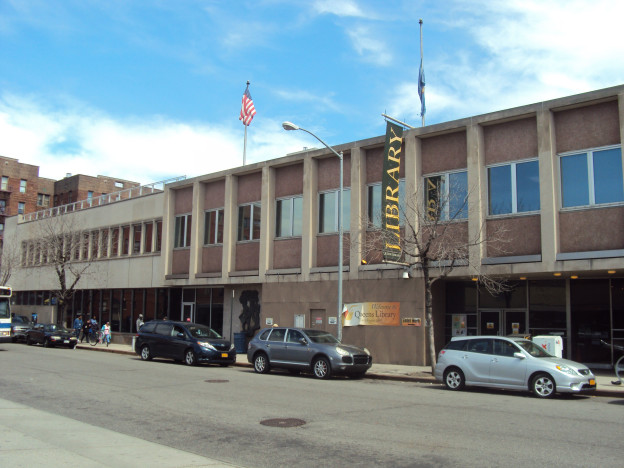
In the early 1960s, when an expansion of the four-story, Georgian Revival style Central Library at 89-14 Parsons Boulevard was deemed necessary, an entirely new building was planned instead. The old building, completed in 1931, was repurposed as a courthouse, and has since been replaced by a large apartment building. Located six blocks to the east, the new Central Library was lauded for its functional and streamlined approach to book circulation, with supermarket-like checkout counters and conveyor belts and electric dumbwaiters for book returns. The library includes a large collection on the history of Queens and Long Island. Its simple exterior features two wall-mounted reliefs by sculptor Milton Hebald. In 2011, the Children’s Library Discovery Center wing was added on 90th Avenue, and in 2013, renovations to the main building, including glass at the recessed entryway, were completed.

Brownsville Branch, BPL and Stone Avenue Branch, BPL, Brooklyn

61 Glenmore Avenue Lord & Hewlett, 1908;
581 Mother Gaston Boulevard William B. Tubby, 1914;
NYC IL|

The simple, free-standing Brownsville Branch, today flanked by high-rise public housing, was once bounded by single-family residences. Before it opened, the neighborhood was growing so dramatically that the building had to be enlarged before it was completed. Due to overwhelming demand by local children, another site just six blocks to the south was purchased at Stone (now Mother Gaston Boulevard) and Dumont Avenues for the Brownsville Children’s Library. Stylistically divergent from the other Carnegie libraries, the Brownsville Children’s Library was designed in the Jacobethan style, rendering it a sort of hybrid between library and fairytale castle. It is said to be one of the world’s first public libraries devoted to children. The exterior features stone carvings depicting characters and scenes from children’s literature, while the interior embraces a child-appropriate scale and features beloved details, like rabbits carved into the wooden benches. After World War II, the library opened to all age groups, renaming itself the Stone Avenue Branch. The Stone Avenue branch was designated a New York City Individual Landmark in April 2015.

Park Slope Branch, BPL, Brooklyn

431 Sixth Avenue;
Raymond F. Almirall, 1905-06;
NYC IL|

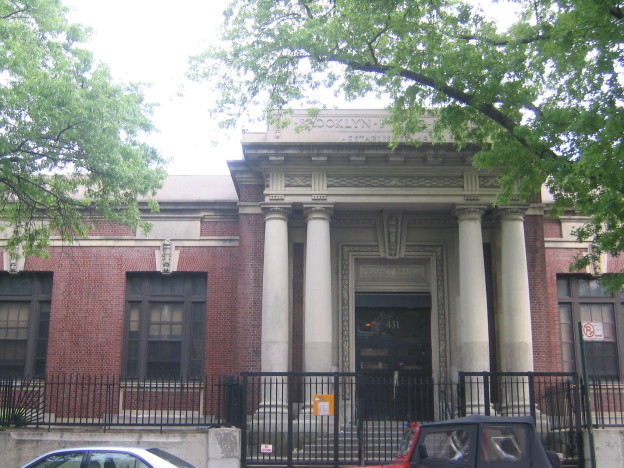
This library was originally the Prospect Branch, housed beginning in 1900 in Prospect Park’s Litchfield Villa and consisting solely of books related to natural history. As Park Slope’s population grew, the demand for a larger, all-purpose library led to its relocation in 1901 to several storefronts on 9th Street between 5th and 6th Avenues. By 1904, the city purchased a large site and began planning for a new Carnegie-funded building. Its name was changed to Park Slope in 1975. The Classical Revival style, brick-clad building with limestone trim features an imposing, projecting portico entrance with Doric columns and a stone pediment. Like those found on the Pacific Branch, the torches in the keystones above the entrance and windows represent the light of learning. Its intact interior features stained glass, tiled fireplaces, wood paneling and marble mosaic floors. The Park Slope branch was designated in 1998.

Pacific Branch, BPL, Brooklyn

25 Fourth Avenue;
Raymond F. Almirall, 1903|

Brooklyn’s first Carnegie library, the Pacific Branch (named for its location at Pacific Street) was heralded upon completion for its dignified Beaux Arts design. The interior of the building, which has retained its original two-story stacks, was also praised for its light, air and efficient use of space. The building’s brick façades feature prominent limestone trim, including keystones above the arched door and window openings and oversized torches and swags supporting the cornice. The building has had a difficult history, including early damage in 1914 during the construction of the nearby subway, as well as a number of fires. Murals completed in 1939 by the Works Progress Administration graced the second floor for a number of years, but are no longer extant. Despite widespread support, the branch is not a designated city landmark. In 2013, it was under threat of being sold to a developer, but public outcry and political pressure led the BPL to reconsider these plans.

Central Building, BPL, Brooklyn

Grand Army Plaza at Flatbush Avenue and Eastern Parkway;
Alfred Morton Githens & Francis Keally, 1941;
sculptural elements:
Thomas Hudson Jones and C. Paul Jennewein;
NYC IL, NR-P|

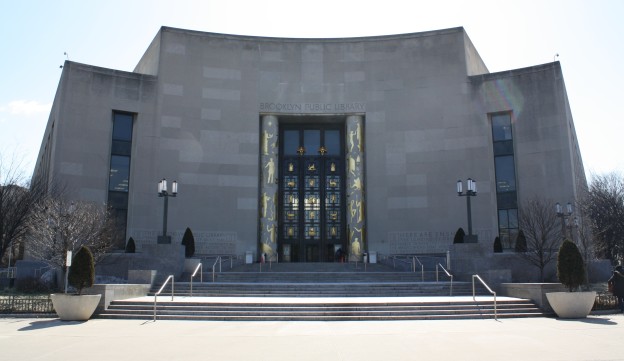
The original 1907 design for the BPL’s Central Building was the work of Raymond F. Almirall, the architect of the Pacific, Park Slope, Bushwick and Eastern Parkway Branches. The grand Beaux Arts design, inspired by contemporary libraries in Europe, with a domed roof and colonnaded entrance, was meant to fit in stylistically with the nearby Brooklyn Museum and Soldiers’ and Sailors’ Arch. Though construction began in 1911, the project was beset with political and financial troubles and stalled in 1929. In 1935, architects Alfred Morton Githens and Francis Keally were commissioned to redesign the building, incorporating the completed foundations and steel structure. The resulting Modern Classical, limestone-clad building features a concave front façade with a 50-foot-tall entrance portico and striking sculpted Art Deco ornamentation. It is one of Brooklyn’s most well-known and frequently used public buildings. The Central Building was designated a New York City Individual Landmark in 1997 and is listed on the State and National Register of Historic Places.

Tottenville Branch, NYPL, Staten Island

7448 Brighton Street;
Carrè
re & Hastings, 1904;
NYC IL|

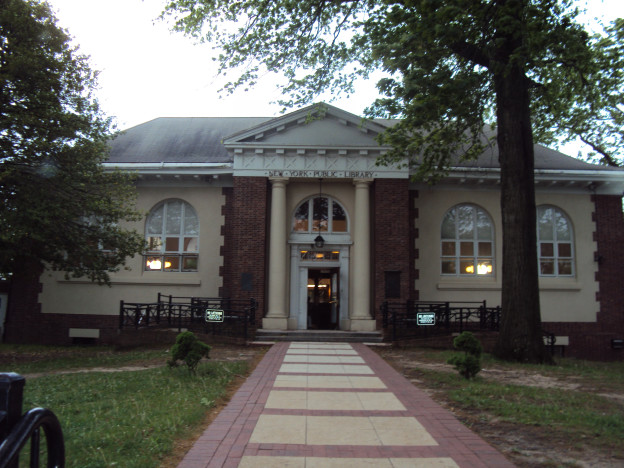
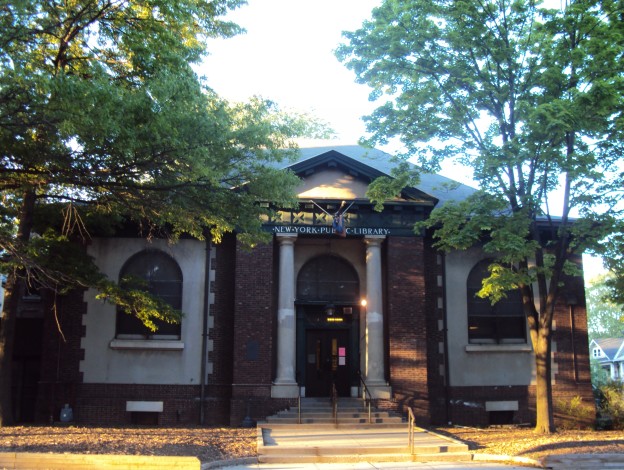
In 1899, the Tottenville Library Association established the Tottenville Free Library, Staten Island’s first free public library with a dedicated space and professional staff. In 1903, the association merged with the NYPL and its collection was moved to the new Carnegie-funded branch – also Staten Island’s first – completed the following year. Tottenville, which had grown immensely over the 19th century due to thriving coastal industries, was the first community city-wide to submit an application for a Carnegie-funded branch when the program was announced in 1901. The resulting one-story, brick structure is Classical Revival in style, with a central, columned entrance portico capped by a triangular pediment, as well as a flared, hipped roof and arched windows. The building’s stucco and wood trim lends a rustic quality that differs from some other Carnegie branches, but was intended to relate to its bucolic context and the village-like character of Tottenville. The Tottenville Branch was designated a New York City Individual Landmark in 1995.

Stapleton Branch, NYPL, Staten Island

132 Canal Street;
Carrè
re & Hastings, 1907;
renovation: Andrew Berman,; 2010-13|

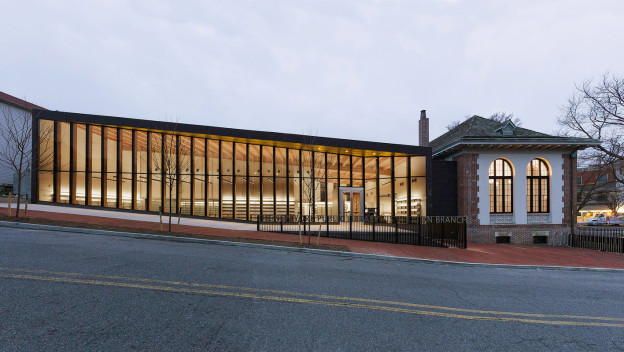
The Classical Revival design of the original Stapleton Branch is nearly identical to the Port Richmond Branch, which opened two years before. Like Port Richmond, it is also situated across from a public park. However, a 2013 rear addition introduced another phase to the building’s story and physical footprint, setting it apart from its brother in Port Richmond. The addition reoriented the library, decommissioning the original entrance on Canal Street in favor of a new entrance via the addition on Wright Street. The addition, which is not visible when viewing the 1907 building from the front, consists of wood structural posts with applied glazing, as well as a wood roof deck. The addition more than doubled the size of the branch.

Port Richmond Branch, NYPL, Staten Island

75 Bennett Street;
Carrè
re & Hastings,1904-05;
NYC IL|

The first libraries on Staten Island were found within institutions and public schools as early as the 1830s, as a result of the influence of New England settlers. Prior to the establishment of branch libraries on Staten Island, public reading rooms began to operate in the mid-19th century. With the Carnegie grant, the NYPL established four branches on Staten Island, enlisting the help of residents to determine the best locations for each. The sites were chosen based on the borough’s concentrations of population and geographic diversity. Port Richmond has been a major port and commercial center on Staten Island since the early 19th century, and this library, situated across from a public park, has been an important civic structure since its completion. Its Classical Revival style façades feature a prominent, projecting central entrance bay with a grand, columned portico. The Port Richmond branch was designated a New York City Individual Landmark in 1998.

Morrisania Branch, NYPL, The Bronx

610 East 169th Street;
Babb, Cook & Willard, 1908;
NYC IL|

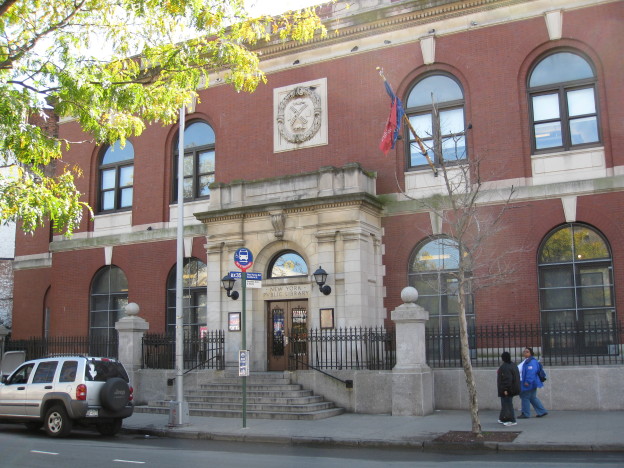
Originally the McKinley Square Branch, the Morrisania community advocated strongly for a Carnegie library in their neighborhood, with over 1,500 petition signatures sent to the NYPL’s site committee. Their successful effort resulted in the construction of this freestanding, Classical Revival style building. The T-shaped building’s main façade is flanked by lower, recessed, two-story wings. Its design features include arched windows and a projecting stone portico entrance, above which is a large, carved stone seal of the City of New York. The Morrisania Branch was designated a New York City Individual Landmark in 1998.

Hunts Point Branch, NYPL, The Bronx

877 Southern Boulevard;
Carrère & Hastings, 1929;
NYC IL|

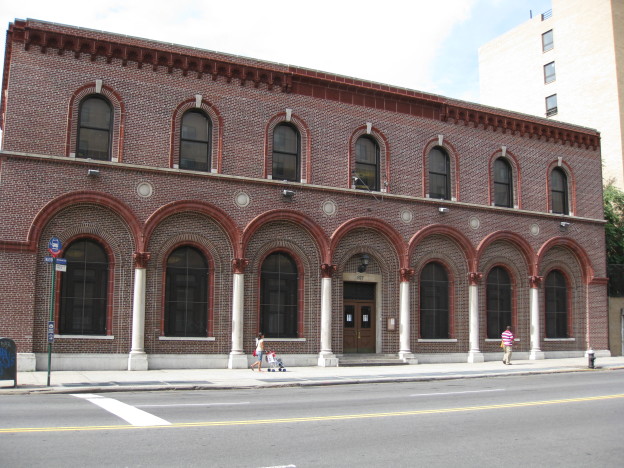
The Hunts Point Branch bears the distinction of being the very last of the Carnegie-funded NYPL branches to be built, and was among the 14 Carnegie-funded branches to be designed by Carrère & Hastings. The two-story, palazzo-inspired structure was designed in the Italian Renaissance Revival style with a blind arcade at the base and arched windows throughout. Its brick façades are accented with ornate terra-cotta details and stone trim. At the time of its construction, automobiles had become a common mode of transportation, so the facility also includes a one-story garage on its west side. The garage housed the Bronx Book Wagon, which served the community from 1928 (a year before the library opened) until the 1980s. Hunts Point was designated a New York City Individual Landmark in 2009.

Mott Haven Branch, NYPL, The Bronx

321 East 140th Street;
Babb, Cook & Willard, 1905;
NYC HD, NR-D|

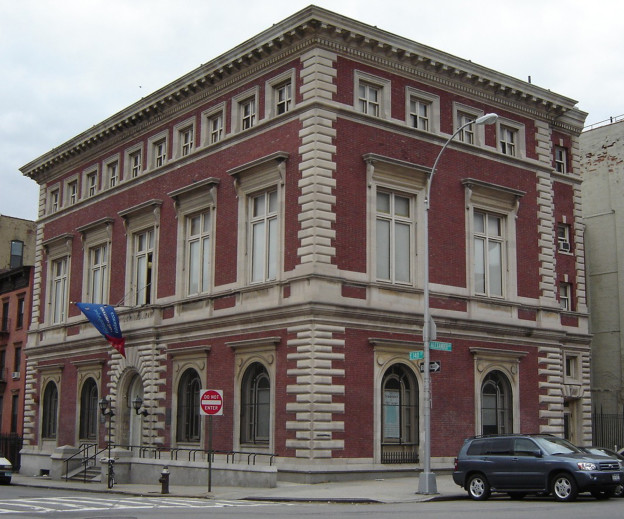
The Mott Haven Branch was the first NYPL building to be constructed in The Bronx. The building’s strong, Classical Revival style design was the work of Babb, Cook & Willard, the same firm responsible for Andrew Carnegie’s own mansion on Fifth Avenue and East 91st Street. Its three-story, brick façades are marked by prominent limestone quoins at the corners and around the entrance. The building is within the Mott Haven Historic District, an oasis of historic architecture, a small-scale residential enclave surrounded by tall mid-century housing projects. The historic district was designated in 1967, making it one of the city’s first. The library is located in the Mott Haven Historic District and a National Register of Historic Places District.

Schomburg Collection for Research in Black Culture, NYPL, Manhattan

103 West 135th Street: Charles F. McKim and William Kendall, McKim, Mead & White, 1904-05 – NYC IL;
104 West 136th Street: Louis Allen Abramson, 1941-42;
515 Malcolm X Boulevard: Bond Ryder & Associates, 1969-80, renovation: Dattner Architects, ;2007|

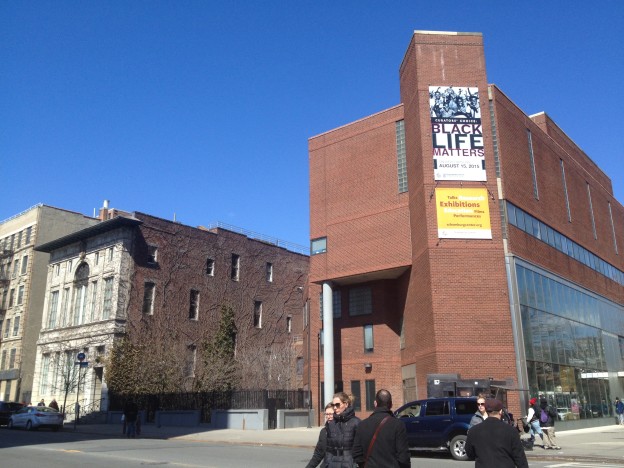
Originally the West 135th Street Branch of the NYPL, this library grew exponentially over the 20th century to encompass a complex of buildings housing the prestigious Schomburg Collection for Research in Black Culture. The original building was one of 11 Carnegie-funded branches designed by the firm of McKim, Mead & White. All that remains of the building, which was designed in the firm’s characteristic Italian Renaissance Revival style, is its West 135th Street façade. During the 1920s Harlem Renaissance, the library became an important center for black cultural events and scholarship. This was due to the pioneering work of Branch Librarian Ernestine Rose, who began compiling a collection of black literature and history books beginning in the 1920s. As a result of this growing and influential collection, the library was renamed the 135th Street Branch Division of Negro Literature, History and Prints in 1925, and the following year, the NYPL increased it with the acquisition of historian, writer, and activist Arturo Alfonso Schomburg’s famous private collection. With its continued expansion, a new wing was added to the rear of the building on West 136th Street in 1941. With this addition, the library, which had doubled in size, was renamed the Countee Cullen Branch. In 1972 the collection was renamed the Schomburg Center for Research in Black Culture. In 1980, a new building was constructed at 515 Malcolm X Boulevard. The complex now represents three distinct eras for this venerable institution. 103 West 135th Street is a New York City Individual Landmark.

NYPL for the Performing Arts, Dorothy and Lewis B. Cullman Center and Claire Tow Theater, Manhattan

40 Lincoln Center Plaza;
Eero Saarinen and Gordon Bunshaft, 1965; renovation: Polshek Partnership, 1999-2001;

Claire Tow Theater: Hugh Hardy, 2012|

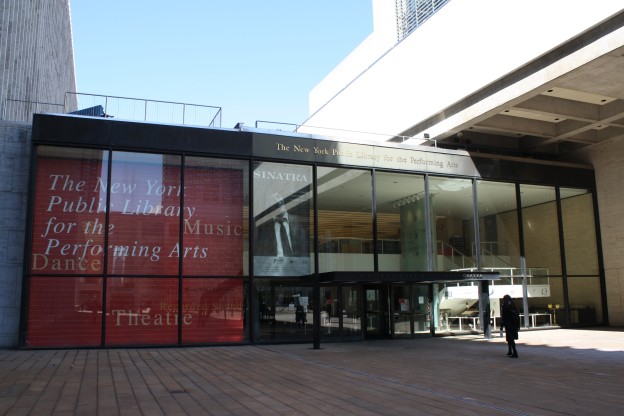
Both a research and circulating library, this formidable library is adjacent to the Metropolitan Opera House and shares a building with the Vivian Beaumont Theater. In fact, its stacks, which hold one of the largest collections of performing arts materials in the world, wrap around the theater flyspace and its public rooms are to the side and rear of the theater. Before the library was conceived as part of the plans for Lincoln Center, performing arts research materials were housed at the Main Branch and the circulating music collection was located at the 58th Street Library. The exterior of the glass and travertine building was the work of Eero Saarinen, while the interior was designed by Gordon Bunshaft of Skidmore, Owings and Merrill. In 2001, a major reconfiguration of the 1960s design was undertaken, notably the consolidation of smaller reading rooms into one skylit reading room on the third floor and improved exhibition galleries, as well as rewiring the building for computers and internet access. In 2012, the two-story, 23,000-square-foot Claire Tow Theater was constructed on the building’s roof.

Jefferson Market Branch, NYPL, Manhattan

425 Sixth Avenue;
Frederick Clarke Withers of Vaux and Withers, 1874-77; renovation: Giorgio Cavaglieri, 1967;
NYC HD, NR-P, NHL|

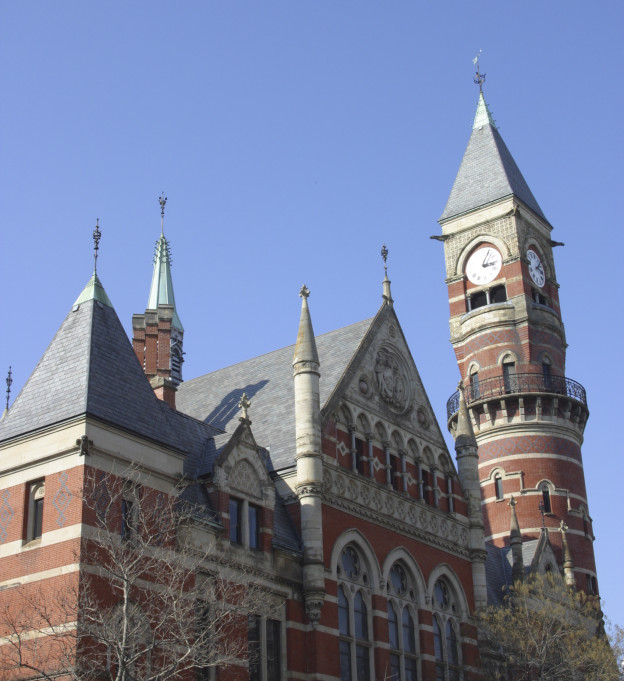
In the 1830s, this small, triangular block became the heart of Greenwich Village when Jefferson Market was built here. In addition to the market, the block also had a small Police Court, prison and watchtower. In the 1870s and 80s, the block was renewed with a picturesque complex of buildings designed by the firm of Vaux and Withers, including the Third Judicial District Courthouse. This magnificent building, designed in the High Victorian Gothic style, is the only remnant of that complex. It features a rich, polychrome palette of materials with bandcourses, Gothic arches, stained glass windows, turrets, a large gable and variegated roof slates. The City seal is found on its Sixth Avenue façade. The crowning achievement is a prominent corner tower, whose top was designed as a fire lookout with an alarm bell and large clock faces to serve the community. When the building ceased to function as a courthouse in 1945, it briefly served as a Police Academy. The building was threatened with demolition in the late 1950s, but public outcry led to its conversion to a branch of the NYPL, one of the first adaptive reuse projects in the country. In 1996, after 135 years of silence, a campaign to reinstate the ringing of the fire bell was successful, and it has rung the hours from 9:00am to 10:00pm ever since.The library is located within the Greenwich Village Historic District, is listed on the State and National Register of Historic Places and is a National Historic Landmark.

Yorkville Branch, NYPL, Manhattan

222 East 79th Street ;
James Brown Lord, 1902; renovation: Gwathmey Siegel & Associates 1986;

NYC IL, NR-P|

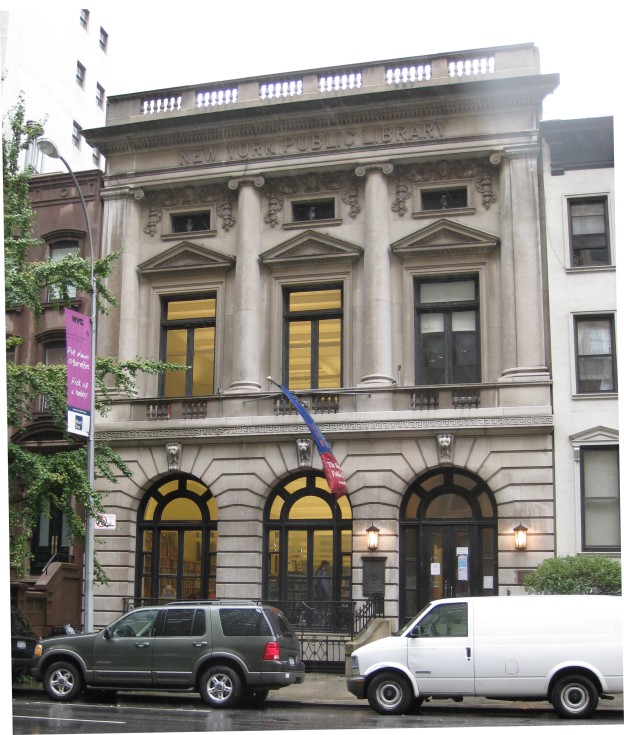
The very first of the Carnegie-funded branches of the NYPL, the Yorkville Branch officially opened in December of 1902. The three-story building has a limestone facade, divided into three bays with elegant arched windows on the main floor and Ionic columns on the second. At the turn of the century, Yorkville was a densely populated German immigrant neighborhood, and as such, the third floor of the original building housed only German language publications. At the end of World War I, Thomas Masaryk used the Yorkville library to conduct the research that led to his founding of the Czechoslovakian state. The library’s interior was renovated in the late 1980s with funds donated by the Rose family. Once again the place of a pioneering event, the renovation was the first time a branch library was overhauled using private resources. The current library occupies two floors within the original ornate Palladian-inspired façade. The building was designated a landmark in 1967, only two years after the enactment of the New York City Landmarks Law. The library is an New York City Individual Landmark and listed on the New York City and State National Register of Historic Places.

Main Branch, NYPL, Manhattan

Fifth Avenue at 42nd Street (Carrère & Hastings, 1901-11, master plan and restoration: Davis ;Brody Bond, 1980-2000; South Court addition: Davis Brody Bond, 2000-02; Children’s ;Center at 42nd Street: Gensler Architects, 2008);
NYC IL, NYC INL, NHL|

The NYPL’s Main Branch is one of the city’s most important civic monuments and most impressive works of architecture. Along with Bryant Park, it is located on the site of the old Croton Distributing Reservoir, once the city’s main source of fresh water. The reservoir’s 50-foot high, 25-foot thick walls were demolished in the 1890s, just as plans were underway for a new central library. Some of the reservoir’s foundations can still be found in the library’s South Court. In 2000-02, a new wing was added to this part of the building and the architects intentionally exposed the foundation wall as a record of the site’s history. Situated on the eastern end of two city blocks, the library’s marble façades and lavish interiors are a masterpiece of the Beaux-Arts style. The firm of Carrère & Hastings, fairly unknown at the time, was chosen to design the building. Their success led to commissions for 14 Carnegie-funded branches across the city, more than any other firm.

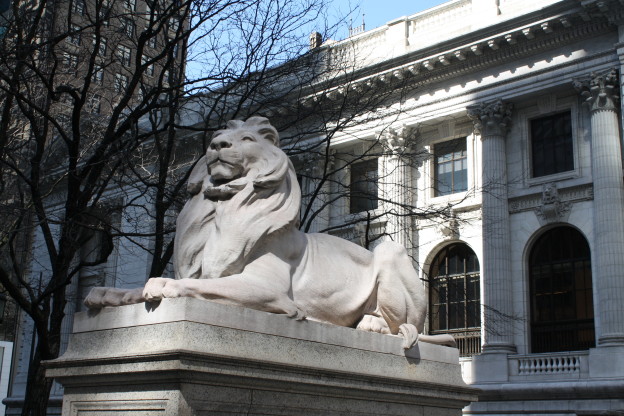
The building’s front is set back from Fifth Avenue by a grand staircase and terrace that give the façade added grandeur and perspective. The terrace’s two famous lion statues were sculpted by Edward Clark Potter and were originally named “Leo Astor” and “Leo Lenox” after the library’s founders. During the Great Depression, Mayor Fiorello LaGuardia nicknamed them “Patience” and “Fortitude.” The main entrance is housed within a triple-arched portico supported by coupled Corinthian columns. The rear, or west façade, expresses and honors the function of the building. Its series of full-height, vertical rows of windows both represent and give light to the seven floors of book stacks within. The steel stacks once held 88 miles of books, which have since been moved offsite. However, the stacks also function as structural support for the building, providing a powerful symbolism to the building’s construction. On all four façades, pedimented pavilions lend visual interest and elegance. When it was completed in 1911, the library bore the distinction of being the largest marble structure in the United States. Formerly known as the Humanities and Social Sciences Library and the Center for Humanities, the building was renamed the Stephen A. Schwarzman Building in 2008 to honor a major gift to the institution.

The library functions as a reference, rather than a circulating library, and, as such, includes magnificent interior reading rooms, including the Rose Main Reading Room. This grand space, with arched windows and a fresco ceiling, is one of the most revered interior public spaces in Manhattan. In the 1980s, the institution undertook a major restoration of many of the library’s interior spaces and added two levels of stacks beneath Bryant Park. At that time, the library collection had outgrown the building, necessitating the park’s excavation. In 2012, library officials announced the Central Library Plan, which would close two nearby circulating branches and consolidate their functions within the main building. This plan was met with widespread public opposition due in large part to its plan to demolish the stacks to make room for a circulating library. The plan was abandoned in 2014.The library is an New York City Individual and Interior Landmark, and a National Historic Landmark.

Ottendorfer Library, NYPL, Manhattan

135 Second Avenue;
William Schickel;
1883-84;
NYC IL, NYC INL, NR-P|

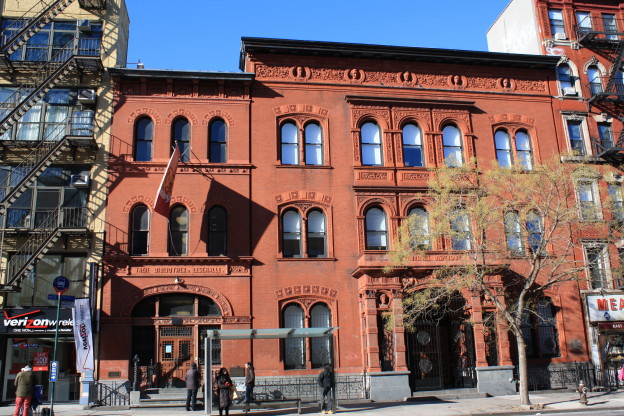
In the 1840s, the East Village (then part of the Lower East Side) became known as “Kleindeutschland” (Little Germany) for its large population of German immigrants. This building was the first branch of the New York Free Circulating Library, donated by German-American philanthropists Anna and Oswald Ottendorfer. The Ottendorfer Library, along with the adjacent German Dispensary (later renamed the Stuyvesant Polyclinic), was intended to uplift the minds and bodies of the Ottendorfers’ fellow German-Americans. Half of the library’s initial 8,000 volumes were in German, and much of its staff spoke German. In addition to its historical significance to the city’s library system, the library, as well as the adjacent dispensary, is also architecturally magnificent. The buildings include Italian Renaissance Revival and Queen Anne-style details, with red brick, terra-cotta trim, arched windows and symbolic ornament: urns and books on the library and busts of famous physicians and scientists on the dispensary. The library is an New York City Individual and Interior Landmark, and listed on the New York City and State National Register of Historic Places.

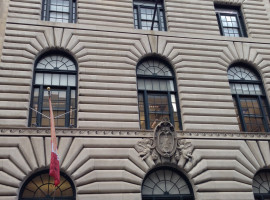
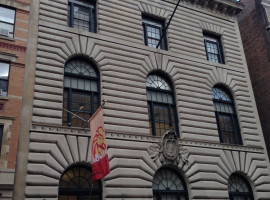
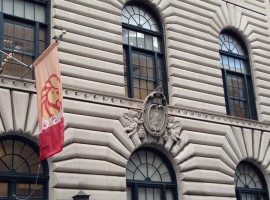
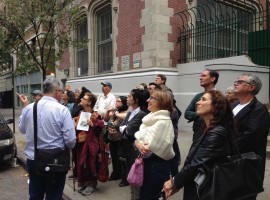
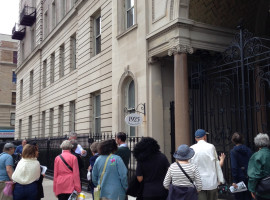
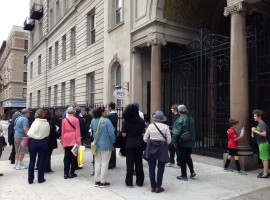
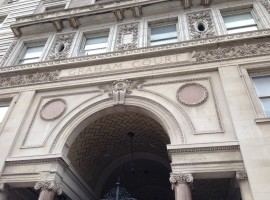
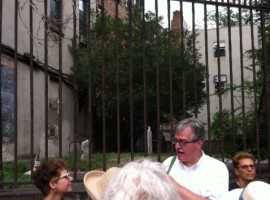
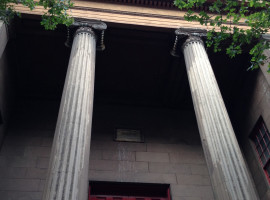
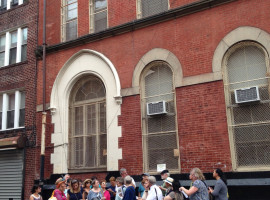
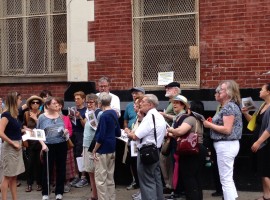
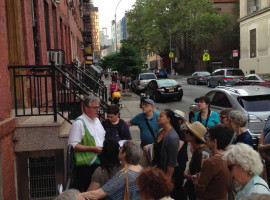
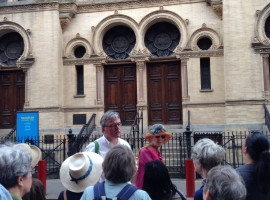
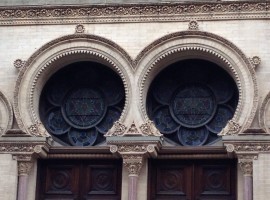
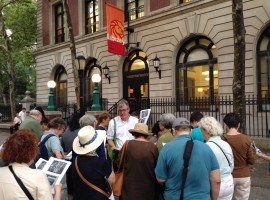
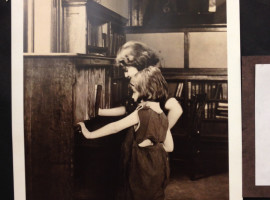
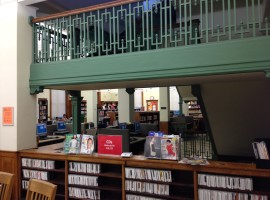
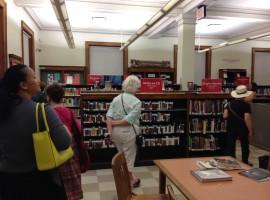
A Tale of Three Carnegies: A Tour of Historic Libraries in Harlem and the South Bronx- Pictures

Saturday, October 18, 2014 (WALKING TOUR)

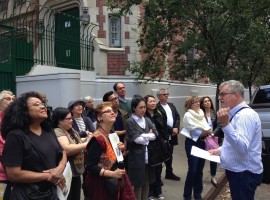
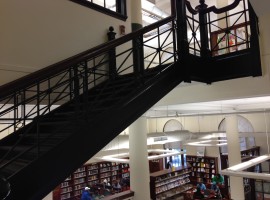
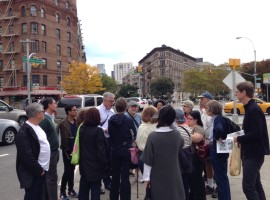
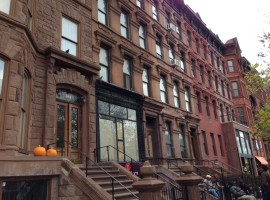
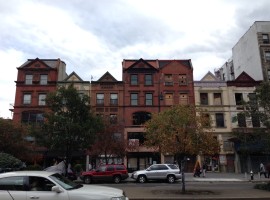
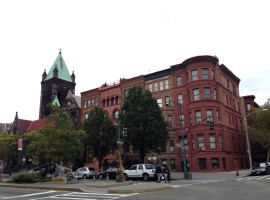
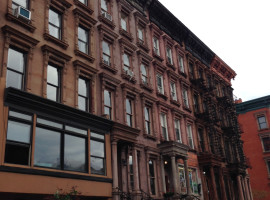
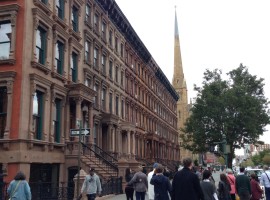
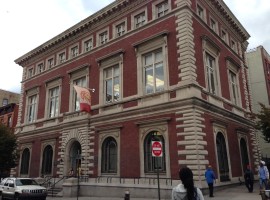
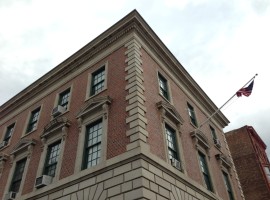
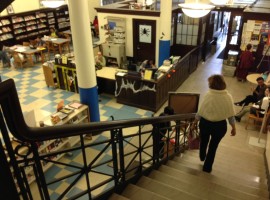
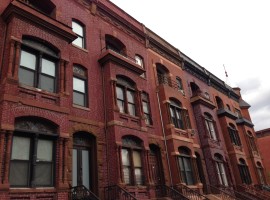
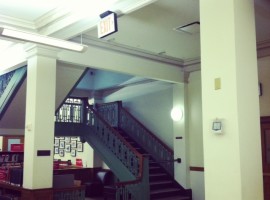
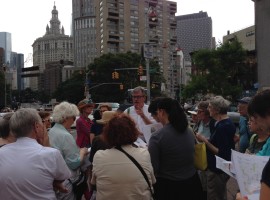
Following the July tour of Carnegie libraries in Chinatown, John Bacon, HDC board member and Director of Planned Giving at The New York Public Library, lead another tour of Carnegie libraries in Harlem and Mott Haven. In Harlem, we visited the 115th Street and Harlem Libraries, and viewed the impressive Mount Morris Historic District in between. The tour then traveled to the South Bronx to visit the beautiful Mott Haven Library and take in its notable children’s floor.

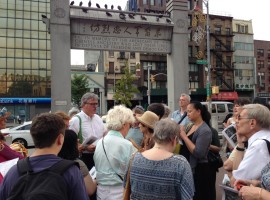
A Walking Tour of Historic Libraries in Chinatown- Pictures

Thursday, July 10, 2014

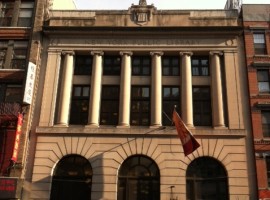
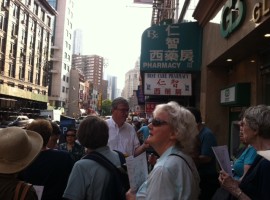
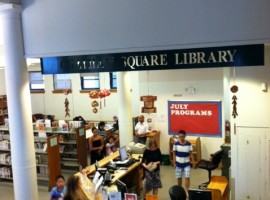
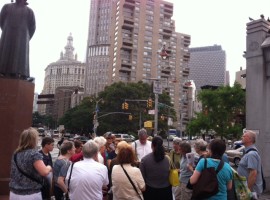
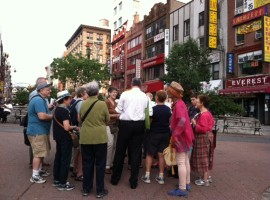
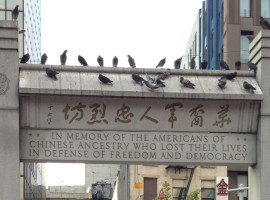
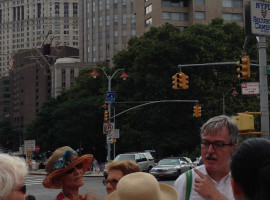
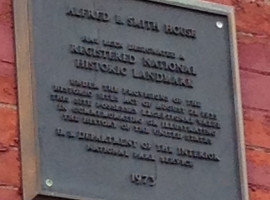
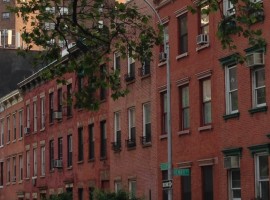
The tour went to two of the busiest Carnegie libraries in the New York Public Library system as well as other sites of interest between and near them, including one of the oldest graveyards in New York, Al Smith’s childhood home, and Knickerbocker Village, a forerunner of later urban renewal projects. The tour, was led by John Bacon, HDC board member and Director of Planned Giving at The New York Public Library, it started at the McKim, Mead and White-designed Chatham Square Library and concluded at the Seward Park Library, which became a New York City landmark in 2013.

Six to Celebrate Tours 2014

Meeting Location Information Will Be Sent To Those Who Have Registered A Week Prior To The Tour 

 ——————————————————————————————————

Atlantic AvenueAtlantic Avenue, Brooklyn
Saturday, June 14, 11:00AM (WALKING TOUR)
SOLD OUT !!
View Pictures of the Tour
A commercial thoroughfare for more than one hundred years, Atlantic Avenue is a diverse retail and dining destination connecting the historic neighborhoods of Boerum Hill, Brooklyn Heights and Cobble Hill. Join us as tour guide Joe Svehlak leads this walking tour between 4th Avenue and Hicks Street, discussing Atlantic Avenue’s architecture, social and commercial history, as well as areas that have been more recently redeveloped.


Forest Close, QueensForest Close
Saturday, June 7, 11:00AM (WALKING TOUR)
SOLD OUT !!
View Pictures of the Tour
Led by architectural historian Barry Lewis, this walking tour will cover some of the highlights of Forest Hills, one of the city’s most beautiful suburban-style communities developed in the early 20th century. Featured on the tour is Forest Close, a nook of 38 neo-Tudor houses surrounding a communal garden. Designed in 1927 in the spirit of the garden city movement, Forest Close can be described as an enclave within an enclave, its private orientation and country-inspired architecture lending charming appeal.


Park AvenuePark Avenue, Manhattan
Tuesday, June 17, 6:00PM (WALKING TOUR)
SOLD OUT !!
View Pictures of the Tours
After a years-long preservation campaign by a coalition of residents, activists and community groups, 2014 is Park Avenue’s year! In February, the Landmarks Preservation Commission held an important Historic District hearing to landmark Park Avenue’s unprotected blocks, and in April, the Commission voted to landmark the district! Votes by the City Planning Commission and City Council are expected in the coming months. Join tour guide Justin Ferate on this walking tour of New York City’s premier historic boulevard and learn more about the effort to protect Park Avenue’s historical and architectural significance.


From Yiddish to Chinese and Beyond: A Walking Tour of Historic Libraries in ChinatownSeward Park Branch, exterior, west façade, 2010 (HDC)
Thursday, July 10, 6:00 PM (WALKING TOUR)

View Pictures of the Tour 
Visit two of the busiest Carnegie libraries in the New York Public Library system as well as other sites of interest between and near them, including one of the oldest graveyards in New York, Al Smith’s childhood home, and Knickerbocker Village, a forerunner of later urban renewal projects. The tour, led by John Bacon, HDC board member and Director of Planned Giving at The New York Public Library, will start at the McKim, Mead and White-designed Chatham Square Library and conclude at the Seward Park Library, which became a New York City landmark in 2013.


Madison Square North, ManhattanMadison Square North
Sunday, September 14, 11:00AM (WALKING TOUR)

SOLD OUT !!
View Pictures of the Tour 

This architecturally diverse neighborhood includes pre-Civil War rowhouses, late 19th century hotels, early 20th century loft and commercial structures, and the remaining buildings of the famous Tin Pan Alley. To better reflect the neighborhood’s boundaries, local residents and advocates have submitted a Request for Evaluation to the Landmarks Preservation Commission to expand the Madison Square North Historic District. Join us as HDC Board member and Madison Square North expert Marissa Marvelli leads a walking tour of this fascinating neighborhood.


Staten Island CemeteryStaten Island’s Historic Cemeteries
Saturday, September 27, 11:00AM (TROLLEY TOUR)

SOLD OUT !!
View Pictures of the Tour 

Celebrate Halloween early with a visit to Staten Island’s historic places of memory and rest. Led by Lynn Rogers, executive director of the Friends of Abandoned Cemeteries of Staten Island, this trolley tour will explore three cemeteries dating to the early 19th century. Stops will include the Marine Hospital/Quarantine Station Cemetery, where thousands of Irish Famine Immigrants were reinterred in April 2014; the Staten Island/Fountain Cemetery & Native American Burial Ground, a haunted site and the city’s largest abandoned cemetery (8 acres); and Lake Cemetery, a working class cemetery where many Civil War and WWI Veterans were buried.


Park Avenue, Manhattan
Monday, October 6, 6:00PM (Walking Tour)

SOLD OUT !!
View Pictures of the Tour 

The June 17 Six to Celebrate tour of the newly designated Park Avenue Historic District quickly sold park avenue tour out and was extremely well received. As such, Urban Historian Justin Ferate will conduct a second tour – beginning at Park Avenue at 91st Street and traveling south along the avenue. The upper segment of the new district boasts of elegant apartment houses by such impressive architects as J.E.R. Carpenter, George & Edward Blum, Mott B. Schmidt, Emery Roth, Mills & Bottomley, and others. In addition, we’ll view religious structures by some of America’s noteworthy ecclesiastical design firms: Patrick C. Keely, Cram, Goodhue & Ferguson, and Schickel & Ditmars.

Join us on this walking tour of New York City’s premier historic boulevard. Learn more about the histories of these remarkable architectural treasures and the effort to protect Park Avenue’s historical and architectural significance for future generations.

A Tale of Three Carnegies: A Tour of Historic Libraries in Harlem and the South Bronx
Saturday, October 18, 2:00PM (WALKING TOUR)

SOLD OUT !!

cornershot

Following the July tour of Carnegie libraries in Chinatown, John Bacon, HDC board member and Director of Planned Giving at The New York Public Library, will return to lead another tour of Carnegie libraries in Harlem and Mott Haven. In Harlem, we will visit the 115th Street and Harlem Libraries, and view the impressive Mount Morris Historic District in between. Bring your Metrocard, as we will then hop on the subway to the South Bronx to visit the beautiful Mott Haven Library and take in its notable children’s floor.