Archives

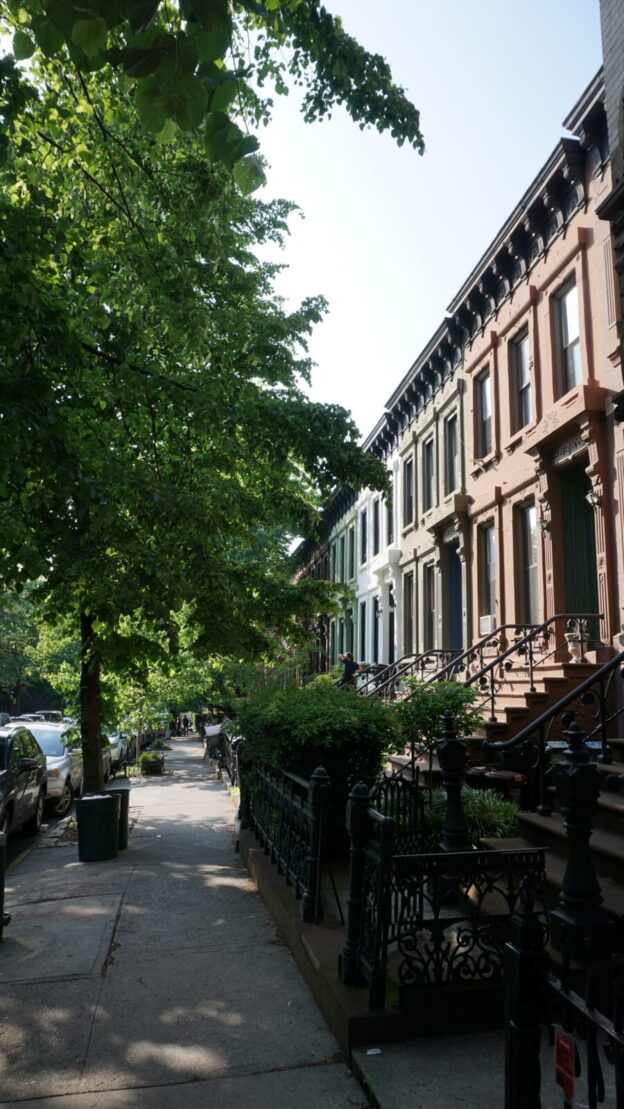
ROWHOUSES AT GARFIELD PL.

86-94 Garfield Place
1892, Philemon Tillion

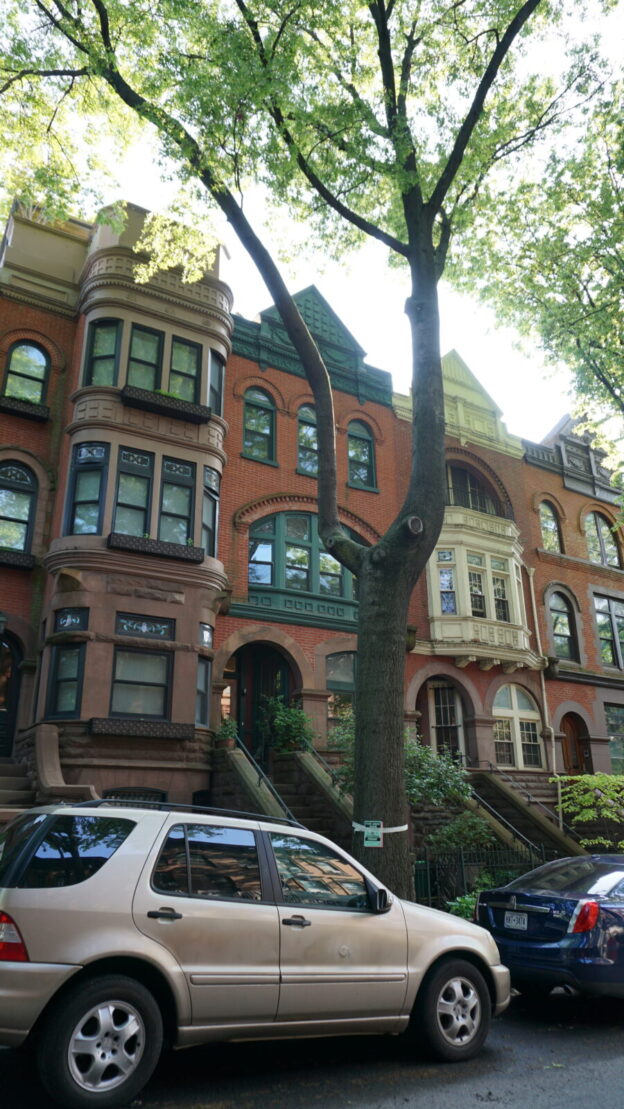
This group of 5 two-story Romanesque Revival rowhouses were built by Theodore P. Cooper with designs by British architect P. Tillion, who established his practice in Brooklyn in 1880, before moving to Manhattan in 1905. Tillion’s early work includes rowhouses in the Greenpoint Historic District and this group in the Center Slope. Most of his known work, however, was done after his sons Philip and Clement joined the firm. Some examples are the additions to the Eberhard Faber Pencil Factory and the Masonic Temple and the Home for the Blind in Greenpoint, and the Trinity Baptist Church on New York Avenue in Crown Heights. All five houses are brownstone-faced, featuring a mixture of rough-cut, smooth and undulating stone. Carved ornaments include quoins around the upper windows, a stone bar bisecting the stained-glass transoms from the elements below, and decorated cornices. All of these elements make it a cohesive group, while at the same time giving each house their own individuality.
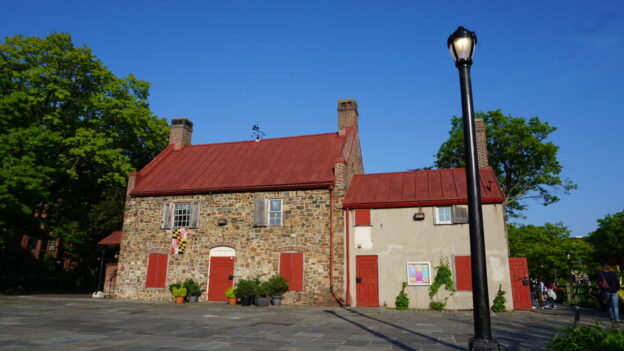
OLD STONE HOUSE OF BROOKLYN

336 3rd St.
ca. 1699, rebuilt in 1935

Located just outside the boundaries of the Center Slope, in Washington Park, the Old Stone House is a reconstruction of the 1699 Vechte-Cortelyou House, built on land taken from the Lenape Indians as early as 1639. The Vechte family came from the Netherlands in 1670 and purchased lands along what would become the Gowanus canal. Hendrick Claessen Vechte served as a Justice of the Peace for Brooklyn and commissioned the Old Stone House in 1699. He and his family lived at the farm until after the Revolutionary War, when they sold it to the Cortelyou family.

The grounds were also the culminating site of The Battle of Brooklyn, the largest battle of the Revolutionary War. It was the first military engagement following the adoption of the Declaration of Independence in July 1776, and its outcome was the seven-year occupation of Brooklyn and Manhattan by the British. Washington and his army, however, weren’t captured and withdrew across the East River to continue to fight, and eventually, win the war.

The Old Stone House was also the original clubhouse of the team that became the Brooklyn Dodgers when they played at Washington Park, now Washington Park/JJ Byrne Playground. The ball park was built on swampy ground located near the shore of a mill pond and the Gowanus Creek. By 1910, the Old Stone House had fallen into disrepair and was gradually buried under 15-ft of landfill. As part of Robert Moses’ ambitious playground construction program, the site of the “Old Gowanus House” was redesigned as the JJ Byrne Playground, wich opened in 1935.

Today, the Old Stone House and Washington Park are part of the Historic House Trust of New York City, and were listed on the National Register of Historic Places in 2011.

FLATS AT UNION STREET

799-809 Union St
1894
Robert Dixon

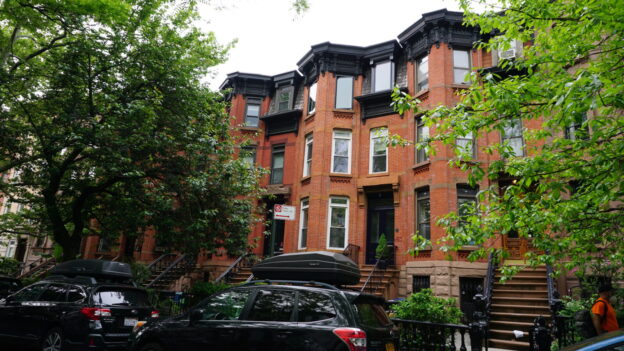
Built by noted Park Slope developer Louis Bonert, and sold by real estate broker John Pullman, these 6 four-story brick structures are great examples of Renaissance Revival style buildings.

They were designed by Robert Dixon, a native Brooklyn resident who established his own practice in 1879 and designed a significant number of public, commercial, and residential buildings throughout the city. In Park Slope, Dixon was responsible for much of the development on the west side of 6th Avenue in the 1870s, and of many of the houses on Lincoln Place between 6th and 7th Avenues. He would continue working in other areas of the neighborhood up to the mid-1890s, showcasing different architectural styles.

FORMER SKENE SANITARIUM

759 President St.
1883-84, additions from 1902 and 1930s
R. B. Eastman

Alexander J. C. Skene came from the UK to study medicine in the US, graduating from the Long Island School of Medicine in 1863. He served as a doctor for the Union Army during the Civil War and later focused on the relatively new field of gynecology and women’s medicine, where he was widely recognized for his work and extensive research.

In 1884, he and Dr. William Thalon opened a private sanitarium in Park Slope, with state-of-the-art equipment, catering to wealthy private patients. He would later also open a hospital for “self-supporting women.” Due to the success of his model, in 1891 Dr. Skene purchased several adjacent plots of land in order to build an addition and expand the grounds. After his passing in 1900, his plans were carried out by a Board, and a new wing was completed by 1902.

In 1924, the Sanitarium was sold to Samaritan Hospital, which built another wing in the Art Deco style and continued its operation until 1950 at least. However, records show the building being converted for residential use in 1980. It currently has 32 apartments, featuring balconies that highlight where the wings join, and a gated garden at the entrance.

APARTMENT BUILDINGS AT CARROL STREET

703-719 Carroll St.
1898
Jeremiah Gilligan

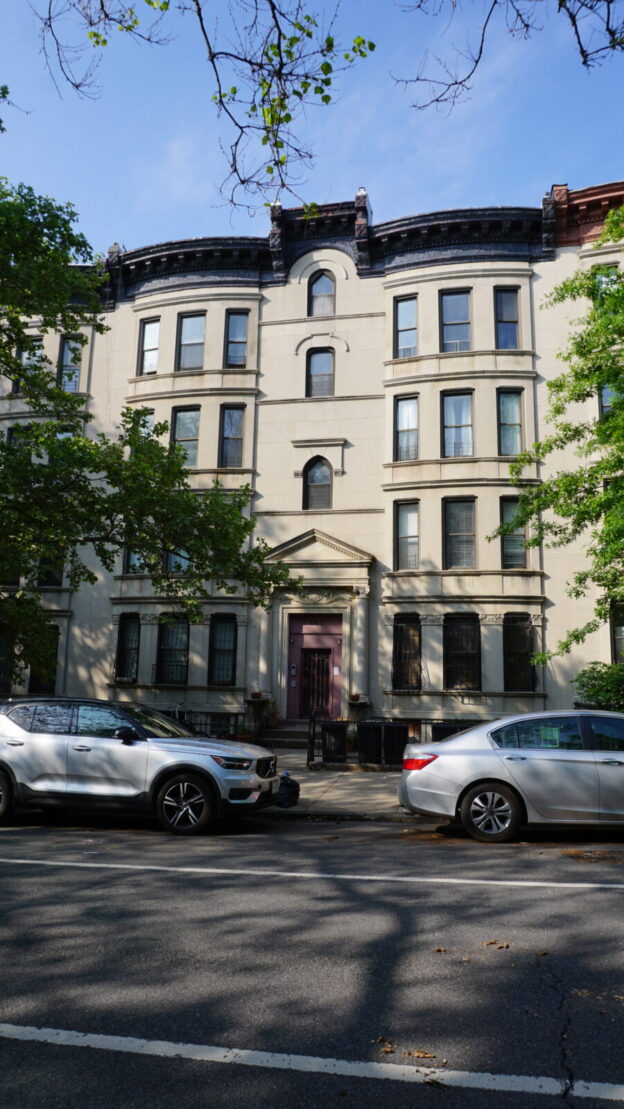
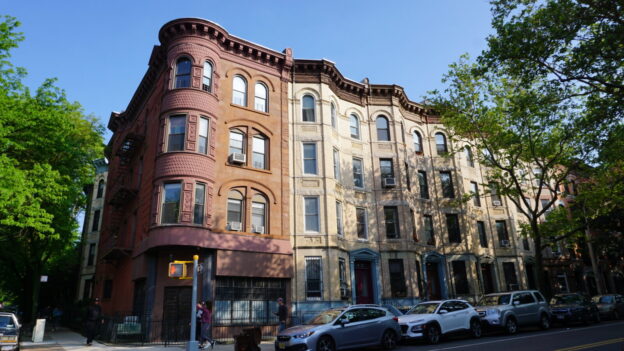
This row of 8 four-story, 8-family apartment buildings is bounded by two historic churches, St. Francis Xavier to the northwest, and the Old First Dutch Reformed Church to the southeast, resulting in a streetscape that encapsulates the uniqueness of the Center Slope. It’s also representative of a time when multiple dwellings were gaining favor among developers due to increases in the population and property values in greater New York.

Built and designed by J.J. Gilligan, a prolific Brooklyn mason and carpenter, these Renaissance Revival style brick structures feature full stone enframements with subdued classical ornament concentrated around the door. The carved stone stoops highlight a recessed central core with the main entry, flanked by slightly projected concave bays, and an iron cornice with Renaissance-inspired ornament.

Other works by Gilligan can be found within the Park Slope Historic District and in the Prospect Heights Historic District.

ST. FRANCIS XAVIER R.C. CHURCH

225 6th Ave
1900-04
Thomas Houghton

Founded in 1886 by Rev. David J. Hickey, St. Francis Xavier began offering services at the parlor of a brownstone on the corner of Carroll Street and 6th Avenue. Their first church was built by the end of that year and was dubbed the “tin church” after its galvanized metal sheathing. The structure, however, soon became too small for the needs of the growing parish, and plans began for a new permanent building. The old church was moved to President Street, where it still stands, having served for well over 100 years now as the parish Lyceum, a center for youth activities, sports, and other activities.

The new church was dedicated in 1904, featuring a Gothic Revival style, and constructed of granite trimmed with Indiana limestone. The house at 243 6th Avenue still stands and is the home of the Sisters of Saint Joseph, who serve in the parish and school. The Sisters were later joined by the Franciscan Brothers of Brooklyn.

ROWHOUSES AT GARFIELD PLACE

86-94 Garfield Place
1892
Philemon Tillion

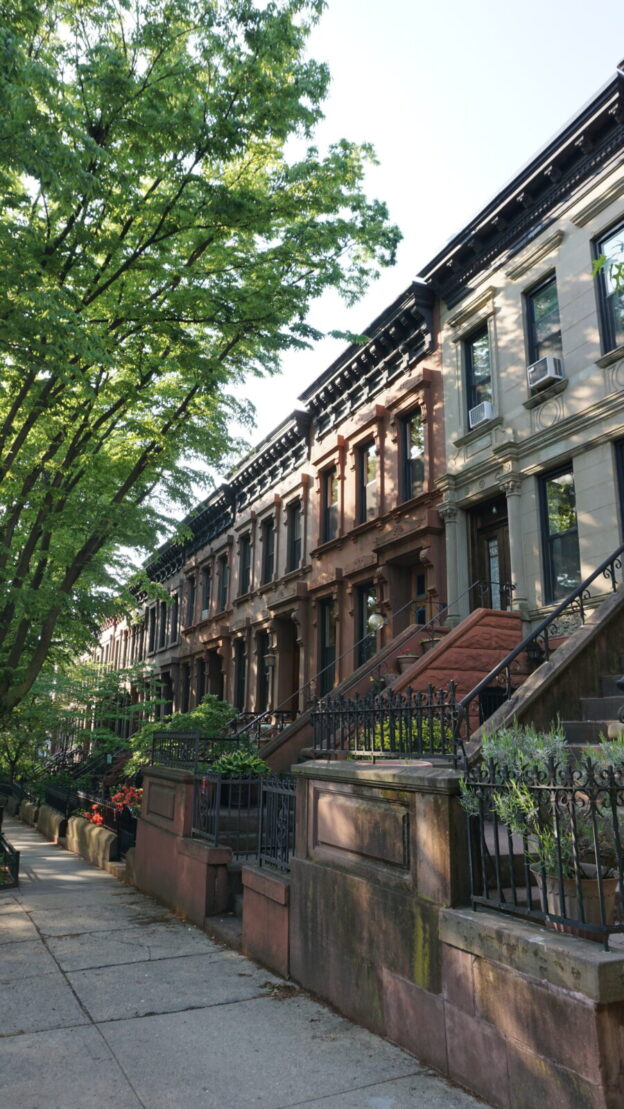
This group of 5 two-story Romanesque Revival rowhouses were built by Theodore P. Cooper with designs by British architect P. Tillion, who established his practice in Brooklyn in 1880, before moving to Manhattan in 1905. Tillion’s early work includes rowhouses in the Greenpoint Historic District and this group in the Center Slope. Most of his known work, however, was done after his sons Philip and Clement joined the firm. Some examples are the additions to the Eberhard Faber Pencil Factory and the Masonic Temple and the Home for the Blind in Greenpoint, and the Trinity Baptist Church on New York Avenue in Crown Heights.

All five houses are brownstone-faced, featuring a mixture of rough-cut, smooth and undulating stone. Carved ornaments include quoins around the upper windows, a stone bar bisecting the stained-glass transoms from the elements below, and decorated cornices. All of these elements make it a cohesive group, while at the same time giving each house their own individuality.

ROWHOUSES AT 1ST STREET

359-365 1st St
1891
Robert Dixon

Built by developer Peter Larsen, these 4 two-and-a-half-story brownstones were originally designed as a group of nine residences by architect Robert Dixon. They feature a full-height angled projecting bay and a main entrance surrounded by carved classical motifs, crowned by a molded projecting cornice and pilasters.

They display some of the main characteristics of the Renaissance Revival style, which in the 1890s came to influence the then-popular Romanesque Revival, and became the preferred style from about 1880 to 1910. The simple, restrained Renaissance-inspired designs have an interest in classicism, with buildings featuring light-colored facades and subdued classical ornaments concentrated around the door and window openings, often with motifs of wreaths, baskets of fruits, and garlands of flowers. Dixon’s work can be found in several areas of Park Slope, as well as in the Clinton Hill, Fort Greene, and Dumbo Historic Districts.

FORMER ST. MATTHEW’S ENGLISH LUTHERAN CHURCH

298 6th Ave
1895
LB Valk & Sons

Founded in 1859, St. Matthew’s was the first English-speaking Lutheran church in Brooklyn. Its parishioners were first and second-generation German immigrants who began worshipping in English as a means to assimilate into American culture. After leasing space in other churches for many years, they bought this lot in 1885 to build a large church for their growing congregation.

The structure has an impressive bell tower and stained-glass façades. The steeple originally had a sharply pitched roof, with a stamped metal cornice and small gargoyles at the corners. The brick was a natural golden or buff color, with lighter limestone trim.

In 1948, St. Matthew’s merged with other Lutheran churches, and the building became known as Maranatha Temple, a non-denominational church. In 1985, it was sold to the Mission for Today, Holy Tabernacle Church. It was recently sold to a developer, and a demolition permit was issued by the DOB. New construction does not need to be contextually appropriate or regulated by LPC.

ROWHOUSES AT 3RD STREET

405-371 3rd St.
c.1880

Once development started in Park Slope, buildings were constructed in the popular middle to late 19th-century residential architectural styles. The earliest was the Italianate style, fashionable between 1840 and the mid-1870s.

Rowhouses in this style are characterized by elaborate projecting ornaments with an emphasis on repetitive forms. Early examples usually have flush brickwork, later replaced by brownstone, round-arched doorways, and double doors. Segmental arches were often used over windows, and round or segmental arches over basement windows. Windowsills were usually supported on small corbel blocks, one at each end. The basements and stoop sidewalls were usually rusticated, and the cast iron stoop handrailing and yard railings were generally balustered. Roof cornices were supported by widely spaced foliate brackets, often arched to relate to the windows below.

This block at 3rd Street is an interesting example of rowhouses in this style, maintaining its cohesiveness and most of its original features.

APARTMENTS AT 3RD STREET

437-461 & 450-478 3rd St
1903-04
Pohlman & Patrick

These Renaissance Revival buildings were also developed by Louis Bonert, and feature a 38ft-wide floorplan, full-height round projecting bays, and a classical main entrance with pilasters supporting a pediment. They are very similar to another group of apartments built the same year by Pohlman & Patrick at 804- 820 8th Avenue. Twelve of these buildings were erected by Bonert in 1903, eight on the south side of the street and four on the north. The following year he would build four more buildings on the north side, this time with Thomas Bennett as the architect, but replicating the original design. The result is one of the neighborhood’s most notable blocks, representative of the height of real estate development.

Just one year after completion, real estate dealer John Pullman helped Bonert sell these and other properties, including over forty single and double flat houses, to David Schwartz and Elias A. Goldstein for $750,000 (about $25 million today). It was considered the largest property sale at the time.

FLATS ON 6TH AVENUE

373-365 & 363-355 6th Ave
1892
Walter M. Coots

As development intensified in Park Slope, multiple dwellings gained increasing favor as the preferred residential typology during the second half of the 19th century. They were typically four-story structures without elevators in the popular styles of the time and differed from tenements as they had only one apartment on each floor.

This group was developed by one of Park Slope’s most prolific builders, Louis Bonert, who hired prominent architect Walter M. Coots. They had previously collaborated when designing 338 356 6th Avenue and continued working on 6th Avenue over the next few years, developing Nos 345 353, thus creating a cohesive and unique corridor between 5th and 7th Street.

The four residential brick structures include a brownstone-faced mixed-use building on the corner lot. The top story features arched windows with decorative panels below, as well as continuous cornice detailing.

338-356 & 345-353 6th Ave
1891
Walter M. Coots

This group of 5 four-story flats were the first to be built on 6th Avenue by Louis Bonert, with designs by Walter M. Coots.

Although Coots opened his office in Manhattan, by 1885 he was listed in Brooklyn directories and became one of the most noted architects of the late 19th century. His work can be found in the Park Slope, Crown Heights North, Prospect Heights and Alice & Agate Courts Historic Districts, as well as in the Cobble Hill, Bushwick, and East New York neighborhoods.

Directly across the street, on the west side of 6th Avenue, stands another group of 5 four-story brick and brownstone structures by Bonert and Coots. Dating from 1893, the buildings feature details in the Neo-Grec style, maintaining the geometry and expression of their façades. This group is also the location of the Park Slope Ale House, at No. 356, a popular local hangout for over 30 years.

ROWHOUSES AT 6TH STREET

432-446 6th St
1887
J. J. Collins attributed

The Queen Anne style, popular from about 1870 to 1890, is characterized by an asymmetrical massing of forms and details, contrasting materials, colors and textures, eccentric details, projecting bay windows, juxtaposition of window pane size, multi-paneled wood doors, multiple, tiled or slate-covered gables, with dormers and chimneys.

This group of houses developed by Theresa B. Collins are a notable example of this style. Although the design is attributed to her husband, they have a striking resemblance to a group of houses designed by prominent architect C. P. H. Gilbert at 54-64 Prospect Place. Collins hired Gilbert in 1887 to build four houses at 340-344 9th Street in the newly popular Queen Anne style, and would later commission another six houses to be built at Prospect Park West. Gilbert would go on to create some of Park Slope’s most eclectic and beautiful rowhouses, designing mansions for the elite in several Brooklyn neighborhoods, as well as in Manhattan.


WOODFRAME HOUSE AT 7TH STREET

402 7th St
ca. 1880

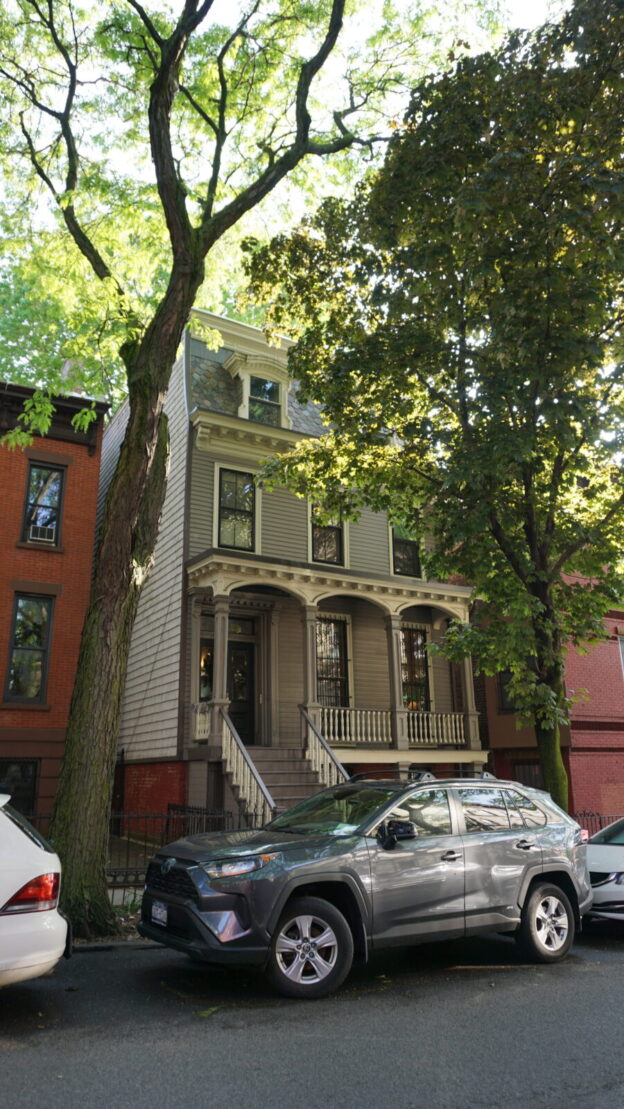
Wood frame houses are among the oldest structures in Park Slope. A few can still be found in the neighborhood, especially in its southern area, possibly due to the late implementation of the city’s “fire limits” (the boundary within which it was illegal to erect a wood house).

This example at 7th Street was first recorded on a fire insurance map in 1886. It features elements from the French Second Empire style, which had been the predominant style after the Civil War, although it appeared only briefly in Park Slope. Its typical feature was the slate mansard roof with iron cresting, as well as enframement on windows, moldings, imposing cornices, and double front doors with horizontal panels at knob height and kickplates at the bottom. The arched doorway, however, was often almost indistinguishable from its Italianate predecessor and was crowned by a low arched or triangular pediment.

KINGSBORO TEMPLE OF SEVENTH-DAY ADVENTISTS

415-419 7th St
1869-70

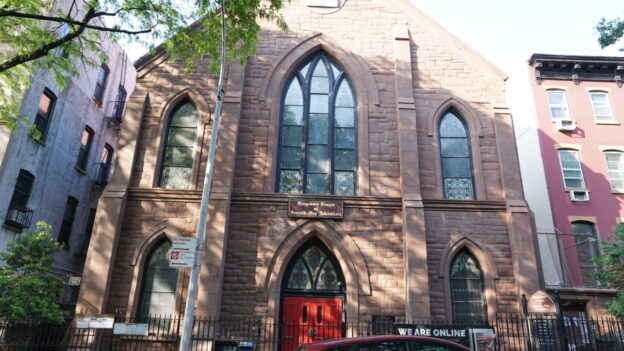
This red brick structure was originally built as the All Saints Episcopal Chapel. The congregation grew considerably over the next two decades, prompting the construction of a larger building on 7th Avenue, completed in 1893.

The chapel was purchased in 1903 by the Emanuel German Evangelical Lutheran Church, a congregation formed in 1884 by several families who left St. John’s Lutheran after it ceased to be a strictly German- speaking church. They had previously purchased a church in Williamsburg, but in 1901 the city condemned all the buildings in the area for the construction of the East River (now Williamsburg) Bridge. The chapel was home to this congregation until 1948 when it merged with St. Matthew’s Lutheran Church. Not much is known about the use of the building for the next decades, but in 1992 it was purchased and restored by Kingsboro Temple.

ROWHOUSES AT 7TH STREET

441-457 7th St
1887
Charles G. Peterson

By the mid-1870s the simpler Neo-Grec style supplanted the rounded, ornate Italianate, and its later variations, as the preferred style for rowhouses and other residential buildings.

Popular until about 1890, Neo-Grec architecture is characterized by extremely stylized classical details, angular forms, and incised detailing formed by mechanical stone cutting; high stoops with massive, angular cast-iron handrails, fences, and newel posts; massive door hoods and enframements with angular decorative elements resting on stylized brackets; double-leaf wood entrance doors with angular ornament; stylized, angular incised window surrounds; projecting angular bays; and projecting cornices resting on brackets.

The style is the second most popular in the Center Slope, with both rowhouses and flats designed in it.

This group of nine brownstones at 7th Street is an interesting example of Neo-Grec rowhouses. They were developed by Charles G. Peterson, a local builder, and architect who in 1886 had completed two Neo-Grec houses at 7th Avenue (Nos. 360 & 362). He would later build another long row at 7th Street (Nos. 583-603), featuring three-sided bays, high straight stoops, wrought iron hand-railings, and slender cast iron newel posts.

Most of Petersen’s work is located within the Park Slope Historic District, including examples in the Romanesque or Renaissance Revival style, and some Neo-Classical buildings.

ALL SAINTS EPISCOPAL CHURCH

286-88 7th Ave
1891-93
John Welch

Founded in 1867, the congregation of All Saints Episcopal Church met initially at a Military Hall at the corner of 5th Avenue and 9th Street. Its first building (All Saints Chapel, Site 7) was a small brick structure on 7th Street, built in 1870. After years of financial difficulties, the church moved in 1891 to this Romanesque-Moorish structure designed by Scottish-born architect John Welch, who had just completed the Church of St. Luke in Clinton Hill, Brooklyn, to great critical acclaim.

The overall configuration of the building recalls the shape of an Early Christian Basilica, with a small sanctuary apse reminiscent of those of Italian Renaissance architect Donato Bramante. It also features two distinctive towers, a bright barrel-vaulted interior with ornate terra cotta detailing, and many stained-glass windows, including one by Louis Comfort Tiffany. After a fire in 1976, some of the interior and east front of the church needed to be rebuilt, and much of the stained glass was replaced.

Today, All Saints is a growing and diverse congregation, with activities and events open to all members of the community.

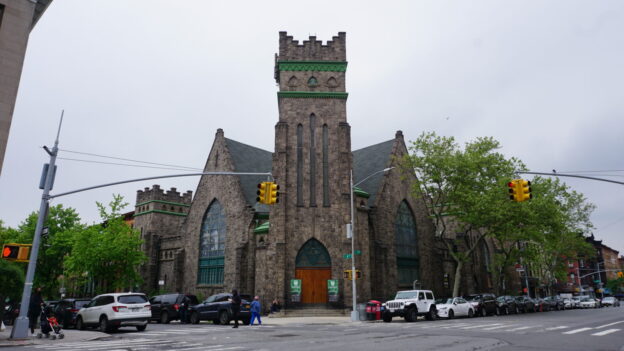
GREENWOOD BAPTIST CHURCH

461 6th St
1900-01
Adolph Leicht

The Greenwood Baptist Mission played a significant role in the growth of the Baptist faith in Brooklyn from the mid-19th century to the early 20th century. It began as a mission school in 1855, with their first chapel erected in 1863 on 15th Street near 4th Avenue. The congregation grew and prospered over the next few years, and in 1874 a new church was built at the same location. By the end of the 19th century, however, plans were made to move to another location.

Designed in the Gothic style, this two-story structure was erected in 1900, featuring rough-faced light grey stone façades, and two gabled fronts with large windows. At the corner where the façades meet, a square tower was built at an angle, with the main entrance located at its base. It is highlighted by three tall lancet openings with round windows above, two bands of terra cotta tiles, and a stepped design at the top.

Because of its architectural and cultural significance, it was listed on the National Register of Historic Places in 2015.

THE ANNANDALE APARTMENTS

203 7th Ave
1892-93
Lewis Anderson

Originally owned by Gold, Nicoll, & Anderson, this five-story apartment building is part of a development that includes four brownstones on 3rd Street. Of these structures, only 509 3rd Street is included within the Park Slope Historic District.

With Romanesque Revival influences, the structure features light-colored brick with brownstone trim and corner quoins, and an archway at the entrance. Like many of the buildings on this stretch of 7th Avenue, the Annandale included commercial space on the first floor, with one shop on the corner of 7th and 3rd Street and another next to the main entrance. The latter was the first location of one of Park Slope’s oldest businesses, Tarzian Hardware. Opened in 1921 by the Tarzian brothers, Charlie and Marty, this store sold hardware, paint, and repaired small appliances. In 1936 it moved a few doors down to the current location at 193 7th Avenue.

MIXED USE BUILDINGS ON 7TH AVENUE

142-154, 156-170 & 151-159 7th Ave
1887-88
Cevedra B. Sheldon

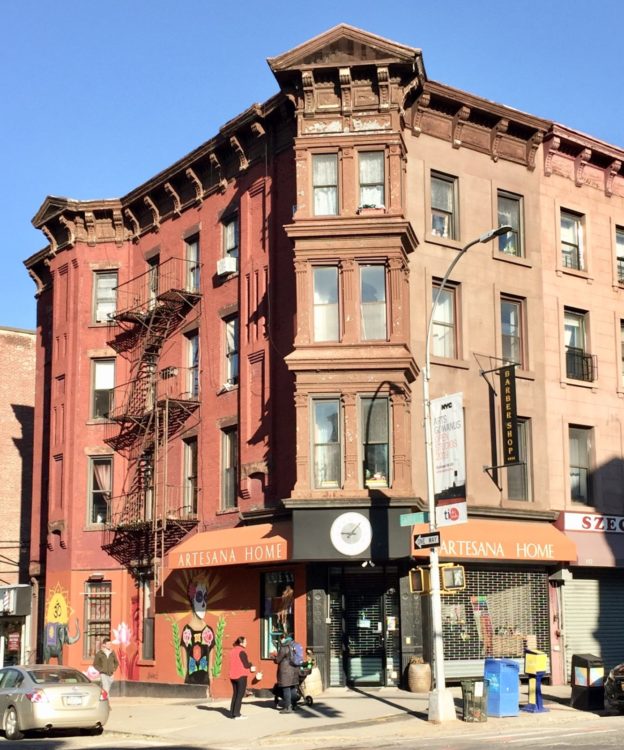
Following the economic upturn of the late 1870s, 7th Avenue transitioned into commercial uses mainly south of Berkeley Place. While residential and religious structures were still being built at the southern end of the avenue, during the 1880s more modest apartment houses and commercial buildings were the predominant typology. Most of them were designed as mixed-use, with shops on the ground floor and flats above, and those on prominent corner lots often featured a projecting angled or rounded bay.

These three corner buildings at Garfield Place still retain their original
configuration. They are the work of C. B. Sheldon, a notable builder active in Brooklyn
from 1863 until 1894. He was also responsible for all the buildings on the west side of 7th
Avenue between Garfield Place and 1st Street, as well as many of the buildings between
Garfield Place and Carroll Street. His work can be found all over the Park Slope Historic
District, and its extensions, as well as in the Fort Greene Historic District. Photo: Building at
142-154 7th Ave.

OLD FIRST REFORMED CHURCH

729 Carroll St
1891
George L. Morse

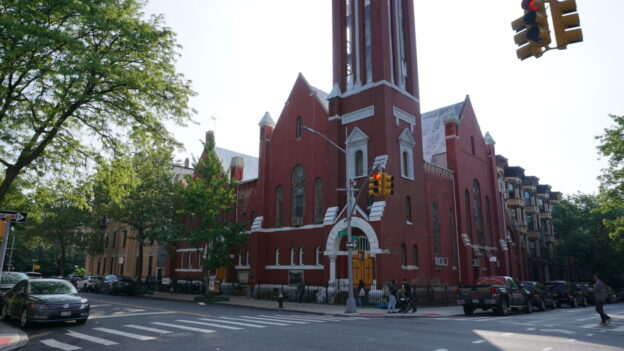
Also known as The Reformed Dutch Church of the Town of Breukelen, this iconic structure is one of the staples of Park Slope’s built and cultural landscape. The congregation was founded in 1654 by Governor Pieter Stuyvesant, as one of three “collegiate churches.” As its numbers grew, the church occupied a series of buildings in the area until the congregation was subdivided. This branch, Old First, is a Neo-Gothic structure dedicated in 1891 and replaced a chapel on Carroll Street used until 1886.  The Cathedral was designed by George L. Morse, one of the borough’s most respected and successful 19th-century architects, credited with single-handedly giving early Brooklyn a skyline of its own. Although much of Morse’s work downtown was razed in the 1930s, Old First remains his only religious building and is a notable and unique example of his skills.

The church’s 212-ft spire is the tallest in Brooklyn. It is made of Indiana limestone without a wood or steel interior structure. The façade also features limestone with stained-glass windows and a solid granite foundation.

The interior was designed in the Gothic Revival style, and features work by renowned artists like Otto Heinigke, William Willet, and Tiffany Studios. It was listed on the National Register of Historic Places in 1998. Its restoration is on-going.

Center Slope, Brooklyn

While Park Slope has received the protection of landmark designation in certain areas, the historic heart of the neighborhood remains at risk of new development and drastic alterations. A special committee of the Park Slope Civic Council is working to expand the Park Slope Historic District and to ensure the preservation of the Center Slope, an area with spectacular brownstones and ties to the American Revolutionary War. From community outreach to survey endeavors, this group is aiming to work towards completing the quilt of landmark protections for the Park Slope neighborhood.