Archives

FDNY ENGINE 255 / LADDER 157

1367 Rogers Ave
1897
Johnson & Hemle

Inspired by Georgian architecture, this firehouse was the headquarters for the Battalion Chief when built. The two-story structure features a three-bay façade with brick and limestone. The large rounded windows on the second floor are flanked by limestone pilasters and an ornate entablature, with wrought-iron balustrades and a balcony on the central bay.

The first floor was designed for a steam engine, hose wagon, and a ladder truck, along with stables for six horses. The second floor had office space and living facilities for the firemen.

It is an early work of prolific architect Frank J. Hemle, and one of the few examples of his partnership with Ephraim Johnson. Throughout his career, Hemle designed a variety of houses, churches, banks, and park buildings. Some of his most noted works are the St. Barbara’s Church in Brooklyn, the Williamsburgh Trust Company building, and the Bush Tower in Manhattan, all designated NYC Landmarks.

Photo by Julia Charles.

ST. STEPHENS LUTHERAN CHURCH

2806 Newkirk Ave
1900, Benjamin Driesler – 1913 additions

St. Stephen’s English Lutheran Church was formally organized in 1898, with regular services held initially at the Vanderveer Homestead. During its first year, the congregation grew exponentially, prompting plans for a permanent building.

A plot of land on the corner of Newkirk Avenue and East 28th Street was purchased in 1899, and construction began of a two-story wooden structure in the English Gothic style, which was intended as a wing of the proposed future church. The lower floor had a Sunday School room, a parlor, and a kitchen. An auditorium with seating for about 300 people was located on the upper floor. It was completed and consecrated in 1900.

By 1913, plans began to expand the building. The auditorium was made 20 feet wider, and a new structure was added to the right side for extra sitting space. The old building was moved back and new materials like limestone, stucco and brick were used “in harmony with surrounding buildings”. Photo by Julia Charles.

EAST 25TH ST. HISTORIC DISTRICT

315-377 & 314-378 E 25th Street
1909-12
Glucroft & Glucroft

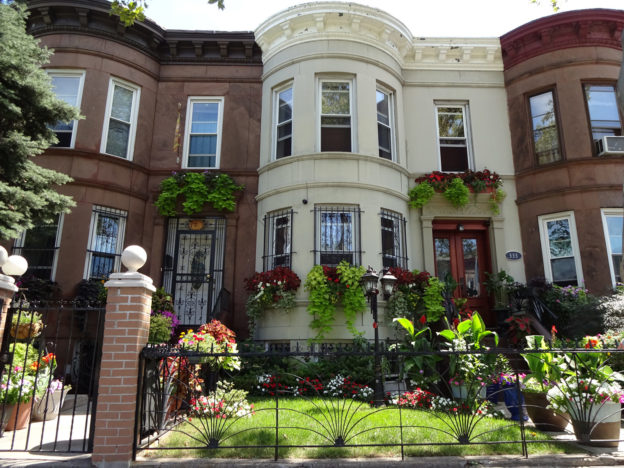
This group of 56 Renaissance Revival rowhouses were built by the Henry Meyer Building Company. At the time, transit improvements spurred residential development in Flatbush, and farmland began to be subdivided and sold to developers by the early-1900s.

This area was part of the former Vanderveer farm, owned by one of the oldest families of Brooklyn.

Motivated by Flatbush’s affluent reputation, Meyer and his son Charles developed East 25th Street as “one-family houses of a high grade,” unlike the many two-family houses that they has previously built in Cypress Hill and Woodhaven. The design included four types of houses, with either a limestone or brownstone front and rounded or angled full-height bays. All feature carved ornaments, pilastered entrance surrounds, and modillioned cornices.

Similar developments quickly lined the surrounding streets, with notable examples still remaining at 31st and 32nd Streets, between Beverley and Cortelyou Roads.

Meyer’s firm only sold 14 houses between 1909 and 1912, ultimately transferring them to developer Realty Associates, who completed the sale.

Before World War II, residents were upper-middle-class white families, with a handful of immigrants, mostly from northern and western Europe. Since the 1950s, the houses’ ownership started to reflect the growth of Flatbush’s African American and Afro-Caribbean communities. Today, the outstanding integrity of the East 25th Street houses is a testament to the remarkable community spirit, pride, and dedication of its homeowners and residents. Their efforts also extend to the carefully maintained front gardens, whose meticulously manicured tropical flowers, shrubs and trees have earned it recognition as “Brooklyn’s Greenest Block” for several years. It was designated as a NYC Historic District in 2020, and certified as eligible for the National Register in 2023.

HOUSES AT VANDERVEER Place

2219-2247 & 2246-2222 Vanderveer Place
1912, Cohn Brothers
1914, Charles Goell

The first houses to be erected at Vanderveel Place were a group of 14 two-story brick single-family homes on the north side of the street, which were developed by the Jaret Construction Company, and designed by the prolific Cohn Brothers, a firm which had recently opened its first office in Flatbush.

The Cohn Brothers specialized in residential buildings, and remained in operation through the early 1950s. Some of their work can be found in the Jackson Heights, Crown Heights, and Park Slope Historic Districts.

With three designs interspersed, this group exemplifies the firm’s different stylistic influences, including elements of Colonial Revival, Renaissance Revival, and Arts-and-Crafts, among others. The south side of the street was developed two years later by Charles Infanger in partnership with builder Charles Goell, who designed a group of 11 two-story brick houses that replicate some of the elements of the Cohn Brothers houses. In this case, two designs are alternated, and a wooden portico with a pediment marks every entrance. Infanger and Goell also built a group of 9 two-story brick houses on the west side of East 23rd St, using the same design.

HOUSES AT EAST 23RD STREET

315-363 East 23rd Street
1913-15
Floyd E. Moore

New York builder F. E. Moore designed these 14 Dutch Colonial Revival single-family houses in 1913, which were completed by 1915. Born in 1866, Moore had been working in the area since the late 1890s, and specialized in frame residential structures. He lived at No. 335 until the 1920s, with his wife and mother.

The two-story frame structures feature gambrel roofs with a three-bay dormer window facing the street. Although the original roof shingles have been replaced, there are a few houses that still have wood shingles on side walls and/or the façade. The entrance is framed by three equidistant pillars, and the base of the wall is clad in rustic stone.

Early residents were white middle-class families, mostly first-generation Americans, with a few immigrant families from northern Europe.

FORMER RIALTO THEATER

1085 Flatbush Ave
1916
R. Thomas Short

Built by Abraham H. Schwartz, The Rialto was one of the first “luxury” theatres built exclusively for showcasing motion pictures. Musical selections were played before and after each feature, and an orchestra provided accompaniment to silent films. Unlike other venues at the time, there was not a full setup for vaudeville or stage productions.

The theater’s success prompted Schwartz to establish Century Circuit Inc., a chain of movie theaters in Brooklyn that by 1928 operated 25 locations.

The building’s façade maintains the ornamental brickwork and carved theatrical masks. The original iron and glass marquee and signage were replaced by the late 1930s, and removed in 2019. The lobby was reported to have marble floors, mirrors, and plasterwork adorning the ceiling. The auditorium had a seating capacity of over 1,500 people, retaining many of the wall moldings, pilasters, and the arabesque ornaments that flank the wall sconces. The theater closed in 1976, after which it was converted into a church. In 2021, part of the building was put up for rent by the current owner.

SEARS BUILDING

2307 Beverley Rd
1932
Nimmons, Carr & Wright – Alton L. Craft

The Sears Roebuck & Company was founded as a catalog company in the early 1890s, but did not enter the retail market until 1925. The first store in NYC opened in 1930 in Crown Heights, and in 1932 plans for a large department store in Flatbush Avenue which would cater to “motoring shoppers” were announced.

The L-shaped building was accessible from both streets by car, with 47 1/2-foot tall asymmetrical façades. Decorative Art Deco reliefs highlighted the entrances and were executed in colors that complement the limestone.

The most recognizable feature was the 103-feet-tall corner tower, present in many of the Sears stores and warehouses as an advertisement and utilitarian element. An extension was built in 1940, designed by the same architects, making the structure a total of 170,000 sqft.

Despite the economic struggles at the time, the store was a great success and remained in operation until 2021. It was designated as a NYC Landmark in 2012.

FORMER BROOKLYN UNION GAS COMPANY

19 Duryea Pl
1930

In 1825, the Brooklyn Gas Light Company was established to light the town’s streets with methane. Although it was short-lived, the idea was revived in the mid-1840s, and the Company signed a contract with the city.

In 1897, they acquired the Flatbush Gas Company, which had been recently awarded a contract for the street lighting in the area. This two-story, classically designed building was erected as their sales office.

The red brick-clad structure has large window bays at the ground floor, which contain the original decorative metal transoms. These windows are separated by paired fluted stone pilasters, which support a Doric stone cornice that extends across the façade. The entrance is surmounted by a broken stone pediment, framing a decorative shield.

In the 1960s, the building housed a Loehmann’s Department Store, and in the late 1990s, it became offices for the Federation Employment and Guidance Service (FEGS). It currently serves as sheltered housing for the Jewish Board of Family and Children’s Services.

Photo courtesy of the NY Municipal Archive.

FORMER FLATBUSH SAVINGS BANK

1045 Flatbush Ave
1927
Halsey McCormack & Helmer

The first office for the Flatbush Savings Bank opened in 1916 at the corner of Martense St. and Flatbush Ave. They soon relocated, but sustained growth prompted the construction of this Renaissance Revival building. The architectural firm of Halsey McCormack and Helmer (formerly Thomas Bruce Boyd, Inc.) were commissioned to design it, as they specialized in bank buildings. They also designed the Williamsburgh Savings Bank, a NYC Landmark.

The main façade on Flatbush Avenue is detailed with ashlar rustication and 45-foot-tall Corinthian columns at the corners. Above the entrance, there is a large arched window flanked by carved stone medallions that symbolize training and industry. Two more medallions, thrift and success, can be seen at the Duryea Place façade. In 1946, a two-story, 50-foot-wide extension was added to the north of the building. In 1997, the bank became a branch of Astoria Federal Savings & Loan Association, and in 2019 it was purchased by a hotel developer with plans to replace it with a nine-story, mixed-use building.

Photo by Julia Charles, ca. 2019.

KINGS THEATRE

1027 Flatbush Ave
1929
C. W. Rapp & G. L. Rapp

The Kings Theatre was built at the height of the movie palace boom when theatre chains attracted audiences with luxurious and exotic environments. One of Loew’s five “Wonder Theaters” in the metropolitan area, it was meant to bring the grandness of the Times Square/ Midtown Manhattan Theater District to residential areas.

Designed in the French Renaissance Revival style, the 82-foot-tall three-story structure features ornamental terra cotta tiles on the façade, a large lobby with full-height semi-circular-arched openings and Corinthian pilasters and columns, and lavish classical ornamentation. The ceilings in the entrance, lobby, and auditorium areas are vaulted with French Baroque paintings.

Among the theaters built in the area in the 1920s, Kings Theatre was the grandest and served as a neighborhood landmark. It closed in 1977 and remained vacant until 2010 when it was completely renovated and reopened as a performing arts venue in 2015. It was listed on the National Register in 2012.

FORMER ALBERMARLE THEATRE

1027 Flatbush Ave
1920
Harrison G. Wiseman

The Albermarle Theater opened in 1920, hosting vaudeville shows and motion pictures. Above the auditorium there was a grand banquet hall, with an entrance on the side.

Although it wasn’t initially considered a success, the theater became a neighborhood staple and remained in operation until a fire partially damaged the structure in 1984. After being closed for several years, the building was purchased by the Jehovah’s Witnesses and presently serves as their Kingdom Hall.

The main façade has a central bay with terra cotta cladding and flanking bays in red brick. Carved ornamentations, also in terra cotta, frame window openings and divide the second and third floors, as well as the pediment marking the entrance. The building is capped by a Doric cornice, and at each corner there’s a double-height pilaster. Most of the ground openings have been sealed, with the exception of the entrances on Flatbush Avenue and Albemarle Road.

UNITED STATES POSTAL SERVICE

2273 Church Ave
1936
Lorimer Rich

This two-story brick structure evokes the form of an idealized residence from the colonial period, making it a more academic example of Colonial Revival than most 1930s post offices in New York state, which had a more stylized manner. It features modest ornamentation, with the main entrance marked by a large limestone panel with the name of the post office inscribed in Colonial style script. The interior is laid out in a utilitarian manner, with a rectangular lobby and no ceremonial spaces. It maintains the original terrazzo floors and a few of the marble panels on the lower part of the walls.

It was one of seven postal stations commissioned to Lorimer Rich as part of the “New Deal” program, created by the federal government to promote economic recovery after the Great Depression. Rich was best known for the Tomb of the Unknown Soldier in Arlington National Cemetery. It was listed on the National Register in 1988.

FLATBUSH AFRICAN BURIAL GROUND

2286 Church Ave
ca. 1750s-1850s

Until the 19th century, Flatbush was mostly a rural area devoted to agriculture, with Dutch settlers relying on enslaved Black laborers to work their land. Family cemeteries on these farms are known to have had separate burial sites for these workers, but their location was often excluded from records and obscured.

Information about the existence of a burial ground in the area was provided in 1810 by the publication of an obituary for a Black woman named Eve, as well as on a map from 1855. Local historians also mention the relocation of remains when Bedford Avenue was laid out in 1865.

In 1878, this site became the location for the Flatbush District School No.1, later P.S. 90. Reports noted the discovery of human remains during construction work in 1890 and in 1904. In 2001, archaeological excavations validated these findings, although no graves could be identified. The school building was demolished in 2015 due to its deterioration, and ever since the community has been actively working towards memorializing the history of the site, while also protecting it from being developed.

HOLY CROSS ROMAN CATHOLIC CHURCH COMPLEX

2530 Church Avenue
1872 church
ca. 1900-1915 rectory, school & convent

The Holy Cross parish was established in 1845 and was the first to serve the growing Catholic population of Flatbush. As numbers increased, by the second half of the 19th century the congregation had outgrown the wood frame structure they had built at the corner of Veronica Place (then Prospect Street) and Erasmus Street, and plans began for a new building.

In 1871 they purchased an adjacent lot on Church Avenue and began the construction of this Gothic Revival structure. Under the leadership of Father James Doherty, the former church was converted into a parochial school for girls, and a rectory and convent were added. In 1883, Father J. T. Woods took over as head of the congregation and began an extensive renovation and expansion project. By the early 1900s, the church complex included the Holy Cross RC School and a new rectory, with a new brick building for the Convent. A new hall was also erected, replacing the former church. Around 1915, another school building was added to the group.

Today, Holy Cross has adapted to the changing demographics by offering services in Spanish, Haitian Creole, and English. They maintain a strong community presence through their educational role, while also providing services such as food pantry and after-school programs.

East Flatbush, Brooklyn

East Flatbush is not only rich in historic character but in nature as well! Sitting within its boundaries is the award-winning “Greenest Block in Brooklyn”, East 25th Street, a block that teems with greenery and community enthusiasm. From churches to Neo-Renaissance rowhouses, the 300 East 25th Street Block Association is working to celebrate and preserve the structures in their unique community and to oppose the threats of demolition and overdevelopment. This group is seeking official recognition and protection of the area by being designated a historic district.

UPDATE:

The East 25th Street Historic District was designated on November 17, 2020