98-81 & 98-95 Queens Blvd.
1939, Joseph Unger
Until 2022, this trapezoidal block was the location of the former Trylon Theater. It was named after the famous spire that, along with the perisphere, became the architectural icon of the New York’s 1939 World’s Fair. It opened that same year, under the administration of United L.I. Theatres.
The structure had a seating capacity of 600 people, with an Art Moderne façade that featured an elliptical marquee and a central tower with glass blocks. The entrance had a Trylon-adorned mosaic ticket booth and was decorated with terrazzo floors and mosaic tiles in a chevron pattern. The interior included a fountain and “World of Tomorrow” themed murals, as well as striated pilasters flanking the screen stage.
Although it was a popular venue, audiences dwindled over the years, and the theater was eventually closed in 1999. It was rented by an orthodox Jewish organization and became the Ohr Natan Community Center.
Along with the theatre, a one- story building was erected for commercial use at the south-east corner of the block. The façade design maintained the simple lines of the Trylon, and featured a rounded corner with glass brick details. It would later be replaced by a taller brick structure with Neo-Classical features, which hosted the offices of the Emigrant Savings Bank until the 1990s. It then became the Tower Diner, a family-owned business that served the community until 2021, when the property was sold to a developer for the construction of a 15-story apartment building.
Despite multiple efforts made by residents and organizations, the block was razed in 2022.
99-01 Queens Blvd
1952, Philip Birnbaum
Located at the boundary of the neighborhood, this irregularly-shaped building is a unique example of early International Style in Queens. Designed by Philip Birnbaum, the mixed-use building received a “1st prize” award by the Queens Chamber of Commerce and it’s regarded as his most notable work.
A New York native, Birnbaum studied at Columbia University. During his career, he designed over 300 apartment buildings across the city, and was praised for the efficiency of his layouts. He received several 1st prize awards in partnership with builder Alfred Kaskel.
The building included the legendary Hollywood Lanes bowling alley, which operated from 1952 to 2002, and featured 30 lanes as well as a lounge, and was the site of major tournaments.
The bank façade features stainless-steel and granite finns, which also divide the storefronts. A curved corner with a short flight of stairs marks the main entrance, leading to a double-height lobby illuminated by floor to ceiling windows. The interior maintains its blue terrazzo floors with contrasting silver motifs in the Art Deco style, and a teakwood balcony with stainless steel accents. It served as a bank until 2015, and is currently a Mount Sinai medical facility.
98-50 63 Drive, 98-40, 98-33
& 98-19 64th Avenue, 98-09 &
98-25 64th Road
1948-49, Leo Stillman
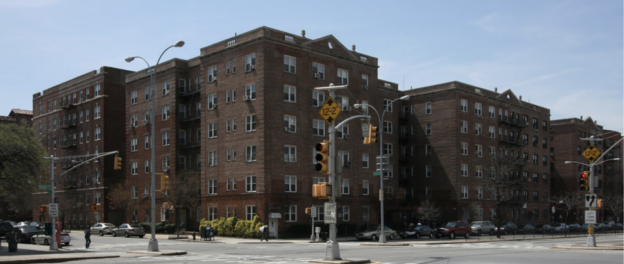
This group of twelve 8-story apartment buildings that occupy almost two blocks north of Queens Blvd, were designed by Russian-born architect Leo Stillman and built by the Nipark Realty Corporation. They are an early example of the post World War II International style in Queens.
Stillman immigrated with his family to the US in 1906, and attended City College and the Beaux-Arts Institute of Design in the early-1920s. He was renowned for his Art Deco designs in the 1930s, and later for his innovations in the use of poured concrete in the construction of apartment buildings. Examples of his work can also be found in the Grand Concourse Historic District.
With exposed concrete walls and midblock courtyards, the Walden Terrace Complex stands out among the red brick surrounding structures, while maintaining a certain continuity of the built landscape. Noted residents include actor and saxophone player Sid Caesar, and actor Hank Azaria.
9730 Queens Blvd
1948, Frank Grad & Sons
After World War II, the Jewish population of Rego Park, Kew Gardens and Forrest Hills grew exponentially, thus increasing the need for synagogues to serve these communities. This was also a period when a new type of American synagogue, known as the Jewish Center, was developed. In addition to being a place of worship, these were places for community life, with social halls, classrooms, and athletic facilities.
Established around 1939, the Rego Park Jewish congregation purchased this lot on Queens Boulevard in 1942 to build a “temple and recreation hall”. The ground- breaking ceremony in 1946 included remarks by Mayor O’Dwyer, who was also present at the dedication in 1948, noting the significance of the temple.
The design by noted architect Frank Grad was one of the first modern synagogues in NYC. With block massing, narrow slit windows and short projecting towers framing the main entrance, the building can be interpreted as late-Moderne or early-Modern. Over the next decade, modernism became the predominant style in American synagogue design.
The Center’s façade is accented by a large mosaic designed by Jewish artist A. Raymond Katz, in collaboration with Vincent Foscato. Katz was famed for his ornamental treatment of the letters of the Hebrew alphabet interlocking with Jewish symbols, and also designed the sanctuary’s stained-glass windows.
It remains as one of NYC most significant architectural, cultural and religious landmarks, for which it was listed on the National Register in 2009.
63rd Dr and Saunders St
(ca. 1940)
What’s now 63rd Drive was previously known as Remsen Lane, after Col. Jeromus Remsen, who had gained notoriety during the Revolution at the Battle of Long Island. The street was renamed in 1913, when the borough largely changed over to a numbered system.
When Rego Park was originally developed in 1923, 63rd Drive was planned to be a residential street, with a shopping district on Eliot
Avenue and Queens Boulevard. In 1942, however, it was announced that the Queens Midtown Highway, later named the Long Island Expressway, would pass through the commercial district and the stores would be demolished.
Bronx native, Robert E. Hill, saw this as an opportunity to develop a new strip, and in 1947 purchased the houses on 63rd Drive to build commercial storefronts. These Art Deco limestone structures, which once housed F.W. Woolworth and McCrory’s as well as family businesses, are some of the last remaining examples of the shops that lined 63rd Drive during the second half of the 20th-century. Despite the economic struggles and changes over time, the strip remains as one of the neighborhood’s main commercial corridors, and an important part community life.
93-06 63rd Dr
1929, Walter C. Martin
The population growth experienced in Rego Park in the early 1920s prompted the community to lobby for a public school. In 1928, the Board of Education erected this three-story brick structure under their building program, featuring elements of Renaissance and Colonial Revival that were typical of educational facilities, such as pilasters, arched pediments with crests, quoins, and decorative limestone details.
Designed by the new
Superintendent of School Building Walter C. Martin, the school had an initial capacity for 895 students, and followed the “M-Type” style developed by Martin’s predecessor William Gompert. The style was noted for its systematic expandability, an innovation first explored with C.B.J. Snyder’s Type-E buildings. This layout considered future growth in the school population, allocating space for two more wings in a cohesive manner. In the case of P.S. 139, these expansions were done in 1960 by architect Samuel Juster, with a modular addition done in 1998 by Karlsberger Architecture.
92-14 63rd Dr
1931, Benjamin Braunstein
In 1926, the Pastor from the Bethany Lutheran Church of Elmhurst reached out to the president of the recently organized Rego Park’s Community Club to use their headquarters for worship and Sunday School. The congregation adopted the name of “The Neighborhood Lutheran Church of Rego Park”, and by 1927 their continuous growth required them to relocate to a vacant store on Queens Blvd, near 63rd Drive. The Rego Construction Company then offered the congregation a property at Wetherole St. to build a chapel, which was gifted by Bethany Lutheran Church.
In 1930, the newly independent congregation began a campaign to build a colonial style structure with a Sunday School room in its basement. Benjamin Braunstein was commissioned to design the building, with modifications by Fred Kirchhoff. Construction began in the fall of 1931 and was completed the following year. Throughout this time, they continued receiving donations from prominent community members and other churches.
Today, the church continues to be a neighborhood staple, maintaining most of its original features such as a stained-glass window along 63rd Drive, a cupola, arched windows with a pitched roof, and a large garden.
6510 Dieterle Crescent
1949, Eric Kebbon
After World War II, the rapid increase of school-age population in Queens prompted the city to begin a building campaign. Superintendent of School Buildings Eric Kebbon designed this Georgian Revival two-story brick building, which features a U-plan and central tower. The front-gabled central pavilion is crowned by broken segmental pediment, a stone frieze and cornice.
Kebbon graduated from the Massachusetts Institute of Technology, working as their resident architect until 1914, when he enlisted and served in the U.S. Army Corps of Engineers during WWI. During the 1930s, he was hired by the U.S. Treasury to design several Court Houses and Post Offices, many of them currently listed on the National Register. In 1938, Kebbon was appointed by Mayor La Guardia to the NYC Department of Education, where he designed and built over 100 schools, among them the neighboring Forest Hill High School. He ended his tenure in 1952, and retired in 1958.
Asquith Cres., Boelsen Cres., Cromwell Cres., Dieterle Cres. & Ellwell Crescent
1923-26
In the early-1920s, the Real Good Construction Company, later known as the Rego Construction Company, purchased farmland in the western section of Forest Hills for residential development. Company president Henry L. Schloh and secretary and treasurer Charles I. Hausmann were originally from Germany, named their project “Rego Park”, after their advertising slogan, “Real Good Homes.”
In the area known as “The Crescents”, which stretches from Alderton Street, between Woodhaven Boulevard and the Long Island Rail Road, they developed single-family brick and frame houses, which featured elements of Colonial Revival and Tudor style. The homes were organized around six crescent-shaped streets with “aristocratic sounding names”, in alphabetical order, meant to attract wealthier people. Each sold for about $7,500 ($130K today).
The success of the Rego Company soon attracted similar developments to the area. In the 1930s, the Mezick-Garbade Company built 265 attached brick houses on the adjacent crescent-shaped lots south of 66th Ave.
63rd Ave, 62nd Dr, 62nd Rd, 62nd Ave & Alderton St.
1930-31
Having previously been in the plumbing and heating business, Alexander Rodman and Gerald C. English established the Rodman & English Company in 1924. During their 12 years in operation, the firm and its subsidiaries became one of the most prominent real estate companies at the time, building more than 1,700 homes in Queens.
Starting from the late-1920s, they were heavily involved in the development of Addisleigh Park (a designated NYC Historic District since 2011) which offers six types of one-family homes in the English Cottage and Colonial Revival styles. The designs were attributed to architects Frank J. Shea, David J. Cohan, and Gerald English.
During this time, the company also built this group of two-story brick rowhouses and freestanding single-family homes. The houses are almost identical to those of Addisleigh Park, and featured high-end interior finishes, state of the art appliances, and underground connections. Their selling price was considerably higher than that of similar surrounding developments, and was aimed at upper-middle class families who would benefit from the upcoming opening of the Rego Park Subway Station. It remains today as a cohesive group, and maintains many of its original features.
85-26 61st Rd
1938-39
In 1926, Bishop Thomas Molloy appointed Fr. Francis Scullin to establish a church that would serve the people in the fast-growing community of Rego Park. A temporary building was erected on 55th Avenue, which hosted the Church of the Ascension for over 10 years.
The congregation purchased 75 lots at Woodhaven Boulevard and 61st Road in 1931, but did not begin construction of a church until 1938. The complex included a school, rectory and convent, and by 1945 it had 1,500 students from grades 1 through 5, with a teaching staff of 32 Sisters of Charity.
Six years later, the name of the church and school was changed to Resurrection Ascension, and in 1954, the Marist Brothers joined to teach boys in grades 6 through 8. The internal structure of
the Catholic Church underwent a series of changes during the 1960s. This allowed for lay teachers to join the school.
A series of auxiliary buildings were added during the 1990s and 2000s, but the complex maintains its cohesiveness and overall integrity.
61-40 Woodhaven Blvd
1955, A. F. Meissner
Thomas Kearns Sr. started his funeral business in 1900 in Brooklyn, and expanded to Queens in 1926. He worked with his sons, and built a parlor in South Ozone Park and later in Rego Park.
In 1950, the design of the new Long Island Expressway slated their location at Woodhaven Boulevard and 60th Ave. for demolition. Thomas Kearns Jr. purchased a new lot a few blocks south, and hired architect A.F. Meissner, who had designed Kearn’s Richmond Hill branch, an innovative award-wining design that maintained the efficiency required for a funeral home.
The slightly curved structure has stone veneer, limestone trim, concrete, brick, among other new materials. The interior features wood panelling, glass and metal details. Meissner also designed the landscaping surrounding the parking lot, as well as a wood frame addition. It was awarded first prize and a bronze plaque from the Queens Chamber of Commerce for the best commercial structure of 1955.
After the success of Remo Hall, Jupiter & Marion Court, apartment buildings became the preferred typology for the development of the northern section of Rego Park. By the late-1930s, the south side of Queens Boulevard and Saunders Street were lined with six-story brick structures, which featured a variety of classical and more contemporary features.
The Savoy, also known as Savoy Gardens (1936, 62-82 Saunders St), is an interesting example of Tudor Revival, with a recessed façade that features towers inspired by castles and pitched roofs. The main entrance has a three-point-arch and decorative stone, highlighted by a carved coat-of-arms-inspired ornament.
The Sterling (1939, 61-41 Saunders St) and The Oxford/Cambridge (1939, 63-07 Saunders St & 95-08 Queens Blvd) were also designed by Benjamin Braunstein, and although they feature less ornamentation than their neighboring predecessors, they maintain the characteristic recessed facade with a courtyard. The main entrance of both buildings is highlighted by Corinthian columns/pilasters and an arched pediment. They also included corner windows, bay windows on the second floor, arched brick accents and stone bands.
Parker House (63-84 Saunders St) and The California (64-20 Saunders St) were built in the 1950s, maintaining the overall characteristics of earlier structures, but include mid-century modern elements to the design of the main entrance. This would become a distinctive feature of the apartment buildings of this area, which appear to be uniform as a group, but have very unique entryways.
93-29 Queens Boulevard
1938-1939
After 36 years of owning the property, the Works Progress Administration was able to fund the construction of this two-story Art Moderne building. It was equipped with a firing range and drill hall for the Queens Veterans of Foreign Wars (VFW) and the American Legion, and was dedicated to the 77th Division of the U.S. Army for its heroism in the Battle of Argonne in France during WWI.
Two murals of “The Lost Battalion” were painted by Oscar Julius in 1938 in the current gymnasium, which honored the hundreds of American soldiers who had given their lives. A tributary limestone inscription was also included in the façade, as well as bronze tablets of the Statue of Liberty.
Over the years, the building hosted a series of events, such as a welcome reception for enrollees of WWII, a birthday for President Franklin D. Roosevelt, dance festivals, boxing matches, and testimonials for Presidents Truman and Eisenhower. In 1960, it was placed under the jurisdiction of the Parks Department, the Queens VFW moved to an upstairs office and the American Legion relocated. Today, it serves the community as a recreation center for people of all ages.
61-40, 62-64, & 62-98 Saunders Street
1927-29 Benjamin Braunstein
After the completion of their first group of single- family homes, and in response to an increase in property value, the Rego Construction Company hired architect Benjamin Braunstein to design three walk-up apartment buildings.
Braunstein, a Constantinople native, had started his practice in 1921, and became known for his multi-family residential designs in the Tudor and Colonial Revival styles in Forest Hills, Rego Park, Kew Gardens, and Bayside. He received several design awards from the Queens Chamber of Commerce, and one of his works, the Hawthorne Court Apartments, was designated as a NYC Landmark in 2014.
The Tudor-style Remo Hall and the Spanish Mission-style Jupiter Court were built in 1927. Each feature an array of terra cotta details and ornamentation, as well as recessed facades and courtyards which maximize fresh air and light.
Marion Court was built two years later, also in the Spanish Mission-style. It features animal-themed
carvings, leaded-glass depictions of castles, and a roof garden, and it is the only building of the three to feature a lobby.
With 70 units each, they were considered one of the Company’smajor achievements. Photos: (top) Remo Hall, (middle) Jupiter Court, (bottom)
Marion Court.
93-40 & 93-54 Queens Blvd
1941, Jacob M. Felson
In 1895, Sam Minskoff emigrated to the US from Ukraine, starting a construction business in 1908. In 1940, Minskoff set his sights on Rego Park, hiring prominent architect Jacob Felson to develop two apartment buildings on Queens Boulevard.
The six-story brick structures have Classical style features, including carved ornaments, balusters on the cornice, and triangular pediments. The three-center arched doorways at the main entrances are flanked by two columns. Unfortunately, recent renovations to the façades have removed many of the original ornamentation.
Born in Russia, Felson immigrated to the US with his parents in 1888. He studied at Cooper Union and began to practice architecture in 1910, becoming president of Fleetwood Enterprises Inc. in 1938. Felson specialized in designing apartment buildings, but also created movie theaters and private homes. Examples of is work can be found in the Upper West Side/Central Park West, Upper East Side, Riverside-West End, and Grand Concourse Historic Districts.
94-05 Queens Boulevard
1976, Kahn and Jacobs
During most of the 20th century, this was the location of “Boulevard Tavern” or “The Boulevard.” Opened by owners Harry and Mabel Le Vay in 1929, for many years it was the only eatery in the area.
The Spanish style building could seat up to 500 people, and became a popular venue for locals and community leaders. It notably hosted politicians like John F. Kennedy and Bobby Kennedy during the 1960s as they addressed their constituents. It was sold and demolished in 1973.
In its place, a large brick structure with a base of slab granite was built to house the AT&T Communications Center, and the Pinkerton Security Corp. The design was one of the last works of the famed architectural firm Kahn & Jacobs, founded by Ely Jacques Kahn, one of the most influential architects of the 20th century. Although Kahn died in 1972, and Jacobs retired the following year, their office continued working steadily for the next few years, merging and eventually dissolving in 1978.
Named after the construction company that initially developed the neighborhood, Rego Park is an enclave of art deco architecture that dates back to 1925. As the neighborhood houses a great number of historic buildings, Michael Perlman of the Rego-Forest Preservation Council is working to preserve the area’s rich history through conducting research and interviews, as well as mapping out potential historic districts. As the area is considerably underserved by preservation protections, this group is campaigning to gain landmark designations for a number of sites.