481-497 Eighth Ave
1928-30, Sugarman & Berger
National Register of Historic Places – District
Located within the boundaries of the Garment Center Historic District, the New Yorker Hotel was the largest hotel in Manhattan at the time of its construction. The 43-story brick-and-stone structure features a series of corner towers that rise in setbacks to a central one, accented by light courts on each facade. These setbacks are capped by carved stone parapets with Art Deco motifs, which can also be found in panels about the fourth-floor windows and on the base. The facade is largely made of brick and terra cotta, with Indiana limestone on the lower stories. Originally, the hotel had 2,503 guestrooms from the fourth story up, with a double-height lobby. The ground floor hosted a bank, multiple ballrooms, and restaurants. The fourth basement had a power plant and boiler room, an early example of a co-generation plant. It was built by developer Mack Kanner, who had been involved in creating the garment district during the mid-1920s. In 1954, it was purchased by Hilton Hotels and underwent extensive renovations. After a series of changes in ownership, it was eventually closed in 1972, and sold to be reused as a hospital. In 1976 it became the national headquarters of the Unification Church, and in the 1994 the top stories reopened as a hotel. It gradually returned to its original use and is currently part of the Wyndham hotel chain.
315 W 34th St
1901-07, William E. Mowbray
In 1901, renowned Broadway producer Oscar Hammerstein began developing the Manhattan Opera House as an alternative to the neighboring Metropolitan Opera House. It offered shows art lower ticket prices with a superior orchestra and stage productions, leading to popularity. After coming to an agreement with the Met, Hammerstein sold the building, which reopened in 1911 as a “combination” house, featuring vaudeville shows and concerts. It was purchased in 1922 by the Free Masons, who altered the facade and added a new Grand Ballroom on the seventh floor. It resumed hosting events on a temporary basis in 1926, and by 1939 it was renamed the Manhattan Center, functioning as a multi-purpose venue. In 1976, the building was purchased by its current owner, the Unification Church, and has undergone renovations and upgrades over the years to expand its technical capacity. It houses two recording studios, as well as the Grand Ballroom and the Hammerstein Ballroom, a performance venue.
354-362 W 34th St.
1929-30, Cross & Cross
Named after William Sloan, chairman of the YMCA’s National War Council during World War I, this building was conceived as lodging and social facilities for men in the armed services. The 14-story, Georgian Revival, brick structure has a light court with two projecting pavilions facing West 34th Street. The two-story base features a limestone ground floor with two entrances framed by broken segmental pediments and carved sculptures. The upper floors have stone details like balustrades, quoins and keystones. It was designed by Cross & Cross, a firm founded in 1907 by brothers Eliot and John Walter Cross. John graduated from Columbia University and the École des Beaux-Arts in Paris. Eliot co-founded the real estate development firm of Webb and Knapp in 1922, and was responsible for the business side of the firm. They became a favorite among New York’s elite and eventually received larger commissions, such as the General Electric Building, the City Bank Farmer’s Trust Company building, and most notably, their building for Tiffany & Co. on Fifth Avenue.
413-423 W 34th St
1922-23, Parish & Schroeder
In the 1920s, former senior partner of R.H. Macy & Company Charles B. Webster set up a fund to build an apartment hotel for low-income women. The building had 360 bedrooms, with shared facilities such as a library, infirmary laundries, sewing rooms and small reception rooms. The ground floor hosted a social club. The 13-story Georgian Revival structure is organized in a U-plan layout, with a central court fronting 34th Street. The three-story base features detailing in light stone, most notably segmental tympanums with carved decorations above the first-floor windows. The entrance porch has columns supporting an entablature topped by a balustrade. The top two floors also display ornamentation in stone, like carved spandrel panels and cornices. Architects Wainwright Parish and J. Langdon Schroeder were classmates and graduates of Rensselaer Polytechnic Institute in Troy, New York. They were pioneers in steel structures, with projects like the railroad bridge across the Ausable Chasm in the Adirondacks and the Y.M.C.A building on West 57th Street.
324-340 W 30th St
1928-29, Crow, Lewis & Wick
This 12-story, Classical Revival structure was built by the French Benevolent society, an organization founded in 1809 to provide healthcare services to people of French descent. It was the fourth location of their non-sectarian hospital, and doubled their existing capacity. The hospital performed outpatient work and provided children’s and maternity services, and also included a training school for nurses. The facade’s central section is set back from the street with two corner pavilions, all set on a two-story stone base. The entrance pavilion is ornamented with fluted Corinthian pilasters, carved terra cotta segmental pediments, and a balustrade above the second-floor windows. Two other entrances are on the corner pavilions, framed by recessed arches and carved terra cotta imagery. The design was by the firm of Crow, Lewis & Wick, established in the early 1900s by Luther H. Lewis, William D. Crow and Hermon Wickenhoefer. They specialized in institutional architecture, most notably hospitals, such as the former Children’s Court in Gramercy Park.
307 W 30th St
Ca. 1876, Edward E. Ashley
National Register of Historic Places – Property
Constructed as a single-family residence by architect and real estate developer Edward E. Ashley, this four- story Neo-Grec building was purchased by the Lithuanian Alliance of America in 1910 as the organization’s headquarters. The brick structure has brownstone door surrounds, lintels and sills that feature carved floral motifs, as well as a large cornice with ornamented brackets. The façade was restored to its original appearance in 2018, based on archival research and historic photographs. Founded in 1886, the Alliance is the oldest continually operating Lithuanian organization in the United States. It was part of the fraternal organization movement from the 1880s and 1890s, which sought to provide assistance to immigrants arriving to the US. Their goal was to preserve Lithuanian heritage and culture, help fellow countrymen integrate into American
society, and provide economic assistance. They also published a weekly newspaper about Lithuanian culture, politics, and current events, opening a space for cultural events during the 1970s. In 2022, the building was listed on the National Register of Historic Places.
308-312 W 30th St
1924-25, Sugarman & Berger
This 11-story building was originally the Hotel Irvin for Women, a residence for working single women. Named after Mary M. Irvin, president of the organization responsible for its construction, it provided independent units at a time when such living quarters were rare and/or chaperoned.
The design was initially commissioned to Jackson, Rosencrans & Waterbury in 1914, but the advent of World War I delayed construction until 1924. At this time, Sugarman & Berger were listed as architects. The hotel opened in 1925 with 56 apartment units, a laundry and a restaurant. The facade features a carved entablature with Classical Revival influences and stone fluted pilasters framing the first two floors. The two entrances are marked by bracketed stone lintels, while windows are capped by friezes and stone panels with swag reliefs. Carved stone panels also appear on the windows of the third and ninth floors.
402 Eighth Ave
1900 Buchman & Fox
Commissioned by Isidor Kempner, this corner tavern was originally built as a boarding house with a ground- floor bar and restaurant. It was designed by the renowned firm of Buchman & Fox, authors of the New York Times Annex Building (NYC Landmark, 2001). The three-story brick structure features a corner entrance marked by turret, windows with flat lintels and a heavy brick keystone, and a dentilled cornice capping the structure. Façades were kept simple, with corner-wrapping and blade signage as the main ornamentation. During the late-19th century, this area was known as the Tenderloin, a hub for entertainment and vice. When the original Pennsylvania Station was built, “corner saloons” such as this were abundant, and it’s estimated that half the Tenderloin’s buildings housed prostitution or illegal gambling operations. The establishment of the garment district displaced the business of the Tenderloin, and the ground floor of this building served prohibition-era garment workers as a cafeteria. It would later resume activities as a pub, and since 1980 it has hosted the Molly Wee Pub.
243-245 W 30th St
1925, Arthur P. Hess
This 12-story structure is an example of a loft factory, a typology that appeared in the early 1910s as a response to the ban on tenement production. Their design considered adequate lighting and ventilation, therefore providing better working conditions. These buildings began to appear near the mansions and high-end clothing stores that lined Fifth Avenue, sparking opposition from residents. The design by Arthur P. Hess features a two-story base clad in terra cotta and carved panels. The main entrance is framed by a Roman arch with a carved keystone, and a large storefront with glass panels originally occupied the rest of the façade. Not much is known about Hess, except that he was born in Mobile, Alabama, and moved to Manhattan around 1910 with his parents. In 1925, he and architect J. Laying Mills entered the competition for the Bergen Branch of the Jersey City Free Public Library, but were not selected. He was active at least until the 1950s.
239-241 W 30th St
1923, Joseph C. Schaeffler
In 1922, J. M. Heatherton’s The Plumbers’ Trade Journal was an established publication, so he began plans for a new building. Local architect Joseph C. Schaeffler was commissioned for the design of this six-story Classical Revival structure, which features a base with a large central showroom window flanked by two entrances with bracketed pediments. The upper floors have a central bay with four stacked loggias, each one with four half columns supporting entablatures. Because of its location, several businesses involved in the fur trade were also housed in the Heatherton during the 1920s. By the mid-1960s, it was exclusively used by furriers, before giving way to medical offices which are still its major tenants. Currently, about 150 fur businesses remain in New York and employ around 1,100 people. Some still ocupy these buildings.
209-211 W 30th St
1872, Napoleon Le Brun & Sons
Founded in 1840, Saint John the Baptist is the second Catholic Church built by German immigrants in Manhattan. The congregation initially built a small frame structure that was destroyed by a fire in 1847 and replaced by a brick building. The arrival of a new pastor in 1870 and the congregation’s continuous growth prompted plans for a new larger church. The renowned firm of Napoleon LeBrun & Sons was commissioned for the design, and construction began in 1871. The French Gothic sandstone structure is set back from the street and raised above it on a base, with a main entrance marked by a Gothic-arch porch. Above it rises a spire added in 1890, which contained five swinging bells. St. Fidelis Monastery was built in 1872 adjacent to the church to house the Capuchin friars. Once a beacon among a mostly residential neighborhood, St. John the Baptist remains a community staple, open to the public and one of the few remnants of that 19th-century landscape.
232-248 W 31st St.
1908, McKim, Mead & White
This building is the sole remnant of the original Penn Station. It provided the electricity needed to bring trains through tunnels and into the station without steam, and supplied heat and light to the station. It was designed by the 1910 station’s architect, Charles McKim of McKim Mead & White, and was completed two years earlier to help power its construction. The five-story structure is clad in the same pink granite used for the station. It has Classical features, with a façade divided into a large three-story section set on a base, capped with a projecting stone cornice, and an attic story with windows. Double-height Roman Doric pilasters separate each bay, with windows secured with iron grills. The attic story has a stone cornice that is smaller and less elaborately molded than the one above the base. It still serves what remains of the original station, but no longer generates power. Its smokestacks have long since been removed.
362-378 Seventh Ave
1919-20 Sommerfeld & Steckler
Also known as the Holmes Building, this 17-story brick structure was built by developer Ephriam B. Miller for offices, showrooms and manufacturing. It was designed by Benjamin Steckler and William C. Sommerfeld, who established their firm in 1906 and gained recognition for their apartment buildings on the Upper West Side, as well as their industrial and commercial structures. With a Neoclassical style, it features a three-story limestone base with stone pilasters between large plate-glass storefront windows on the ground floor and cast-iron window surrounds on the second and third floors. The fourth floor has stone pilasters with recessed panels capped by a stone cornice. The upper floor windows have simple stone sills, with a stone cornice on the 14th floor. The main entrance is marked by a suspended iron marquee. It originally had Art-Deco style light fixtures attached to the pilasters between storefronts.
361-363 Seventh Ave
1930-31, Emery Roth
Built by developer Louis Kleban, this 22-story brick structure housed offices and showrooms for manufacturers during most of the 20th century, especially those associated with the fur industry. Additionally, publishing companies and educational institutions were among its first tenants. This included the School of Jewish Woman, endorsed by Prof. Albert Einstein in 1933. The ground floor housed a restaurant, and was converted to a retail store in the 1970s. The design has Art Deco and Gothic influences, with a series of setbacks capped with geometric stone decorations. The entrances on the ground floor are framed by fluted pilasters with carved panels that feature foliate designs. It was the work of renowned architect Emery Roth, who began his career in Chicago and moved to New York after meeting Richard Morris Hunt at the World’s Columbian Exposition of 1893. Roth soon established his own firm, developing some of the most influential examples of residential architecture in Beaux Arts style.
371 Seventh Ave
1929, Murgatroyd & Ogden with George B. Post & Sons
Originally the Governor Clinton Hotel, this 25-story brick and stone structure was the second hotel built in the vicinity of Pennsylvania Station. Like its predecessor, the Hotel Pennsylvania, it had an underground tunnel connecting it with the train station and subway. A mixture of Romanesque and Northern Italianate style, it features a stone base, double-height arcades, and setbacks with crenelated cornices on the upper floors. It was designed by Everett F. Murgatroyd and Palmer H. Ogden, in association with George B. Post, who established their firm in 1922 and specialized in hotels. One of their most renowned works is the Barbizon Hotel for Women, a NYC Landmark. The hotel also had two major event spaces on its second floor, the Governor’s Room and the Florentine Dining Room. Then-governor Franklin Delano Roosevelt inaugurated the Governor’s Room at the hotel’s opening dinner, which was also attended by his predecessor Al Smith, and New York Mayor Jimmy Walker.
165 W 31st St
1922-23, Starrett & Van Vleck
The first building of the Equitable Life Assurance Society of the United States was located at 120 Broadway. The company was founded in 1859 and provided financial services and insurance. After a fire destroyed this building, it was replaced in 1915 by the Equitable Building (NYC Landmark, 1996), but by the 1920s the company began to plan its relocation, purchasing land near Penn Station.The monumental 26-story structure has a 15-story base and three setbacks that create penthouse floors. It features Renaissance Revival influences, with showroom windows, panels carved with foliate designs, pictographs, and a balustraded cornice framing the first three floors. The main entrance has a stone arch with decorative spandrels and a cornice. It was designed by the firm of Starrett & van Vleck, known for their designs of flagship stores like Saks Fifth Avenue, Lord & Taylor and Bloomingdale’s.
401 Seventh Ave
1919, McKim, Mead & White
The 22-story, Classical Revival, 2,200-room Hotel Pennsylvania was the world’s largest hotel until 1927. It was built by the Pennsylvania Railroad and had a tunnel connection to Penn Station. Since it was planned to aesthetically and urbanistically complement both the station and the nearby General Post Office, William Symmes Richardson, a member of McKim, Mead & White, was in charge of the design. It featured a 62- foot limestone base, which matched the height of the station’s street façade, and a portico colonnade. The hotel opened in 1919, and was designed to meet the newly emerging need for businessmen’s hotels, which included function rooms. During the 1930s and 40s the hotel’s ballroom, Café Rouge, was a major venue for performers and big-bands like Count Basie, Duke Ellington, The Dorsey Brothers, Woody Herman, the Andrews Sisters, and the Glen Miller Orchestra. Despite repeated efforts made by community groups and preservation organizations to have the hotel designated a New York City Landmark, the building was demolished in 2023. Photo by David Holowka.
100 W 33rd St
1910, Daniel Burnham – 1926, Shreve & Lamb
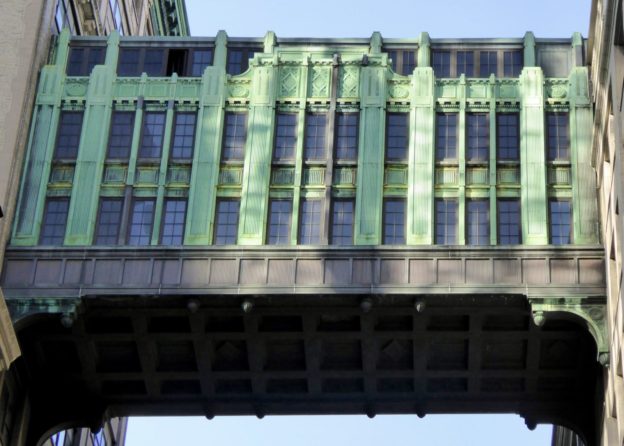
Gimbel Brothers Department Store was established in Indiana in 1842 by Adam Gimbel and operated for over a century, with 35 stores in five cities. This 10-story building served as their flagship store in New York and was designed by one of the most influential architects and urban planners of his time, Daniel Burnham. Burnham was the chief architect for the 1893 Chicago World’s Fair and helped steer American architecture towards classicism, ushering in the City Beautiful Movement. He also designed another NYC icon, the Flatiron Building (NYC Landmark, 1966). In 1926, Gimbels erected an ornate, three-story Art Deco skybridge connecting the main store with their administrative offices across 32nd Street. It was designed by Shreve & Lamb, soon to be Shreve, Lamb & Harmon, architects of the Empire State Building. It was one of the most prominent aerial bridges ever built, at a time when New York’s skyline inspired futuristic images, films, and many other art forms.
421-423 Seventh Ave
1926-27, William Van Alen
In 1925, Childs’ Restaurant commissioned architect William Van Alen to design this 14-story commercial and office building. The company was established in 1889 as one of the first national dining chains in the US, expanding to real estate development during their peak years.The use of a steel-frame structure allowed for as much glass as masonry on the upper floors. It features an L-shaped layout and very little ornamentation. The first four floors are clad in marble, with brass Art Deco details framing the main entrance. In 1980, a large screen was installed on the west and south facades, partially obstructing the view of the third to eighth floors. Van Allen had previously designed a building on Fifth Avenue for Childs’, which featured curved glass corner windows without a corner post, an innovation that garnered him widespread praise. He attended Pratt Institute and was awarded the Paris Prize scholarship in 1908. Upon his return, Van Allen and H. Craig Severance established a very successful firm, known for their multistory commercial structures. The partnership ended in 1924, with each architect continuing to practice independently.
463 Seventh Ave
1925, Buchman & Kahn
National Register of Historic Places – District
Built on the site of the former New York State Arsenal, and part of the Garment Center Historic District, this Renaissance Revival 22-story structure has an ornate four-story base clad in terra cotta, with decorative brickwork, pilasters and intricate floral carvings. The fourth floor has a windowed arcade with animal figures and human statuary. The upper floors have a more austere design, with a projecting masonry cornice crowning the building. It was designed by prominent architect Ely Jacques Kahn during his partnership with Albert Buchman. A New York native, Kahn graduated from Columbia University in 1903 and was a professor at Cornell University. Buchman was from Cincinnati and graduated from Cornell in 1880, establishing his practice in New York. He partnered with different architects during his career, the last of whom was Kahn. They were active from 1917 until 1930, when Buchman retired, and were responsible for high-profile projects such as the Film Center Building, 2 Park Avenue, and the Squibb Building. Kahn continued the practice as the Firm of Ely Jacques Kahn.
Nelson Tower
450 Seventh Ave
1929-30, H. Craig Severance
National Register of Historic Places – District
Located within the boundaries of the Garment Center Historic District, the 45-story Nelson Tower originally housed showroom and office space for businesses in the garment trade. It was developed by Julius Nelson, a builder and executive in the dress manufacturing sector, who also leased the air rights over the adjoining properties to ensure sunlight and ventilation to the structure. Designed by H. Craig Severance, it became the tallest building in the neighborhood, featuring a four-story base faced in limestone, with storefronts at the ground level and Moderne-style details. Above it, the building rises through a series of setbacks to a tall, slender central tower with cut-out corners and pavilions. Severance had designed a series of well-known buildings in New York City, including the Coca-Cola Building and 40 Wall Street. He had worked for Carrere and Hastings in his early career and later partnered with William Van Alen. After they parted ways, they would find themselves competing to build the world’s tallest building in the late 1920s. Severance designed 40 Wall Street and Van Alen the Chrysler Building.
201 West 34th Street
1929-30, Walker & Gillette
National Register of Historic Places – District
This five-story brick structure was originally built as a branch for the City Bank of New York, the largest commercial bank during the first half of the 20th century. The Moderne-style building features narrow curving corner, faced in cast stone with metal trim above the second-story windows and between the fourth- and fifth- story windows. Ribbed piers frame the first-floor windows and main entrance, which is also highlighted by two eagles surrounding a medallion, one of the bank’s signature symbols. The design is the work of the prolific firm Walker & Gillette, which was active from 1906 to 1945. Alexander Walker was a Jersey City native, who graduated from Harvard University, while Gillette was from Massachusetts and had studied at the Ecole des Beaux-Arts in Paris. Both had apprenticed with prominent offices in New York. The firm was known for its townhouses and suburban mansions for the elite, but in 1921 it ventured into commercial architecture with the construction of the New York Trust Company Bank. Through the late 1920s they would design a dozen other neo-classical bank branches in the New York area, as well as skyscrapers. One of their most prominent civic commissions was the extension of the New York Historical Society, carried out in 1938. The building is located within the boundaries of the Garment Center Historic District, listed on the National Register in 2008.
The Empire State Development Corporation’s Pennsylvania Station Project seeks to remove multiple blocks of important historic buildings around Penn Station. Working with Andrew Cronson and David Holowka of Save Chelsea, HDC will highlight and advocate for the landmarking of these threatened buildings. In addition, Save Chelsea aims to expand outreach efforts to residents of the neighborhood and elected officials to call attention to the need to preserve the area’s historic fabric.