Prospect Park
Ca. 1960
In the late 1960s, demographic changes in the areas east of Prospect Park consolidated them as Afro- Caribbean enclaves. Local musicians then began congregate in this area near the southeast entrance of the park, calling themselves the Congo Square Drummers, referencing the historic Congo Square in New Orleans. Before the Civil War, open spaces like these were crucial for safeguarding African culture, providing enslaved people a place to gather, socialize, express their spirituality and perform traditional music. Drum circles took inspiration from these sites, offering new generations a connection to the broader African diaspora. Through the years, performances at Drummer’s Grove became highly anticipated events, attracting an increasing number of people during the spring and summer months. This prompted the Prospect Park Alliance to officially recognize it as a place of importance, launching a renovation project in 1997 that included seating for drummers and spectators. Photo: Artists performing at Drummer’s Grove, courtesy of I Am Caribbeing.
553 Rogers Ave
1922
Established in 1970 by Lawrence P. Dorsey, Dorsey’s Fine Art Gallery is one of the oldest Black-owned art galleries in New York City. For over 50 years, it has showcased works by some of the nation’s greatest African-American artists. Born in St. Louis, Dorsey attended LeMoyne- Owen College in Memphis, Tennessee, where he majored in journalism and was editor of the college newspaper. During World War II, he served as a supply sergeant and was stationed in Germany, before being honorably discharged in 1945. In 1953, Dorsey moved to Brooklyn and worked as a head waiter on a cruise ship, where he would begin collecting works of art. Upon his retirement, he bought a framing business located at this two-story brick building to open an art gallery, which fostered and displayed pieces by renowned artists like James Denmark, Jacob Lawrence, Ernest Crichlow, Ann Tanksley, Emmett Wigglesworth, Otto Neals, Elizabeth Catlett, and the late painter and illustrator Tom Feelings. The gallery also held an annual holiday art auction to raise funds for the neighborhood. Dorsey passed away in 2007. In 2011, a section of Rogers Avenue between Fenimore Street and Hawthorne Street was named after him.
5101 Church Avenue
1928
Conrad Ifill was born and raised in Trinidad and Tobago. He had a large family but few resources, so he learned to bake in order to help feed them. He emigrated to Canada in 1968 and later moved to New York, working in computer data processing and accounting on Wall Street for over 10 years. In 1981, Ifill decided to change careers and open his own bakery. He rented a space in a commercial building at the corner of Utica Avenue and Union Street. It was so successful that in 2015 he opened a second location at this corner of Church Avenue. The bakery specializes in Caribbean pastries, like currant rolls, guava tarts and nine-rum cake, as well as hard dough bread and many other traditional baked goods. It became a fixture of Little Caribbean, and Ifill was an active member of the community. He passed away in 2019 due to COVID-19, and the Utica Avenue store was closed in 2021.
736 Flatbush Ave
1926
In 1995, Gavin Hussey co-founded a small restaurant called Danny & Pepper’s at Flatbush Avenue, mainly selling jerk chicken. The dish originated on the island of Jamaica, where it descended from a cooking technique developed by aboriginal Arawaks. Ten years later, Hussey -nicknamed “Peppa” since childhood- opened his own restaurant on Flatbush Avenue, where he continued to serve chicken and escovitch fish, along with a few other traditional dishes. Born in St. Andrew Parish, Jamaica, Hussey grew up helping his mother cook for their large family. His unique style of jerking made the restaurant a neighborhood favorite, and the menu was soon expanded. Two new locations were opened in Brooklyn and one in Manhattan, all run by his family, consolidating Peppa’s as a staple in the Little Caribbean community. Photo courtesy of I Am Caribbeing.
624 Flatbush Ave
1926
In 1984, Trinidadian Tony Fongyit opened this ice cream parlor and vegetarian store on Flatbush Avenue. The shop’s menu was inspired by his adherence to Rastafarianism and an Ital diet, which advocates for the consumption of pure and natural food, directly from the earth, avoiding animal byproducts. Scoops quickly became one of the neighborhood’s
important cultural hubs, with loyal customers supporting it for over 40 years. In 2015, the six-story converted tenement building that hosts the shop was sold to a local developer who attempted to evict Fongyit after his lease expired in 2019. He was able to continue operating on a month-to-month agreement, but a court ruling in 2024 stated that the storefront be evicted by the end of August.
2123 Caton Ave
2022
Located at one of the main intersections of Little Caribbean, the Flatbush Caton Market was established in 2000 as an open-air market for West Indian goods. The initiative was led by Dr. Una Clarke, the first Caribbean-born woman elected to the City’s legislature, who partnered with the City of New York to provide a permanent space for street vendors. The site was a former municipal parking lot, where merchants would set up tents. Over time, the need for a more permanent structure prompted a fundraising campaign, which resulted in the construction of a one-story brick building at the same site. The now- enclosed market opened in 2001, allowing vendors to grow their businesses and hosting community events. In 2013, plans for the re-development of the site were announced by the New York City Economic Development Corporation. The project included commercial, residential and community uses, and a new space for the Flatbush Caton Market. The new 14-story mixed-use complex was completed in 2022, with the market occupying the ground floor and renamed Flatbush Central Caribbean Marketplace.
1109 Nostrand Ave
1906
Born in Saint Vincent and the Grenadines, an island country in the eastern Caribbean, Allan Smith moved to the US in the 1950s. He began working at hospitals, and by the late 1950s he and his wife Gloria started baking products at home and selling them from the back of their vehicle. In 1961, they rented a storefront at 425 Saratoga Avenue and opened their first bakery. Due to its popularity, by 1967 the family had relocated the business to its current address at Nostrand Avenue. The bakery is known for its Caribbean and West Indian breads, pastries and cakes, as well as savory
preparations. It is one of the longest-standing Caribbean businesses in the neighborhood and is still owned and managed by the Smith family.
1127 Nostrand
1914
In the late 1990s, McDonald Romain identified the need for authentic West Indian food products in the Little Caribbean neighborhood. These were widely available in his home country of Granada but there were few ways to bring them to the US. He then set out to establish Labay Market, which opened in 2005 at this three-story brick building at the corner of Nordstrand Avenue, offering a wide array of goods essential to prepare traditional dishes. Romain, also known as “Big Mac,” imports many of the items from his family’s 60- acre farm in Grenada. He also imports traditional utensils and spices from nearby islands.
1194 Nostrand Ave
1906
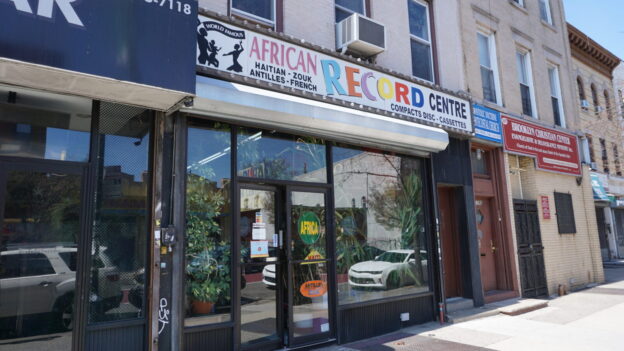
Established in 1968, the African Record Centre specializes in the distribution and promotion of African music. At the time, there was little information available about African culture, so brothers Roger “Roy”, Rudolph and Roland Francis decided to put together the largest selection of African music in New York, thus helping to establish the genre within the United States. The Francis brothers were originally from Brooklyn and became familiar with traditional African music and dances through a folkloric ensemble they had formed in the early 1960s. They began importing music from Europe, Africa and the Caribbean, becoming distributors of Makossa, the first label for African music in the United States. The store’s first location was in Harlem, and was soon followed by this location at Nostrand Avenue. They would later expand into books about the black diaspora and spirituality, opening the Yoruba Book Center at the corner of New York Avenue and Rutland Road. Although this is their only remaining location, the African Record Center continues to be one of the neighborhood’s most beloved and influential spots, attracting people from all over the world. Interior view by Nenim Iwebuke, courtesy of Afropop Worldwide.
1081 Nostrand Ave
1913-14, William J. Ryan
Established in 1898, the parish of Saint Francis of Assisi leased a plot of land on Nostrand Avenue from the Lefferts family and built their first church building. By the early 1900s, a rectory and parish hall had been added to the complex, followed by a convent for the Sisters of St. Joseph. In 1909, a school was opened on Maple Street to host 250 students. The congregation continued to grow, and construction of a new and larger church began in 1913. A second school was built in 1937, with the previous buildings converted into a chapel and parish hall. In 1980, it was merged with the neighboring St. Blaise church. Sociocultural changes in the area are reflected in the makeup of St. Francis’ congregation, as it remains a significant place for the community. Among its most popular events is the annual Guyanese Mass, organized by former pastor Rev. Msgr. Paul W. Jervis to raise funds for his native Guyana.
331 Hawthorne St
1991
The St. Gabriel’s Episcopal Mission was established in 1905, meeting initially at the residence of one of its members. The following year, the congregation purchased a lot at Hawthorne Street to build a church, but funds were insufficient to complete the structure. The basement was built first, with a temporary frame structure above it to serve as worship space while funds were raised for a permanent building. These plans, however, never fully materialized. The initial structure was improved over the years, allowing it to serve around 200 people for over 80 years.
After a period of decline in the 1970s, the church was reincorporated and plans for a permanent building were resumed. A new two-story brick complex was completed in 1991, designed to provide space for both liturgical and community activities, including a senior center funded by the New York City Department for the Aging.
157 St Paul’s Pl
1900-02, Herbert R. Brewster
The first Protestant Episcopal congregation in Flatbush was established in 1836, building their first church on land donated by prominent English resident Matthew Clarkson. The simple wooden structure was maintained for over 60 years until it was replaced by the current Gothic Revival building. The brick structure features two crenelated towers joined by a Sunday school building, all in gray granite trimmed with Indiana limestone. It was designed by local architect Herbert R. Brewster, who had recently won a competition for the design of the now-demolished St. James Protestant Episcopal Church, at the corner of St. James Place and Lafayette Avenue. Brewster would later specialize in the design of theaters, building several in Brooklyn, Queens, Staten Island and Connecticut. Also known as St. Paul’s Church in the Village of Flatbush, the church remains a staple for the community, hosting a variety of activities like the Little Caribbean Town Hall.
1356 Nostrand Ave
1988
The Lenox Road Baptist Church was formally organized in 1872, when they purchased this lot at Nostrand Avenue and built a frame structure that same year. In the 1960s, the arrival of African Americans and Caribbean people of color to the neighborhood began to transform the originally all-white congregation. The church’s direction and focus also shifted towards a more socially-oriented ministry, consolidating it as a beacon in the community during the 1960s and early 1970s.
In December of 1975, a fire destroyed the church building, and soon after their pastor was reassigned, leaving the church in a crisis. Services, however, were soon reestablished at the Grand Theatre, and a new minister was hired within a year. It would take 13 years for a new building to be completed, but the church remained as one of Brooklyn’s most significant African American parishes.
3510 Church Aave
1931
Established in 1983, Sesame Flyers International is the largest contracted Caribbean American Organization in Brooklyn, offering a range of personal development, cultural, social welfare, and supportive services for youth and families of Brooklyn and beyond. Founder Joseph Charles grew up in Trinidad and Tobago and was inspired to name the organization after the nickname for the streets where he played and his frequent trips to and from the island. The initial goal of Sesame Flyers was to provide a safe environment for children, while at the same time exposing them to the culture of Trinidad and Tobago. Over the years, the organization evolved and began offering programs for adults and children, also becoming an advocate for Caribbean culture in NYC. They famously participate at the Labor Day Carnival, with large music trucks, masquerade dancers and an award- winning band.
1399 Nostrand ave
1916-18
Established by Shelley Worrell and Janluk Stanislas, I Am Caribbeing is a cultural organization dedicated to showcasing Caribbean culture in Greater New York City and around the world. Through a multidisciplinary approach, they have become a hub for creativity, featuring artists and makers from the Caribbean, while also supporting the development of small business in Flatbush and the surrounding neighborhoods. Among Caribbeing’s most celebrated activities are its culinary and cultural guided tours, which promote local business and introduce people to the Caribbean diaspora. In 2017, Caribbeing began working in the official recognition of Little Caribbean as a center for culture, community and commerce, thus acknowledging and celebrating the contributions made by Caribbean-Americans in the city. Since then, their efforts have expanded from amplifying Caribbean culture and supporting businesses to fostering community and documenting cultural heritage.
Caron Ave at Flatbush Ave
2021
Dr. Roy A. Hastick Sr. was born in Grenada in 1950, and moved to the US in 1972. He worked for several years as an administrator, community advocate, entrepreneur and newspaper publisher. In 1985, he founded the Caribbean American Chamber of Commerce and Industry as an incubator to help startups and small businesses. The success of this organization brought Hastick Sr. widespread recognition and numerous awards, including an appointment as Grenada’s delegate to the United Nations.
Nostrand Ave at Newkirk Ave
2018
Haitian General Toussaint L’Overture was the most prominent leader of the Haitian Revolution. He was manumitted as an affranfchi (ex-slave) before the French Revolution, amassing a considerable fortune through his coffee plantations. L’Overture began his military career at 50, establishing a series of alliances that allowed him to expand and consolidate the revolution. In 1801, he seized power and established himself as Governor-General for Life, but was arrested and jailed by the French the following year.
Flatbush Ave at Rutland Rd
2019
Born on a small island near Granada, Lamuel A. Stanislaus moved to the US to study at Howard University in Washington, D.C., obtaining a Doctor of Dental Surgery degree. He founded a family practice in 1956 in Brooklyn Heights, which he maintained until 1985, when he was appointed Grenada’s Ambassador to the United Nations. Stanislaus served until 1990, and again from 1996 to 2004, heading the creation of separate UN consulate for Caribbean nations. He was also active in establishing the West Indian Day Parade.
Newkirk Ave at Rogers Ave
2018
After the victory against France, Jean-Jacques Dessalines became Haiti’s first ruler. Born into slavery, he joined the Haitian Revolution at 30, and quickly rose through the ranks. Dessalineswas one of the main lieutenants for General Toussaint Louverture before taking control of the Haitian Army. As a way to secure the country’s independence, he ordered the slaughter of all remaining white Frenchmen, making him a controversial figure.
Church Ave at Nostrand Ave
2006
Located in the heart of Little Caribbean, this intersection of Church Avenue and Nostrand Avenue was the first to be co-named in honor of prominent figures of the Afro-Caribbean diaspora.Jamaican reggae singer, guitarist, and songwriter Robert “Bob” Nesta Marley was considered one of the pioneers of the genre. He gained worldwide acclaim for his distinctive vocal and songwriting style, bringing Jamaican music to a global platform.
Based in the Flatbush neighborhood of Brooklyn, I AM CARIBBEING is dedicated to showcasing Caribbean culture, particularly along the corridors of Flatbush, Church, Nostrand, and Utica Avenues, aka “Little Caribbean.” I AM CARIBBEING is led by Kennya Cummings and Shelley Worrell, two community activists dedicated to highlighting the most culturally iconic places of the area. I AM CARIBBEING is a leading force in this thriving community, where West Indians live, work, and play. HDC will work with I AM CARIBBEING to promote their work commemorating the history of the Caribbean diaspora in New York City.