Archives

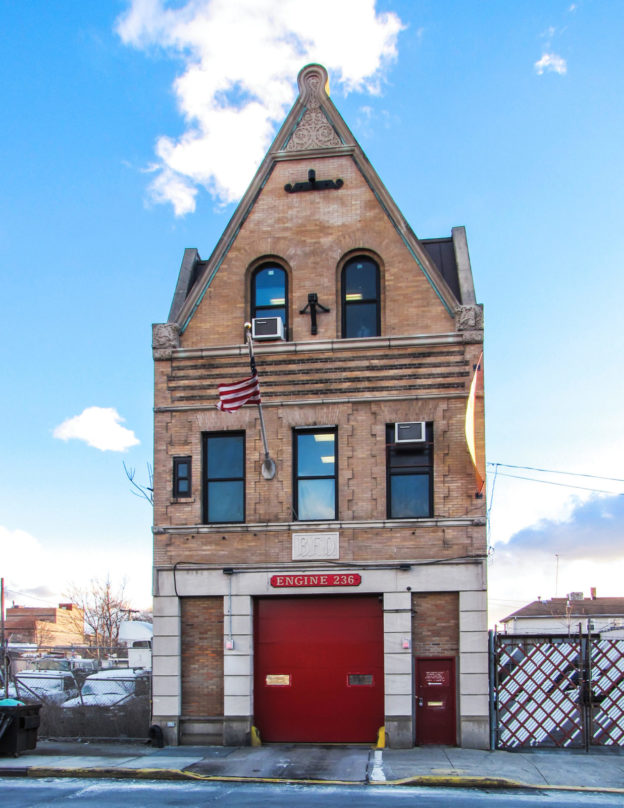
Engine Company 236

998 Liberty Avenue
1895

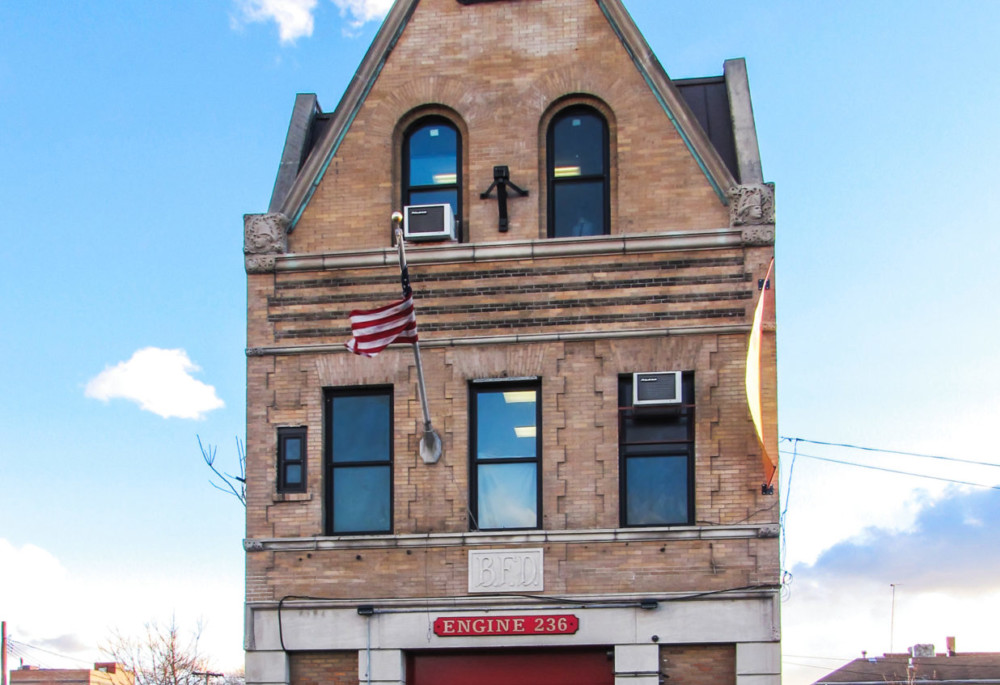
“BFD,” the initials fancifully engraved just above the first story of this Romanesque Revival style fire station, say a lot more than one might think on first glance. Standing for “Brooklyn Fire Department,” the initials confirm that this building dates to sometime between 1869, when the Brooklyn Fire Department was organized, and 1898, when the boroughs were consolidated to form the Greater City of New York. The Brooklyn Fire Department only lasted a few decades before merging with the FDNY after the city’s consolidation. Interestingly, this building was constructed in 1895 to house Engine 36, so it only served the Brooklyn Fire Department for about three years. Shortly after the consolidation, the fire companies were renumbered to avoid confusion, and this company became Engine 136 until 1913, when it was reorganized again to become Engine 236. Referred to as “The Pride of East New York,” Engine 236 continues to serve the community today.

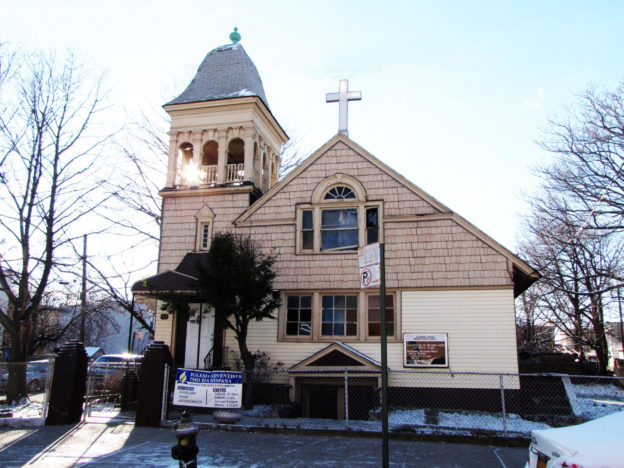
Glenmore Avenue Presbyterian Church

994 Glenmore Avenue
1899

This lovely Shingle Style church at the corner of Glenmore Avenue and Doscher Street might seem more at home on a country lane in the Hudson Valley, but when it was constructed in 1899, East New York was still a quiet suburban enclave. It was built for the Glenmore Avenue Presbyterian Church, which is still an active congregation. While the structure has suffered some insensitive alterations, including the loss of its original clapboard siding and the replacement of its front porch, it retains its general massing, including a graceful and oversized corner tower with an arched belfry and bell-shaped roof, as well as most of its original windows and dormer windows on both of its side facades.

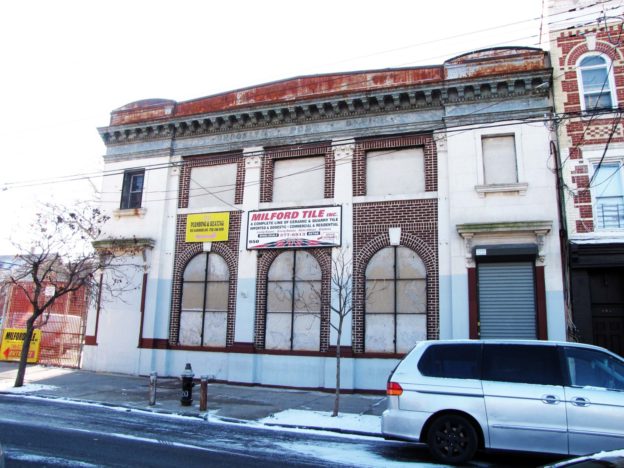
Former Brooklyn Post Office

950 Glenmore Avenue
c. 1920

This charming building originally served as the New Lots Post Office, as evidenced by the faded letters just below the cornice that read “BROOKLYN POST OFFICE.” At the time the building was constructed in the 1920s, it cost just twenty cents to send a package via first class mail. Though most of the building’s window openings have been filled in, its symmetrical façade still features many original details, like arched windows, Corinthian style pilasters and a bracketed cornice. Due to the construction of a new post office on Sutter Avenue, the building was sold in the 1960s to Milford Tile, which continues to operate it as their Brooklyn-based showroom.

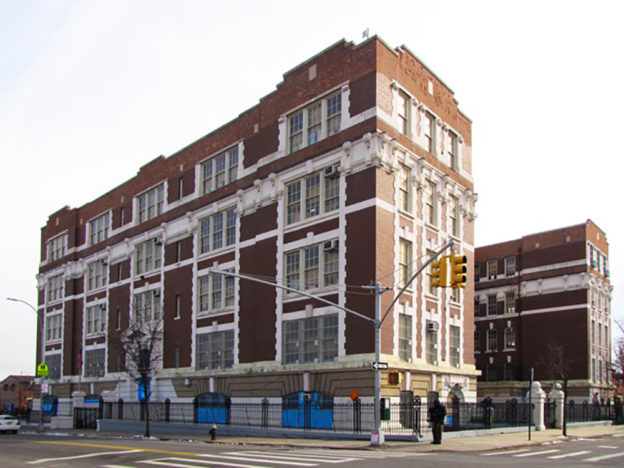
Public School 149 The Danny Kaye School

700 Sutter Avenue
Charles B. J. Snyder
1906

Public School 149 was one of the roughly 400 schools constructed during the tenure of the notable architect/engineer C. B. J. Snyder, superintendent of school buildings for the Board of Education from 1891 to 1923, when the city’s population was growing and new laws mandated children’s education. Snyder was known for his innovative “H-plan” design, inspired by the medieval Hôtel de Cluny in Paris, which allowed for improved ventilation, advances in fireproofing, better lighting, larger classroom sizes and the incorporation of two courtyards for recreation. Public School 149 initially housed kindergarten through ninth grade classes, but in the 1920s was downsized to offer only sixth, seventh and eighth grade classes when the city adopted a Junior High School system in an effort to relieve overcrowding. At that time, it became known as either Junior High School 149 or East New York Junior High School. In 1967, the city opened another junior high school nearby, I.S. 292, and P.S. 149 became an elementary school. The school is named for famed actor, dancer and musician Danny Kaye (born David Daniel Kaminsky), one of the school’s most illustrious alumni (he attended from 1919 to 1927), who also attended Thomas Jefferson High School.

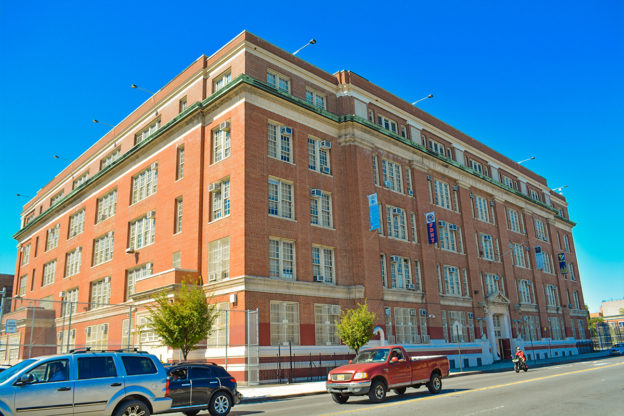
Thomas Jefferson High School

400 Pennsylvania Avenue
Probably Charles B. J. Snyder, New York City Board of Education
1922-24

In 1921, plans to build a high school in East New York were made public. Prior to that, students had to travel significant distances to schools outside of the neighborhood, so the announcement was extremely well received. In May 1922, Mayor John Francis Hylan, local leaders and six live bands led the parade and celebrations surrounding the school’s groundbreaking ceremony. Dedicated to the third President of the United States, Thomas Jefferson High School opened with roughly 4,000 school seats in September 1924. Some of the school’s notable attendees include Howard Zinn, Danny Kaye, Shelley Winters, Jimmy Smits and Al Lewis, who played Grandpa Munster in the 1960s TV show The Munsters.

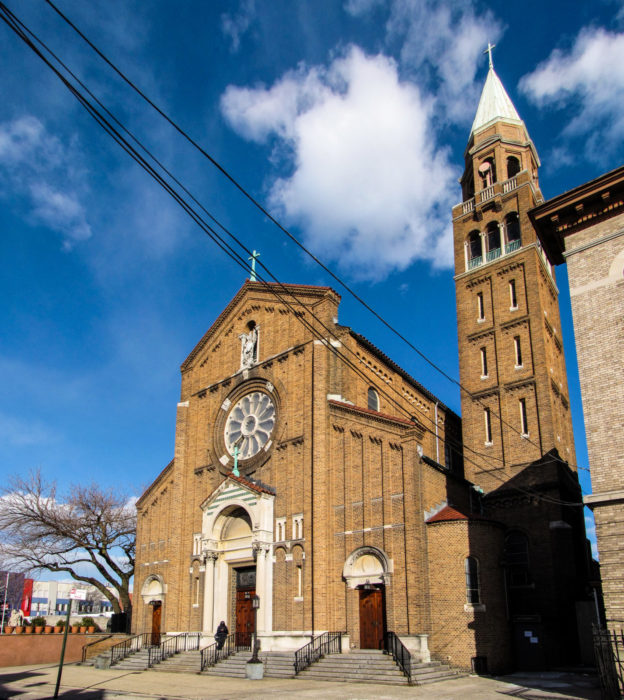
St. Michael’s Roman Catholic Church

225 Jerome Street
Church: 1920-22
Supporting buildings: 1897-1956

St. Michael’s Roman Catholic Church has served its community for over 150 years, during which time its campus grew to occupy almost the entire block between Atlantic and Liberty Avenues and Jerome and Warwick Streets. In 1860, a group of German immigrants received authorization from John Loughlin, the first Bishop of the Diocese of Brooklyn, for the construction of a Roman Catholic Church in New Lots. A wood frame structure was erected that same year, with Bishop Loughlin himself dedicating the site. Soon after, a school and rectory building was constructed next door. In 1897, a larger brick elementary school was constructed at the corner of Warwick Street and Liberty Avenue. The campus continued to expand with the enlargement of the rectory and the construction of more educational facilities on Warwick Street. By 1920, the growing parish was in need of a larger worship space, so a grand Romanesque Revival style church with an elegant bell tower was planned to take the old church’s place. The new church extended the width of the block to Warwick Avenue, where it also extended northward to accommodate a new monastery. In 1956, a high school was built at Jerome Street and Liberty Avenue. While the church originally served a German congregation, its demographics shifted over the years to serve Irish, Polish and Italians, and later African Americans, Puerto Ricans, Dominicans and Mexicans. Today, its congregation is predominately Spanish-speaking. In 2006, the church merged with St. Malachy Roman Catholic Church, a historically Irish parish in East New York, to form the new parish of St. Michael-St. Malachy.

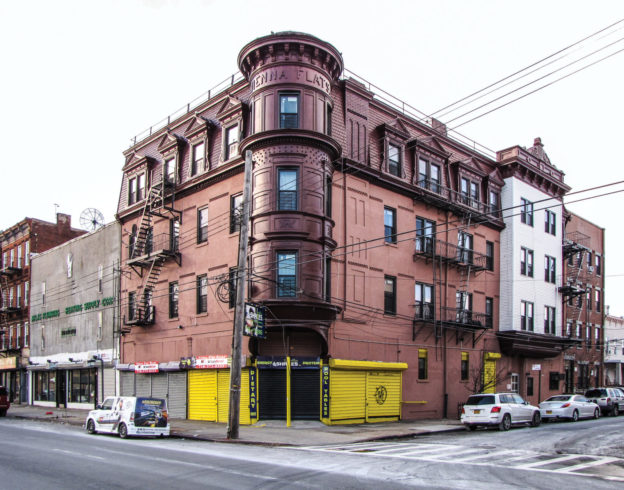
Vienna Flats

2883 Atlantic Avenue
William Danmar
1885-90

This Queen Anne style apartment building was commissioned one year before East New York was annexed as part of the City of Brooklyn. Upon its completion in 1890, it was the largest building in the area, designed to cater to small, working class families, with rental apartments advertised in the Brooklyn Eagle for $10.00 per month and up. Its Danish architect, William Danmar, was also an author, notable professor of architecture at Cooper Union and one of the founding members of the Architecture Department of the Brooklyn Institute of Arts and Sciences (precursor to the Brooklyn Museum). Although many of its architectural details have been lost over the years, the Vienna Flats retains its mansard roof with pedimented dormer windows and its distinctive curved corner bay, which runs the entire length of the building. The curved bay has a swooping entrance hood at the bottom and bears the building’s name in large capital letters at the top.

Empire State Dairy Company (later Borden Dairy Corporation) Buildings

2840 Atlantic Avenue
Theobold Engelhardt and Otto Strack
1906-07 and 1914-15
NYC Individual Landmark

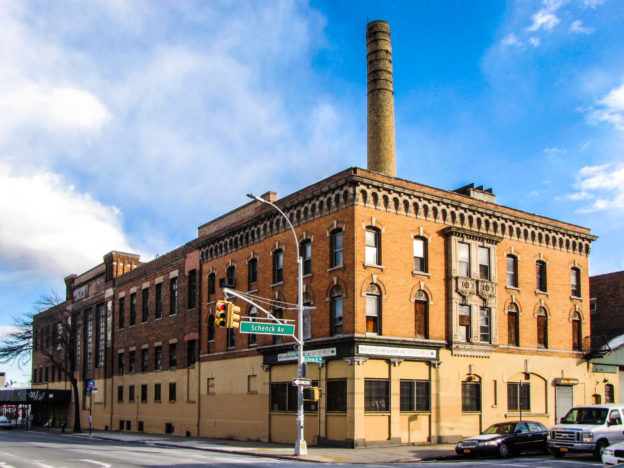
Constructed as a dairy distribution center for the Empire State Dairy Company, this complex was sold soon after completion to the Borden Dairy Corporation. The complex was built in two stages, with the earlier buildings at Atlantic and Schenck Avenues completed in 1907 and the later ones just east on Atlantic Avenue completed in 1915. Unlike most factories, where functionality takes precedence over design, the buildings exhibit fine architectural details, including two remarkable terra cotta murals facing Atlantic Avenue. One depicts a woman leading a cow and a calf to water and the other depicts a man leading a bull to water. The characters in these scenes are set within bucolic, lush landscapes of water, meadows, pines and mountains, harkening to the agrarian beginnings of the dairy industry. The murals were manufactured by the American Encaustic Tiling Company, and are considered the largest extant decorative tile installations by the company. In large part due to the rarity of these art works, members of the local community were instrumental in advocating for the designation of the complex as a New York City Individual Landmark, which was finalized in 2017.

New Lots Town Hall

109-111 Bradford Street
Architect unknown
1873

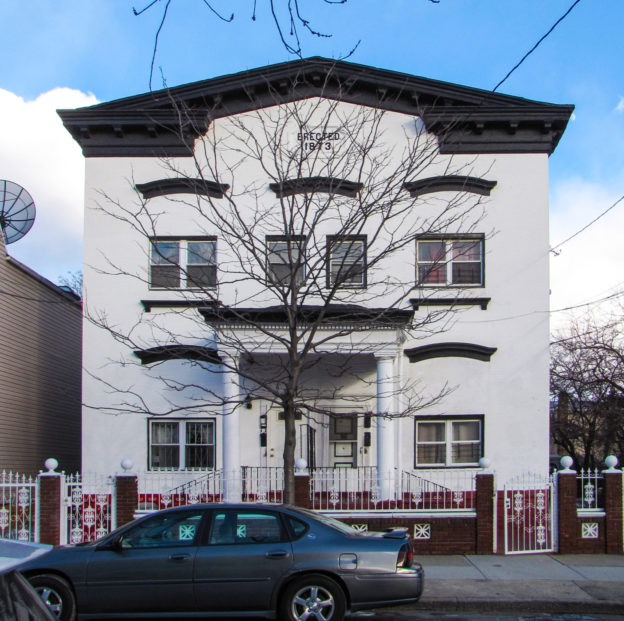
This structure stands as a rare remnant of the town of New Lots. In 1873, the newly established and growing town authorized a $10,000 bond for the construction of a town hall. Opening in December of that year, this building included office space, rooms for public assembly and a fire department. Later, space was made for a police force and jail cells, as well. After New Lots became the 26th Ward of the City of Brooklyn in 1886, a town hall was no longer necessary and the building became the 71st police precinct until 1892, when a larger police station was built at 484 Liberty Avenue. In 1899, the building became the 26th Ward Homeopathic Hospital and Dispensary, later the Bradford Hospital, until it closed in 1934. Eventually, the building was converted into a multi-family residence. Today, while its large windows have unfortunately been shrunk, their lintels and sills remain as a memory of the original openings. The building also retains its cornice and 1930s entrance porch.

Mrs. Maxwell’s Bakery

2700 Atlantic Avenue

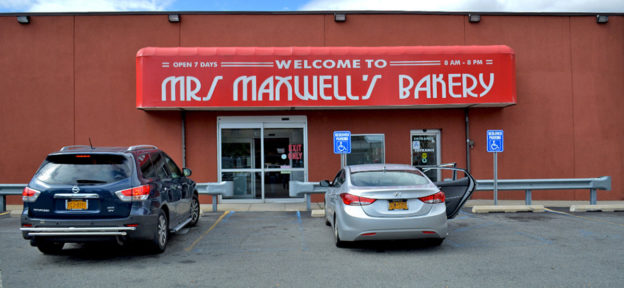
A crucial stop on a tour of the neighborhood is Mrs. Maxwell’s Bakery, which has been serving the community since 1928. During World War II, the bakery, previously known as “Essential Cheesecake,” changed its name in a bid to secure a contract to provide baked goods to the troops stationed at Fort Hamilton. “Mrs. Maxwell” was conceived as a motherly, nurturing mascot by the bakery’s owners, who sought to tug on the heart-strings of the procurement decision makers. Their effort paid off, and Mrs. Maxwell’s Bakery was awarded the contract. The fictional Mrs. Maxwell has been an integral part of the business ever since, and the bakery continues to serve a loyal clientele. Try one of her pastries or take home one of her cakes. You will undoubtedly return!

Prince Hall Masonic Lodge

68 Pennsylvania Avenue
Harde & Short
1906-07

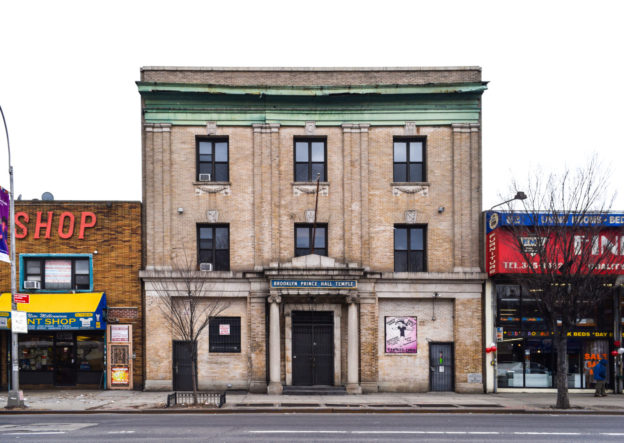
With much fanfare, a procession marched on July 29, 1906, from Liberty Avenue to 68 Pennsylvania Avenue, where the cornerstone was laid to begin construction of the Tyrian Masonic Lodge. The Tyrian Masons trace their history back to the ancient Biblical city of Tyre, but this particular lodge, number 618, was founded in 1867. The organization had previously been headquartered in a building on Atlantic Avenue and then in Happ’s Hall at Liberty and Wyona Avenues before constructing this larger building. Pennsylvania Avenue runs through East New York and the adjoining neighborhood of Cypress Hills, and was once a premier avenue, making it a desirable location for the new headquarters. The organization’s membership consisted of upper middle class men, but the building was also home to the Tyrian Ladies Auxiliary, a charitable group. In 1971, the property was acquired by the Prince Hall Masons, an African-American Masonic body, so named in honor of an African-American abolitionist recognized for his leadership in the free black community. Although a community center primarily operates here today, it has been reported that the free masons still utilize the space.

Piels Brewery

124-128 Sheffield Avenue
c. 1900

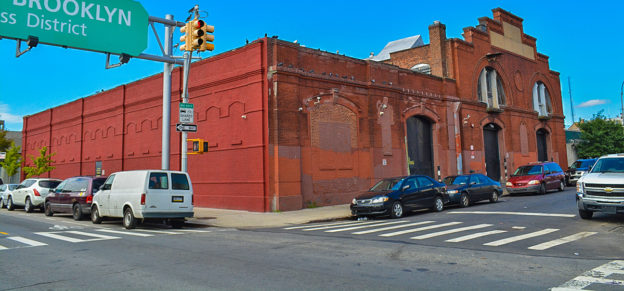
Considering East New York’s thriving German immigrant population in the second half of the 19th century, it is no surprise that the neighborhood was once home to a significant brewing complex, the Piels Brewery. In 1883, Gottfried, Wilhelm and Michael Piel – three brothers from Düsseldorf, Germany – purchased a small brewery at Georgia and Liberty Avenues and slowly expanded the complex. Its success was largely due to the ingenuity and skill of the youngest brother, Michael, who incorporated traditional brewing techniques with the new science of refrigeration. As expected with any large brewery at that time, the location included a traditional, open-air beer garden for its patrons. In 1912, due to the brand’s growing popularity, the brothers closed the garden in order to expand the brewery itself. After surviving Prohibition by producing “near beer,” the brand installed the world’s largest beer sign, featuring neon lights, atop the complex in 1936. The Piels brewing legacy lasted for ninety years until September 1973, when it closed its doors. At that time, much of the complex was demolished, though this structure still stands as a reminder of the once thriving local business and East New York’s German heritage. Also surviving at 315 Liberty Avenue is the company’s 1959 Administration Building, whose original Modern style has unfortunately been altered beyond recognition.

Cornerstone Seventh-Day Adventist Church

138 Pennsylvania Avenue
Builder: Frank Richards
1922

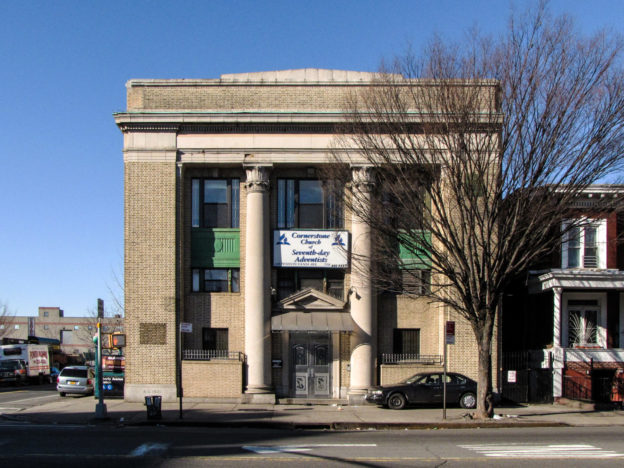
This stately structure was built in 1922 as the Homestead Branch of the National City Bank of New York, an institution founded in 1812 and known since 1976 as Citibank. A Brooklyn Eagle article from January 9, 1922, described it as “a handsome, but not extravagant, structure, with all the up-to-date appointments of a first-class bank.” The same article described some of its interior features: “There are windows on three sides, admitting real daylight into the tellers’ and bookkeepers’ cages. The finish of the cages is Tennessee marble and bronze. Metal desks that have the verisimilitude of mahogany harmonize with real mahogany trim and chairs.” In 1977, the property was sold to the Cornerstone Seventh-Day Adventist Church, which made only minimal changes to the front façade, including the addition of a sign and awning over the entrance and the removal of its original sign band above the grand columns, which read “The National City Bank of New York.” Its conversion to and continued function as a church is an excellent example of successful adaptive reuse.

Former Magistrate’s Court

135 Pennsylvania Avenue
Mortimer Dickerson Metcalf
1929

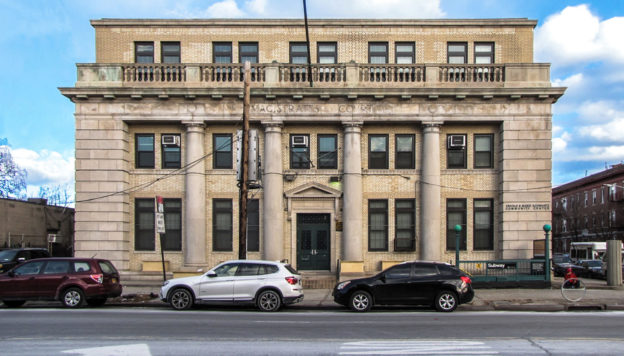
While many buildings on Pennsylvania Avenue have been altered or demolished, it was once considered East New York’s grand boulevard, home to fine residences and institutional buildings, including this former courthouse. Designed in the neo-Classical style popular for government buildings at the time, the Magistrate’s Court was the work of Mortimer Dickerson Metcalf, who previously worked for the prestigious New York architectural firm of Warren & Wetmore (architects of Grand Central Terminal). It was one of many such courthouses in Brooklyn, where low-level criminal cases were heard until the city’s court system was centralized in 1962 (the building’s near-twin, an individual landmark also designed by Metcalf, is located at 4201 4th Avenue in Sunset Park). The location, previously home to St. Clement’s Protestant Episcopal Church, was likely chosen for its proximity to the local police precinct (site 4). After 1962, the building housed the Arnold and Marie Schwartz Community Center, a day care program, the Police Athletic League and the offices of Brooklyn Community Board 5. In 2009, due to a lack of funding, the community center was forced to close, but new funds set aside in the 2015 East New York Neighborhood Plan should enable its reopening. Despite its change of use, the building’s history as a courthouse remains legible through an inscription on the frieze that reads “MAGISTRATES COURT.”

Former 75th Police Precinct Station House

484 Liberty Avenue
Emile M. Gruwe
c. 1886-92
National Register of Historic Places

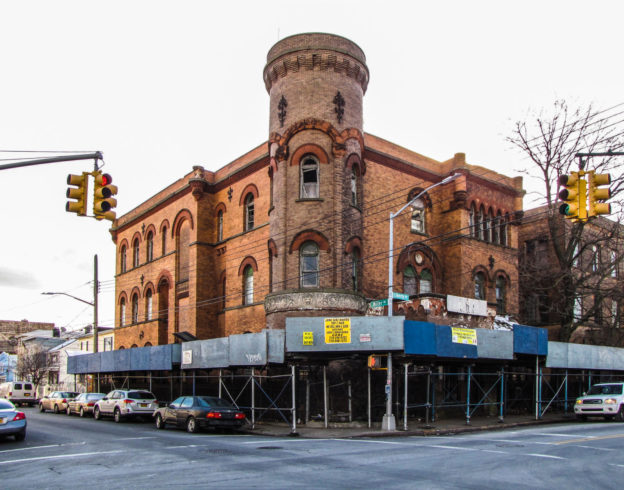
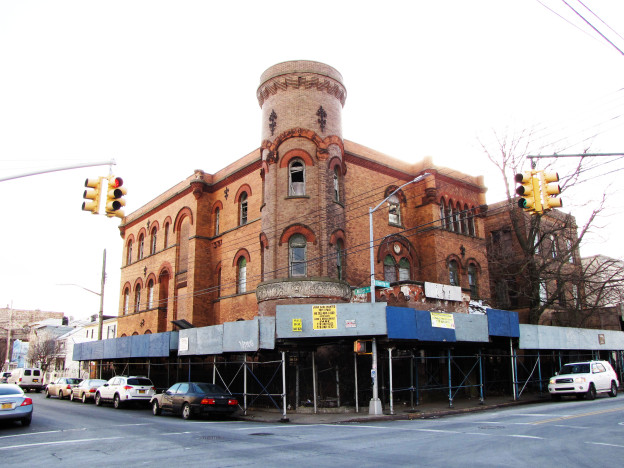
To protect its rapidly growing population in the 1880s and 1890s, Brooklyn greatly expanded its police force and built precincts throughout its neighborhoods. This magnificently adorned but dilapidated structure served as the 75th Precinct until the 1970s. Affectionately known to the local community as “The Castle,” it was designed in the Romanesque Revival style with Venetian and Norman Revival ornament, including brick molded cornices, arched openings, brownstone moldings and stone bandcourses with carved faces and Byzantine leafwork. It originally had a crenellated roofline, lending it a fortress-like quality, but that detail has been removed. In 1976, the People’s First Baptist Church bought “The Castle” at auction from the City, but due to the declining health of the church’s owner and faith leader, the building fell into disrepair. In 2016, the building again changed hands, but its future is uncertain. A near-identical twin of this building, designed by the same architect, stands at 4302 Fourth Avenue in Sunset Park, Brooklyn and was designated as an individual landmark in 1983. That building is also in a state of disrepair but is currently being considered for use as a public school.

Grace Baptist Church of Christ

233 New Jersey Avenue
Architect unknown
1898

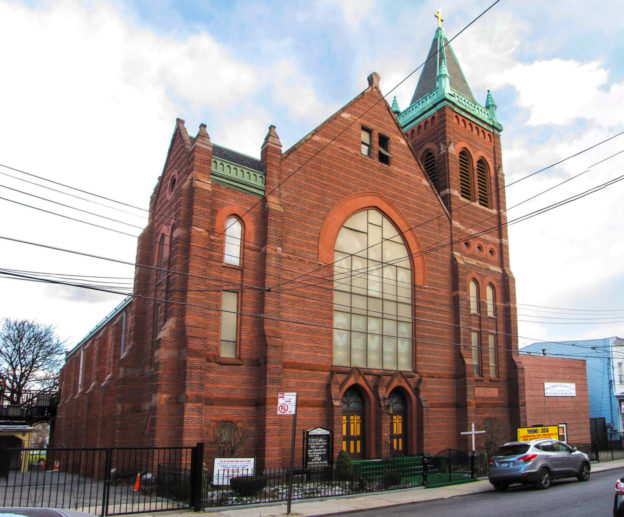
This stately Gothic Revival style church was originally built for the German congregation of St. John’s Evangelical Lutheran Church, which referred to itself as St. Johannes Evangelisch-Lutherische Kirche – a name memorialized in stone at the base of the church’s tower. From its formation in 1847, this German immigrant congregation worshipped in a wooden church building at the corner of New Jersey and Liberty Avenues, making it one of East New York’s earliest institutions. The new church, constructed just south of the original building, was dedicated in 1898. Committed to staying connected to their heritage, the members of the church spoke German and for many years refused to conduct services in English. This was largely in response to the early 20th century trend of German congregations switching to English-speaking services. This eventually led to a schism in the congregation, wherein a group broke off to form the English-speaking Lutheran Church of the Reformation on Barbey Street. By the mid-20th century, most of the German population had moved out of East New York, so in 1972, the parish voted to disband and sold the building to the congregation of Grace Baptist Church of Christ, which continues to worship here. The structure is adjoined by a charming rectory building, faced in the same rough-hewn brick as the church.

Second Calvary Baptist Church

503 Glenmore Avenue
Architect unknown
1921

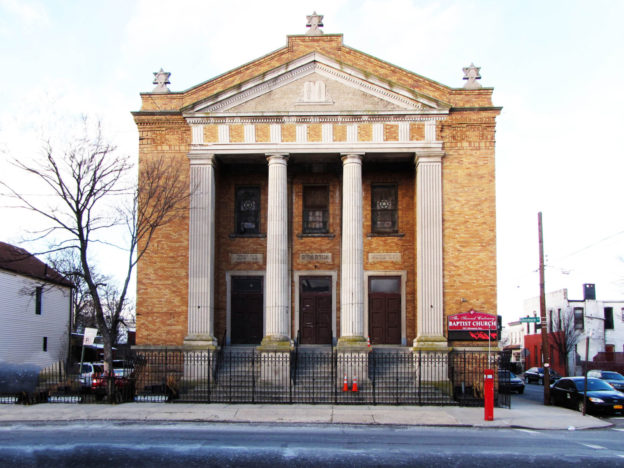
There is a longstanding tradition in New York City of adapting religious buildings for use by other religious groups, and the Second Calvary Baptist Church is a shining example of this practice. This structure was originally constructed for the Agudath Achim B’nai Jacob Synagogue, which operated here until transferring ownership in 1974 to the Second Calvary Baptist Church. Remarkably, while the church made changes to adapt the building, it left nearly all of the Jewish iconography and ornament intact on the building’s exterior. If not for the church’s new signs at the corner of Glenmore and Miller Avenues, the grand structure would appear to still function as a synagogue, as it retains Hebrew inscriptions above the three entrance doors, a prominent depiction of the Torah in the center of the building’s pediment, three large sculptures of the Star of David on the roofline and stained glassed windows containing the Star of David. Through the preservation of these elements, the new congregation has honored the building’s past, beautifully merging the old and the new. Aside from its religious symbols, the building commands a strong presence with its Classical style temple front, sculptural details, decorative brickwork and iron fence, which are all wonderfully intact.

Holy Trinity Russian Orthodox Church

400 Glenmore Avenue
Roman Meltzer
1935

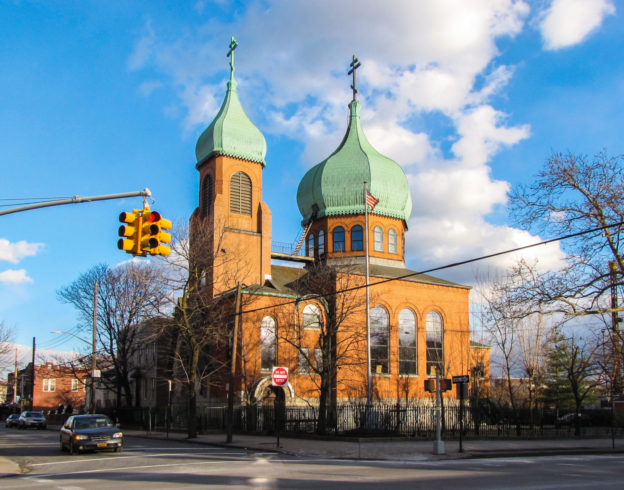
Founded in 1909 by immigrants from Belarus, the Holy Trinity Russian Orthodox Church commissioned this magnificent structure a few decades later, with construction completed in 1935. The church was designed in the traditional Russian Orthodox style by Roman Meltzer, a notable Russian-born architect. Before arriving in New York in 1921, Meltzer worked as an architect and decorator for several of the Imperial palaces in St. Petersburg, and was appointed court architect in 1903. He was best known for his Art Nouveau style interiors and for the wrought-iron grillework he designed for the Winter Palace entrance gates and garden railing. In the late 1950s, the interior of the Holy Trinity Russian Orthodox Church was redecorated with murals by the famed iconographer Pimen M. Sofronoff.  On the exterior, the church’s domed copper roofs, which have tarnished to reveal a beautiful green patina, have become neighborhood icons and serve as a beacon to those of the Russian Orthodox faith. After many years of coping with a diminishing congregation, the church’s membership has increased in recent years due to an influx of Russian immigrants to southern Brooklyn.

East New York, Brooklyn

East New York is a dynamic and largely unrecognized jewel in New York City. In the mid-17th century, Dutch farming families began migrating here from the town of Flatbush, referring to the land as the “new lots,” and it was soon identified as a subsidiary of Flatbush. In 1852, residents deemed themselves independent and began to refer to the community officially as New Lots. Present-day East New York is part of what was once the town of New Lots. In 1886, New Lots was annexed to help form the city of Brooklyn, and in 1898, was annexed again when Brooklyn and the other boroughs were consolidated to become the City of Greater New York.

In 1835, developers began buying farms in New Lots and laying out streets and lots. The area was prime for development due to the presence of the Jamaica Turnpike and the Long Island Railroad tracks along Atlantic Avenue. It was also a well-known destination for its two horse racing tracks, Union Course and Centerville Race Track (both demolished). The area’s most influential developer was a Connecticut merchant named John Pitkin, who purchased 135 acres and named his neighborhood East New York. The renaming was not only to set it apart for real estate purposes, but Pitkin envisioned a world-class and impressively-designed community filled with factories, shops and housing to rival New York City – an illustrious goal. Although Pitkin experienced significant losses during the financial panic of 1837, sales picked up in the mid-19th century and East New York became a thriving community even before neighborhoods much closer to Manhattan had even begun to be developed. Transportation improvements in the 1880s, including the opening of the Brooklyn Bridge and the introduction of steam cars and the elevated railroad on Atlantic Avenue, led to a building boom in East New York. Immigrants, including Germans, Italians, Russians and Eastern Europeans, migrated from crowded Manhattan neighborhoods to settle in the East New York countryside, in hopes of building a community where they would be free to communicate in their native languages, congregate and worship, patronize businesses catering to their cultural tastes and provide their children with opportunities to become skilled and educated citizens.

By the 1930s, East New York was widely regarded as a stable, working class community, boasting of great housing stock, schools and low crime. After World War II, however, the neighborhood unfortunately experienced a slow decline that it is still recovering from today. After the war, the city lost a great number of manufacturing jobs at the same time as large numbers of Puerto Ricans and African Americans were arriving in the city seeking employment. East New York was hit particularly hard in the 1970s by the FHA Mortgage Scandal and the unscrupulous and racially-charged real estate practice of “blockbusting,” which resulted in home foreclosure and abandonment. Unemployment, drug abuse and crime became commonplace in East New York, and its notorious reputation unfortunately lingers today. In recent years, East New York has begun to experience a rebirth. Vacant lots have been transformed into community gardens; well-maintained homes have helped to revitalize blocks; desolate sections under the elevated train tracks now exhibit vibrant murals; and diverse groups are working to enhance the neighborhood. One of these is Preserving East New York, a grassroots preservation group that formed to protect the neighborhood’s historic resources and illuminate its 300-year narrative of refuge, expansion, battle and rebirth. The group is advocating for landmark designation of some of the area’s historic buildings, an effort mainly spurred by the city’s announcement in 2015 that East New York would be rezoned for increased density as part of Mayor Bill de Blasio’s Housing New York plan.