Ca. 1910-
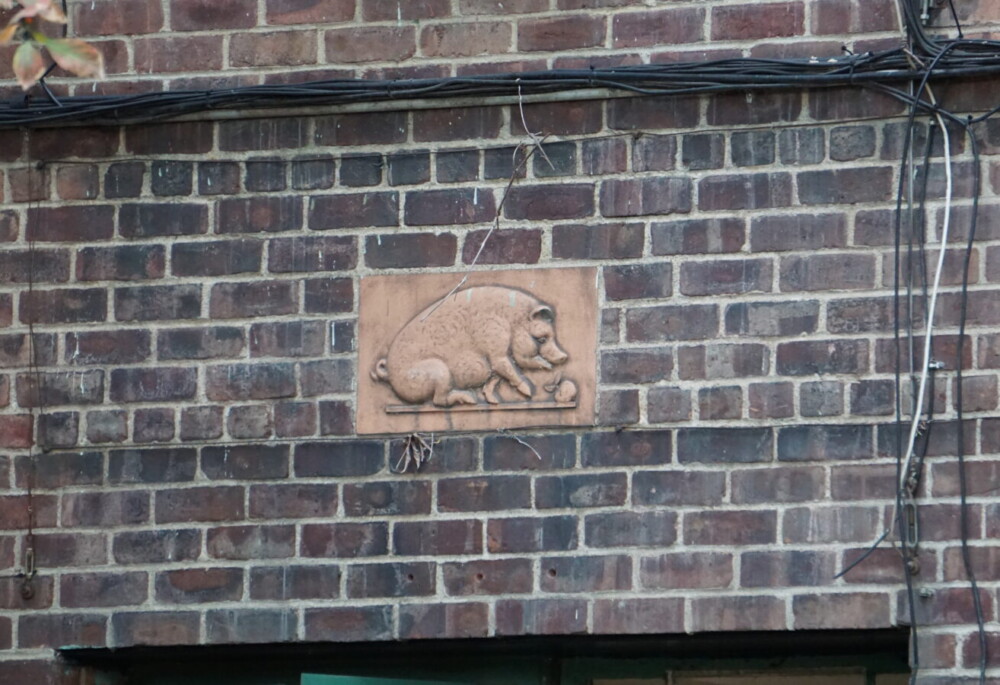
In 1934, Theodore Andre Beck earned a bachelor’s degree in sculpture from Yale University’s School of Fine Arts. Not much is known about his life, other than he won a competition to create a sculpture for the University of Tennessee, in Knoxville, in 1931. Beck’s design became the official representation of “The Volunteer”, the school symbol for its “spirit and ideas”, and the University had a series of small- scale reproductions manufactured and distributed. Construction of the full-size statue, however, would be delayed until 1965 due to a series of funding issues and the onset of WWII. By then, students and faculty were unfamiliar with the design and objected to it, stating that it didn’t fully reflect the Volunteer’s ethos. Beck agreed to make a series of modifications, and the new nine-foot statue was unveiled in 1968. It is currently located at the University’s Circle Park. Photo: “Pig with Apple”, unattributed.
1904-1958
Son of a well-known sculptor, Burr Churchill Miller Jr. was born in Wilkes-Barre, Pennsylvania. He grew up in Connecticut, and graduated from Yale University in 1928 with a bachelor’s degree in philosophy. Miller studied architectural sculpture at the Yale School of Fine Arts under the guidance of Swiss sculptor Robert G. Eberhard, and traveled to Paris where he trained with sculptor Henri Bouchard. He later moved to New York, where he studied stone carving with celebrated artist José de Creeft, author of the Alice in Wonderland sculpture in Central Park. In 1939, Miller had his first one-man show and was part of the World’s Fair. He also had exhibitions at the Pennsylvania Academy of Fine Arts, the National Academy of Design, and the Golden Gate Exposition. Miller was a member of the Sculptors Guild, the National Sculpture Society, the Federation of Modern Painters and Sculptors, and the Connecticut Academy of Fine Arts. Photo: “Man with Accordion”, unattributed.
1906-1992
Theodore Cotillo Barbarossa was born to Italian parents in Ludlow, Vermont. They relocated to Boston, Massachusetts in the early 1910s, where Barbarossa attended the Massachusetts College of Art and Yale University, receiving an honorable mention at the 1934 Prix de Rome. He then moved to New York, working primarily with bronze, wood and stone, gaining notoriety for his animal and figure sculptures. Much like his contemporaries, Barbarossa was part of President Roosevelt’s WPA New Deal art initiative, for which he created relief sculptures depicting national ideals such as industry, education, and agriculture for post offices and other federal buildings. One of his best-known works are the five statues on the façade of the Boston Museum of Science. He was a fellow of the National Sculpture Society, a member of the National Academy of Design, the Allied Artists of America, the Audubon Artists, the International Institute of Arts and Letters, and the New England Sculptors Association. Photo: “Woman with Doves” attributed to Theodore Barbarossa.
1901-1988
Born to Polish immigrants, Joseph Kiselewski studied at the Minneapolis School of Art, the National Academy of Design and the Beaux-Arts Institute of Design. While he worked as an assistant to sculptor Lee Lawrie, he won the Parisian Beaux Arts competition in 1925 and received the Prix de Rome in 1926. Kiselewski established a highly successful studio in New York in 1929, and in 1936 was appointed an Associate of the National Academy of Design. By 1944, he had become a faculty member. Kiselewski’s work designing numerous medals for the US Air Force and the US Army earned him the J. Sanford Saltus Medal in 1970 for excellence in the art of medallic sculpture. Among his most known sculptures are four pieces at the Bronx County Courthouse, the Bas-Relief above the doors for the George Rogers Clark Memorial. For the 1939 World’s Fair, Kiselewski created a 30-foot-high by 140-foot-wide sundial called “Time.” He retired in 1980 to Browerville, Minnesota. Photo: “Gossip” by Joseph Kiselewski.
1900-1967
Born in the French city of Metz, then part of Germany, Carl Ludwig Schmitz studied at the State Academy of Fine Arts in Munich. He immigrated to the US in 1923, continuing his studies at the Beaux- Arts Institute of Design in New York. Throughout his career, Schmitz had exhibitions at several prestigious institutions, such as the Architectural League, the Art Institute of Chicago, the Metropolitan Museum and the National Academy. He also received many awards for his work, including a gold medal from the 1937 International Exposition in Paris, the George D. Widener Memorial Medal for his relief sculpture “Foreign Trade,” and a National Sculpture Society Award in 1945 for his model of Our Lady of Victory. At the 1939 World’s Fair, his sculpture “Drama” was part of the Court of Peace façade of the Hall of Nations. Schmitz also became an instructor at the National Academy of Design, and was later a fellow and secretary of the National Sculpture Society. He lived in New York all his life and had a studio at 246 W 80th St. Photo: “Woman and Child” by Carl Schmitz.
1897-1981
Born to American parents in Rome, Edmond Romulus Amateis grew up in Washington, DC. His father Louis was a renowned sculptor, and founded the School of Architecture at George Washington University. Amateis began his studies at the Beaux- Arts Institute of Design in New York in 1915, leaving temporarily to serve in the US Army during WWI. Upon his return, he worked in the studios of sculptors Henry Shrady and John Clements Gregory, winning a three-year fellowship to the American Academy in Rome in 1921. For the 1939 New York World’s Fair, Amateis created three bas-relief panels for the Medicine & Public Health Building. The panels (Benevolence, Efficiency, and Humility) depicted scenes from heroes of American folklore. He went on to receive numerous awards for his work and became an Associate in Sculpture at Columbia University. In 1936, Amateis was elected an Associate member of the National Academy of Design, and from 1942 to 1944, he was president of the National Sculpture Society. Photo: “Girl with Doll” by Edmond Amateis
1888-1975
The son of a well-known Russian scientist, Gleb W. Derujinsky studied law and graduated in 1912 from the University of St. Petersburg. Simultaneously, he attended drawing school, gaining praise for his artistic aptitude. He traveled to Paris to study under renowned sculptors, entering the Imperial Academy of Arts in 1913, where he participated in exhibitions, received several prizes and was nominated for a Prix de Rome. After the Russian Revolution in 1917, he fled to Crimea and then to New York as a sailor on a cargo boat. By the early 1920s, Derujinsky was an active member of New York’s art scene. He was elected as a member of the National Sculpture Society, became a teacher at the Beaux-Arts Institute of Design, and several of his commissions were awarded medals. For the 1939 World’s Fair, he created a fountain group called “Europa and the Bull”. Among Derujinsky’s most known pieces are the busts of Theodore Roosevelt and Franklin D. Roosevelt, as well as pianists Alexander Siloti, Sergei Prokoflev and Sergei Rachmaninoff, for which he was given the Anna Hyatt Huntington Prize at the National Academy of Design in 1949. Photo: “Woman with Harp” by Gleb Derujinsky.
1910-1995
George Kratina was an American sculptor of Czech descent. Both of his parents were artists, his mother Rose was a painter, and his father Joseph was a noted sculptor. After learning from his father at the Sculptors Guild, Kratina attended Syracuse University where he studied chemistry and wood technology, and later trained in sculpture at Yale University. While there, he competed in the “sculpturing” category at the 1932 and 1936 Olympics, in Los Angeles and Berlin respectively. In 1938, Kratina received the Prix de Roma and completed his studies abroad. When he returned to New York, he became a design and sculpture professor at Cooper Union and the Rensselaer Polytechnic Institute, where he was greatly loved by his students. Kratina worked with wood, bronze, enameled steel and aluminum, often in monumental dimensions. He was awarded many prizes and won several competitions, including a monumental sculpture for the Catholic Welfare Conference Building in Washington D.C., and the Liturgical Arts Society Award. Photo: “Man with Umbrella” by George Kratina.
1906-2001
Born in Maryland, Raymond Granville Barger was an artist best known for his monumental outdoor sculptures, including works for the 1964 New York World’s Fair. He graduated from the Carnegie Institute of Technology and the Yale University School of Fine Arts, receiving a special fellowship from the American Academy in Rome. For the 1939 World’s Fair, Barger was commissioned by the Heinz Company to create a sculpture for their Dome. The 65-foot high piece had a column encircled by 22 golden figures, crowned by a figure of the “Goddess of Perfection.” While living in New York, Barger also had a successful business in model- making and photography for architects, including Frank Lloyd Wright and Skidmore, Owings & Merrill. He moved to Pennsylvania in 1966, where he wrote prolifically and referred to himself as both a poet and sculptor. Over time, Barger’s work became more abstract, with “Transition” deemed the culminating example of his evolution. The 25-foot- long bronze sculpture was originally commissioned for the J. C. Penny Headquarters Building in New York City in 1965, and is currently displayed at the James A. Michener Art Museum. Photo: “Bear” by Raymond Barger.
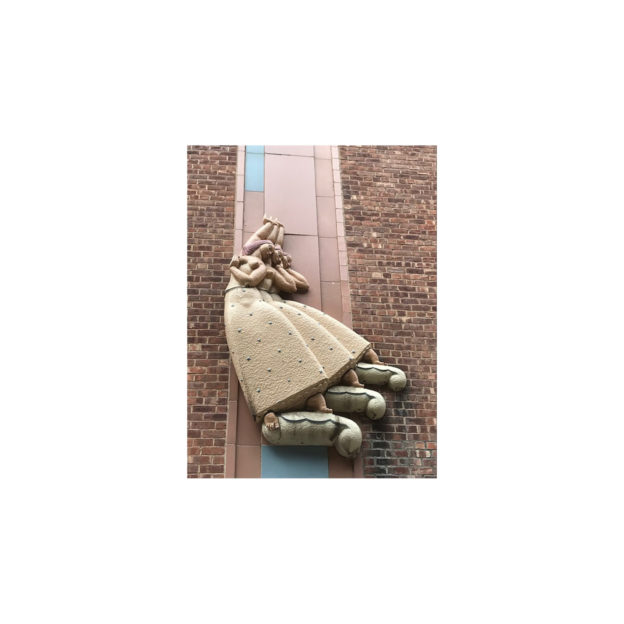
At the time of Parkchester’s conception, projects under the New Deal programs allowed for thousands of paintings, sculptures, and works on paper to be produced by American artists and displayed in public settings. The 1939 World’s Fair also provided a major platform for artists to present their work to a wider audience, furthering the concept of accessible art that could be part of people’s everyday lives, of which the Parkchester Complex is a unique and remarkable example. Nine prominent sculptors were hired to create artwork for the project. Together, they produced nearly 100 individual original designs of glazed terra cotta sculptures, medallions and plaques. Over 500 pieces were manufactured by the Federal Seaboard Terra Cotta Corporation, which were distributed throughout the buildings’ exteriors and open space. Unfortunately, this feature would not be included in the following developments by the Metropolitan Life Insurance Company. To date, only a handfull of sculptures have been paired with their author. Over the last few years, several pieces have been removed by the current owners without clear information of their future. In response, the community is actively documenting and cataloguing the remaining artwork of Parkchester.
As part of Parkchester’s self- sustainability, the heating system was 5.5 designed around a central plant strategically located near the railroad track border of
the North quadrant. Four boilers produced steam that was distributed through 14,000 feet of piping to boiler rooms in 29 buildings, which in turn, distributed it to the remaining buildings. The project also made provisions for a future conversion to coal or electricity. With the goal to reduce traffic within the quadrants, five garages for residents were built on the outskirts of the Complex. The 5-story structures had a combined capacity of 3,500 to 4,500 vehicles. Two flanked the heating plant, one was located on the West quadrant, and two more were on the East quadrant. Currently, only three of them are still in operation, since one of the garages in the east quadrant was demolished in 2006. Photo: Former Heating Plant.
In total, the Complex has Parkchester 12,271 apartments in 171 red- rick buildings, grouped into 51 clusters. Heights range from 7 to 13 stories, creating a heterogeneous skyline that ensures access to sunlight to each unit. The buildings were also placed at least 60 feet apart, to facilitate air circulation. The tallest structures are at the corners of the main avenues and around the open spaces, as not to obstruct light, while the rest of the buildings are informally arranged throughout the interior of each quadrant. To keep construction costs low and the timeline tight, the buildings were designed using a modular unit system. Three different “core” structures were created, which contained the main services -staircases, elevators, trash chutes and ventilation- as well as kitchens and foyers. These “cores” were combined with five different “wings” which included living rooms, bedrooms, and other living spaces. The layout standardization allowed for materials to be purchased in bulk, providing a variety of apartment units without compromising the project’s affordability. Photo: View of the southeast quadrant under construction, ca. 1939, by Architectural Forum.
Of the 129 acres of land purchased by the Metropolitan Life Insurance Company, only 37% was used for buildings. This is consistent with the “Tower in the Park” model, as it optimized the design of residential buildings in order to provide ample open space in urban environments, without forgoing density. In addition to the Metropolitan Oval, the layout for Parkchester included a central lawn on each quadrant, surrounded by pathways filled with plants and shrubs. Landscaping was also used as a noise barrier, with over 4,000 maples, birches, honey locusts, pines, oaks, dogwoods, and magnolias planted throughout the Complex. The courtyards around each building were left open, with no private backyards, providing visual continuity and ensuring accessibility. Recreational facilities were also part of the open space planning, with a total of 43 courtyards distributed among the four quadrants, as well as eight playgrounds and a softball diamond to the north. Photos: (top) View of interior court and path, (bottom) Aerial view of a quadrant’s central lawn, 1940. Courtesy of the Library of Congress.
1589 Unionport Rd
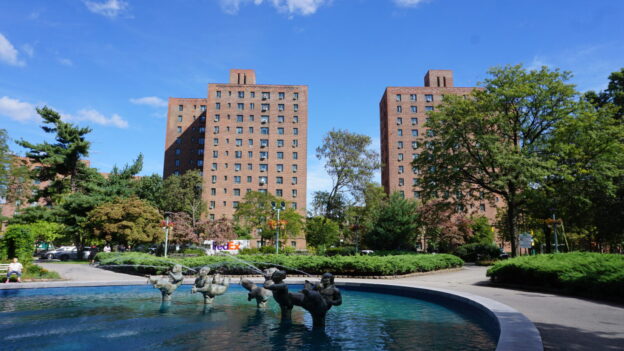
The point where Unionport Road intersects with Metropolitan Avenue is articulated by a large roundabout park named Metropolitan Oval. Since those are the main thoroughfares of the Complex, and were designed to have heavier traffic, the Oval also acts as a speed regulator for vehicles. The two-acre park features a large decorative wading pool with a fountain named “Fantasia”, created in 1939 by renowned sculptor Raymond G. Barger for the New York World’s Fair, and installed at The Oval in 1941. Seating areas and landscaped flower beds surround the pool, and on the southwest section there is a memorial for servicemen who died in World War II, the Korean War and the Vietnam War. It was recently renamed the Aileen B. Ryan Oval after a former resident and prominent New York State Assemblymember and Bronx Council Member-at-Large.
Metropolitan Ave & Unionport Rd
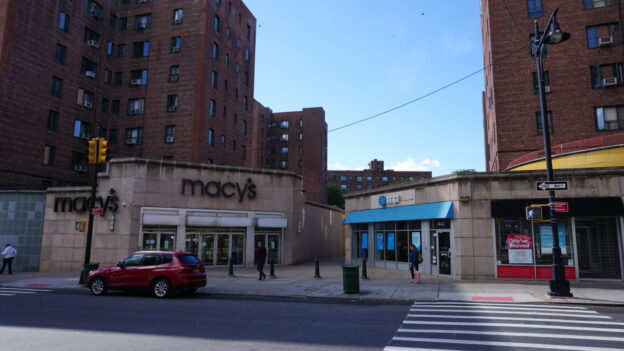
As the main thoroughfares of the Complex, Unionport Road and Metropolitan Avenue were conceived as mixed-use corridors. The largest shopping center is located at the southwest corner of Metropolitan Avenue, and includes a Macy’s Department Store, the first branch after its 34th Street flagship store in Manhattan, a USPS office, and the former Loew’s American Theater, designed by prominent architect John Eberson in 1940. The rest of this commercial area was planned to have roughly 200 stores i Moderne-style buildings with glazed terra cotta panels, curving facades, and stylized signage. Until 1985, this was also the location of the Parkchester branch of the New York Public Library. Through a partnership established in 1942, the Metropolitan Life Insurance Company gave the library, rent-free, a fully furnished 4,600 square-foot space at 1384 Metropolitan Avenue, becoming the first sub-branch in the city to be located in a housing development. By 1950, circulation outranked many of the city’s full branches, and several requests were made to extend the initial 32-hour weekly operation.
1939-40, MetLife Board of Design: Gilmore D. Clarke, Irwin Clavan, Robert W. Dowling, Andrew J. Eken, George Gove, Henry C. Meyer & Richmond H. Shreve
The layout of the Parkchester Apartment Complex draws heavily from Le Corbusier’s “Towers in the Park” model, which gained popularity among public housing developments between the mid-1950s and 1970s. The style is characterized by clusters of high-rise residential buildings surrounded by green space, providing dense, low-cost housing for urban workers while also reducing congestion. MetLife established a Board of Design led by architect Richmond H. Shreve to develop a plan for Parkchester. Among their first decision was the incorporation and expansion of an existing street that divided the property diagonally. An intersecting second avenue was then added, creating four quadrants that would organize the entire complex. This also allowed for more manageably size sections, fewer paving needs and controlled vehicular traffic. Buildings were distributed in groups of different heights to maximize access to light and air. Open space was prioritized, with playgrounds, ball fields, gardens, sitting areas and tree-lined walkways occupying more than 70% of the land. Service structures and commercial corridors were also included, creating a self-contained community.
1759 Castle Hill Ave
1897-98, George H. Streeton
In 1842, Bishop John Hughes purchased land in Westchester Village to establish a church and parish school. The area was then farmland, and an old barn was used as a temporary church while funds for a new building were raised. Another plot was added to establish a cemetery, and both were dedicated in 1845 during the feast of St. Raymond Nonnatus, giving the parish its name.
Over the next few years, St. Raymond’s grew significantly, and by 1850 it had at least nine new mission chapels in The Bronx under its tutelage. Their expansion continued, and in 1865 a large piece of land was added to build a Catholic Protectory. This institution was created to provide housing and education to orphaned Catholic children, also offering training in trades and domestic work. The Protectory remained in operation for over 70 years, with facilities designed in the Victorian Gothic style. In 1938, the property was sold to the Metropolitan Life Insurance Company for the construction of Parkchester. During the second half of the 1800s residential development continued in The Bronx, increasing the number of St. Raymond’s parishioners. A new cemetery was established, and plans began for a new church. Architect George H. Streeton was commissioned to design this Byzantine Revival structure, which was completed in 1898. A new building for the elementary school was completed in 1909, while construction of a new convent and rectory was halted until 1931 due to the First World War. The opening of Parkchester prompted St. Raymond’s to expand their educational programs further, opening a larger elementary school in 1951 and establishing new high schools for girls and boys in 1960 and 1962, respectively. Both the church and its schools have evolved over the years to reflect the neighborhood’s demographic and cultural changes, remaining a community staple. Photos: (top) Exterior of St. Raymond’s, courtesy of Bronx Catholic (bottom) Exterior of St. Raymond’s Academy for Girls, by Hugo L. González.
1315 Olmstead Ave
1940-41, Eggers & Higgins
In 1940, the Roman Catholic Archdiocese of New York purchased a site at the corner of Westchester and Olmstead Avenues to build a church and school for the residents of the recently inaugurated Parkchester Complex. It was estimated that St. Helena would have around 10,000 parishioners. The design was commissioned to the prominent firm of Eggers & Higgins, responsible for the construction phase of the Thomas Jefferson Memorial and the West Building of the National Gallery of Art. They had been longtime associates of renowned architect John Russell Pope, who died in 1937. The massive brick structure adeptly contains a church, a rectory, a parochial school and a convent, all while clearly representing its ecclesiastical purpose from the exterior. Ornamentation is kept simple, expressed mostly through limestone trim and setbacks. The interior has coffered ceilings with stenciled beams, and stained-glass windows designed by the Payne Spiers Studios, Inc. in New York City. Construction was completed in 1941, and was dedicated in 1942 by Archbishop Francis J. Spellman. The church quickly became a community staple, acquiring more land in the late 1940s to expand the school facilities. This included, among other structures, a business school that operated from 1957 to 2002. Photo courtesy of the Library of Congress.
74 Hugh J. Grant Circle
1940-42, Halsey, McCormack & Helmer
Founded in 1887, the Dollar Savings Bank was the first savings institution organized in The Bronx. Its founders were local businessmen, and the funds were used to finance improvements in the borough. The sustained growth of the institution prompted its fourth president, Howell Taylor Manson, to start an expansion campaign in 1926, with the first branch office opening at Grand Concourse in 1932. By 1936, Dollar Savings had become the 18th largest bank in the country. Following the opening of the Parkchester Complex, the bank purchased a lot at the southeast corner of 177th Street and Hugh J. Grant Circle to build a new branch office, with architect Adolf L. Muller of Halsey, McCormack & Helmer heading the design. The firm specialized in bank buildings, with works like the Williamsburg Savings Bank, and the main headquarters for the Dollar Savings Bank (NYC Landmark, 1992). The interior had murals by renowned artist Arthur Crisp, who also created pieces for other branches of the bank.
Hugh J. Grant Circle
1916-17, Squire J. Vickers
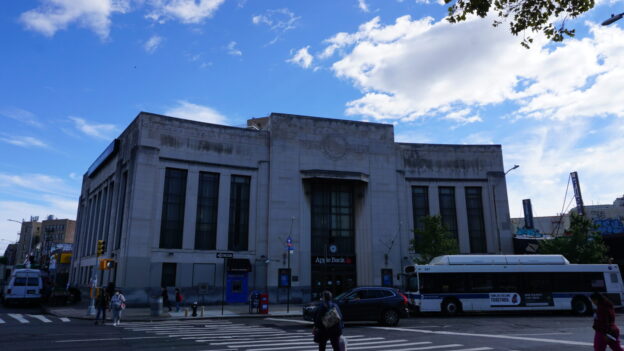
Opened in 1920, this elevated station was built as part of the east Bronx extension of the Pelham Bay Park branch of the Lexington Avenue subway. It is located within the Hugh J. Grant Circle, a roundabout that was part of Louis A. Rise’s proposal for connecting main thoroughfares. This, in order to adopt a grid street plan during the annexation of East Bronx in 1895. The two-story concrete structure features Art Deco and Neoclassical details, including large rounded street-level openings, projecting corner piers with vertical bands of geometric terra cotta tiles, and decorative bands of polychrome ceramic tile on the façade. The building was designed by Squire J. Vickers, who served as the Design Architect of the New York City Subway System from 1906 to 1942. He was responsible for most of the Dual System and later IND stations, and was known for featuring simple but colorful and creative tile work in his designs. Vickers graduated from Cornell University, and was also a talented painter. Many of his works were translated into mosaic plaques and are displayed throughout the system. The station underwent repairs in the 1960s and 1990s, with major renovations completed in 2010.
Parkchester is an extraordinary complex of more than 50 buildings, located on 129 acres of land, three-quarters of which is left to open space. This pioneering housing development influenced mid-twentieth-century thinking on the planning and design of large apartment complexes and is considered a model of good high-density housing. Parkchester features an extraordinary collection of terra cotta details and public sculptures designed by leading artists. In 1978, the Landmarks Preservation Commission conducted a Bronx survey that recommended the designation of Parkchester as a historic district. More than 40 years later, that designation has yet to happen. HDC will continue working with HDC Board Director Susan Tunick and Sharon Pandolfo of The Parkchester Project. The Parkchester Project aims to save the historic character of Parkchester and advocate for its landmark designation.